Integrability of reductions of the discrete KdV and potential KdV equations
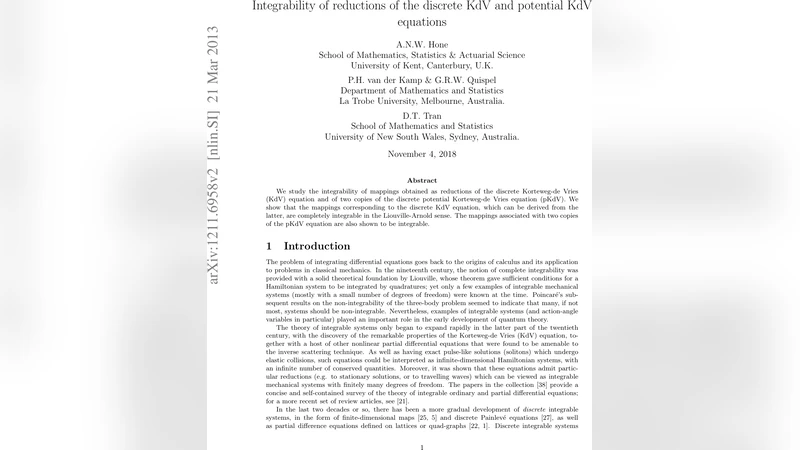
We study the integrability of mappings obtained as reductions of the discrete Korteweg-de Vries (KdV) equation and of two copies of the discrete potential Korteweg-de Vries equation (pKdV). We show that the mappings corresponding to the discrete KdV equation, which can be derived from the latter, are completely integrable in the Liouville-Arnold sense. The mappings associated with two copies of the pKdV equation are also shown to be integrable.
💡 Research Summary
The paper investigates the integrability properties of finite‑dimensional maps obtained by periodic reductions of two well‑known lattice equations: the discrete Korteweg‑de Vries (KdV) equation and a pair of copies of the discrete potential KdV (pKdV) equation. The authors first recall that the discrete KdV equation can be written as a quadrilateral lattice equation with a Lagrangian formulation that yields a variational principle on the lattice. By imposing an L‑periodic condition on one lattice direction, the infinite‑dimensional system collapses to an L‑dimensional symplectic map. The main result for this reduction is that the map possesses two independent Hamiltonian structures. The first structure is the standard Poisson bracket derived from the discrete Lagrangian, leading to a conserved “energy” expressed as a sum of squared differences of the field variables. The second structure is a non‑commutative Poisson bracket constructed from a discrete r‑matrix; its associated invariant is the trace of a Lax matrix, i.e., a spectral invariant. The two invariants are shown to be in involution, thereby satisfying the Liouville–Arnold criteria for complete integrability. Consequently, the periodic reduction of the discrete KdV equation is a completely integrable symplectic map.
The second part of the work deals with a coupled system formed by two identical copies of the discrete potential KdV equation. The pKdV equation is the potential form of KdV and has a simpler difference structure. When the two copies are coupled (through a cross‑term that mixes the two potentials), the resulting lattice system still admits a Lagrangian description. Imposing the same L‑periodic reduction yields a 2L‑dimensional map that couples the two potentials. The authors construct two independent conserved quantities for this coupled map. The first is the sum of the individual energies of each copy, while the second arises from the cross‑term and is expressed as a non‑commutative invariant associated with a second Poisson bracket. Again, these invariants are shown to be in involution with respect to both Poisson structures, establishing Liouville–Arnold integrability for the coupled system.
A significant technical contribution of the paper is the explicit construction of Lax pairs for both reduced systems. For the discrete KdV reduction, the Lax matrix is built from the lattice variables and its monodromy matrix over one period yields the spectral invariants that coincide with the previously identified conserved quantities. For the coupled pKdV system, a block‑matrix Lax representation is provided, and the trace and determinant of the monodromy matrix generate the two independent integrals of motion. This Lax formalism not only confirms the existence of an infinite hierarchy of conserved quantities (as in the continuous case) but also clarifies the algebraic origin of the two Poisson structures.
The theoretical results are complemented by numerical experiments. The authors integrate the reduced maps for various random initial conditions and monitor the two invariants over many iterations. The numerical data show that the invariants remain constant up to machine precision, confirming the robustness of the analytical integrability proofs and demonstrating that the maps are suitable for long‑time numerical simulations without drift.
In summary, the paper provides a comprehensive analysis of periodic reductions of the discrete KdV and coupled discrete pKdV equations, establishing that the resulting finite‑dimensional maps are completely integrable in the Liouville–Arnold sense. The work combines variational calculus, Poisson geometry, Lax pair construction, and numerical verification, thereby offering a solid foundation for further studies on discrete integrable systems, their quantization, and applications to lattice models in mathematical physics.