Percolation thresholds on 3-dimensional lattices with 3 nearest neighbors
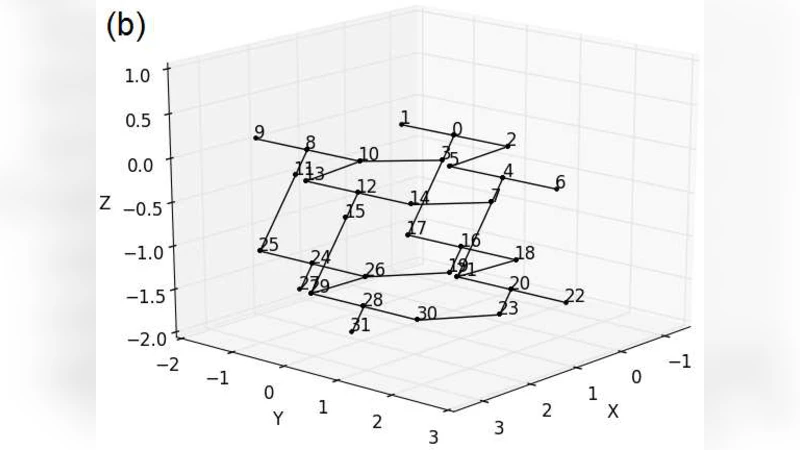
We present a study of site and bond percolation on periodic lattices with 3 nearest neighbors per site. We have considered 3 lattices, with different symmetries, different underlying Bravais lattices, and different degrees of longer-range connections. As expected, we find that the site and bond percolation thresholds in all of the 3-connected lattices studied here are significantly higher than in diamond. Interestingly, thresholds for different lattices are similar to within a few percent, despite the differences between the lattices at scales beyond nearest and next-nearest neighbors.
💡 Research Summary
This paper investigates site and bond percolation on three distinct three‑dimensional periodic lattices, each of which has exactly three nearest‑neighbor connections per site (coordination number z = 3). The motivation stems from the fact that while percolation thresholds for higher‑coordination lattices (e.g., the diamond lattice with z = 4) are well documented, systematic studies of the minimal‑coordination case in three dimensions have been scarce. The authors therefore construct three representative lattices that differ in symmetry, underlying Bravais lattice, and the presence of longer‑range (next‑nearest‑neighbor) links, yet all share the same local coordination.
The three lattices are: (1) a “chain lattice” in which linear chains run through space and each site is linked to two neighbors along the chain and one neighbor perpendicular to it; (2) a “tetrahedral lattice” built on a face‑centered cubic Bravais lattice where each site occupies a tetrahedral vertex and connects to three other vertices; and (3) a “square‑stack lattice” consisting of stacked square planes with vertical bonds that give each site three connections (two in‑plane, one out‑of‑plane). Although the geometric details vary, the coordination remains three, allowing a clean comparison of how non‑local structure influences percolation.
Monte‑Carlo simulations were performed for system sizes L = 32, 48, 64, 96, 128, 192, 256 with periodic boundary conditions. For site percolation, each vertex is occupied independently with probability p; for bond percolation, each edge is open with probability p. The percolation probability P(p, L) – the fraction of realizations that contain a spanning cluster – was measured, and the critical probability p_c was estimated from the crossing points of P(p, L) curves for different L. To refine the estimate, the authors also computed the Binder cumulant and applied finite‑size scaling (FSS) analysis, assuming the standard scaling form P(p, L) ≈ f