Modulational instability of a Langmuir wave in plasmas with energetic tails of superthermal electrons
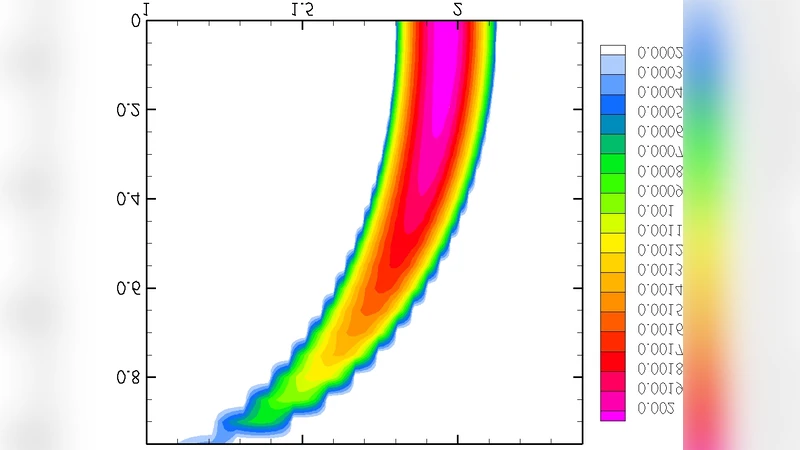
The impact of superthermal electrons on dispersion properties of isotropic plasmas and on the modulational instability of a monochromatic Langmuir wave is studied for the case when the power-law tail of the electron distribution function extends to relativistic velocities and contains most of the plasma kinetic energy. Such an energetic tail of electrons is shown to increase the thermal correction to the Langmuir wave frequency, which is equivalent to the increase of the effective electron temperature in the fluid approach, and has almost no impact on the dispersion of ion-acoustic waves, in which the role of temperature is played by the thermal spread of low-energy core electrons. It is also found that the spectrum of modulational instability in the non-maxwellian plasma narrows significantly, as compared to the equilibrium case, without change of the maximum growth rate and the corresponding wavenumber.
💡 Research Summary
The paper investigates how a population of super‑thermal electrons, described by a relativistic power‑law tail, modifies the linear dispersion of Langmuir and ion‑acoustic waves and the nonlinear modulational instability of a monochromatic Langmuir pump in an isotropic plasma. The authors adopt a κ‑type distribution
(f(v)\propto\left(1+v^{2}/v_{0}^{2}\right)^{-(\kappa+1)})
with a characteristic speed (v_{0}) that can reach a few‑tenths of the speed of light. By choosing small κ values the high‑energy tail contains the majority of the plasma kinetic energy while the low‑energy core remains essentially Maxwellian.
Linear dispersion.
Using the Vlasov‑Poisson formalism the electron susceptibility is recomputed for the κ‑distribution. The resulting Langmuir dispersion relation becomes
(\omega^{2}\simeq\omega_{pe}^{2}+3k^{2}v_{T,\text{eff}}^{2})
where (v_{T,\text{eff}}^{2}= \langle v^{2}\rangle/3) is defined by the full second moment of the distribution. Because the tail dominates the kinetic energy, (v_{T,\text{eff}}) – and therefore the effective electron temperature (T_{\text{eff}}) – can be five to ten times larger than the temperature of the core electrons. Consequently the Langmuir frequency is shifted upward, a result that can be interpreted in fluid language as an increase of the electron pressure term.
In contrast, the ion‑acoustic dispersion, (\omega\simeq k c_{s}) with (c_{s}^{2}\approx(k_{B}T_{e}+3k_{B}T_{i})/m_{i}), is governed by the temperature of the low‑energy core because the pressure contribution from the sparse high‑energy electrons is negligible. Numerical evaluation confirms that the ion‑acoustic phase speed is essentially unchanged when the κ‑tail is introduced.
Modulational instability.
The authors then study the nonlinear interaction of a strong, monochromatic Langmuir pump (E_{0}\exp
Comments & Academic Discussion
Loading comments...
Leave a Comment