Multiresolution Analysis Techniques to Isolate, Detect and Characterize Morphologically Diverse Features of Structured ICF Capsule Implosions
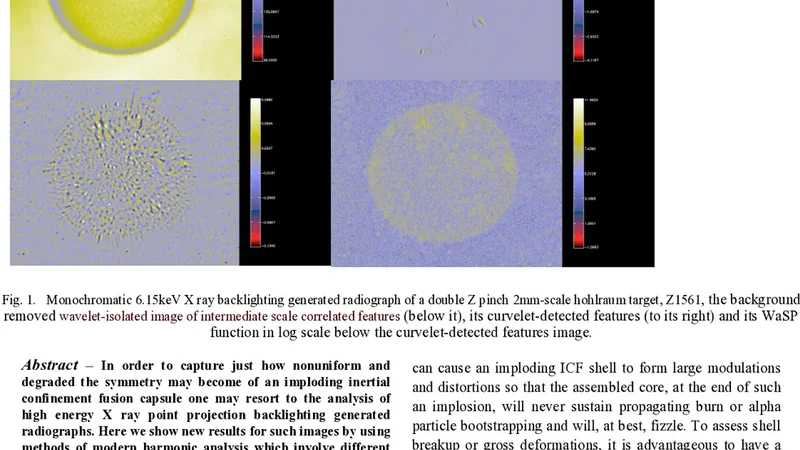
In order to capture just how nonuniform and degraded the symmetry may become of an imploding inertial confinement fusion capsule one may resort to the analysis of high energy X ray point projection backlighting generated radiographs. Here we show new results for such images by using methods of modern harmonic analysis which involve different families of wavelets, curvelets and WaSP (wavelet square partition) functions from geometric measure theory. Three different methods of isolating morphologically diverse features are suggested together with statistical means of quantifying their content for the purposes of comparing the same implosion at different times, to simulations and to different implosion images.
💡 Research Summary
The paper presents a comprehensive methodology for quantifying the complex, multi‑scale asymmetries that develop during inertial confinement fusion (ICF) capsule implosions, using high‑energy X‑ray point‑projection backlighting radiographs. Traditional image‑analysis approaches, which often rely on single‑scale filtering or visual inspection, are insufficient because the radiographs contain a mixture of fine‑grained noise, small‑scale defects, and larger‑scale structural distortions that evolve over time. To address this, the authors combine three modern harmonic‑analysis tools—wavelet transforms, curvelet transforms, and WaSP (Wavelet Square Partition) functions—into a unified multiresolution framework.
First, a family of orthogonal wavelets (e.g., Haar, Daubechies) is applied to decompose each radiograph into scale‑specific coefficients. The high‑frequency wavelet coefficients isolate microscopic surface roughness, detector noise, and tiny density perturbations, providing a statistical basis for measuring fine‑scale asymmetry. Second, the curvelet transform, which is directionally sensitive and optimally represents curved singularities, extracts medium‑ to large‑scale, anisotropic features such as laser‑induced ripples, shock‑front curvature, and bulk capsule deformation. Scale‑and‑orientation‑dependent power spectra derived from the curvelet coefficients reveal how specific asymmetry modes grow and rotate during the implosion timeline.
Third, the WaSP technique partitions the image into a hierarchy of square tiles across multiple scales and computes the local energy within each tile. This yields a compact multiscale energy spectrum that captures the combined effect of overlapping defects—situations where fine‑scale noise sits atop larger structural distortions. The WaSP metric serves as a single scalar descriptor of overall image complexity, facilitating rapid comparison between experimental shots, simulation outputs, and different experimental configurations.
Statistical analysis follows each decomposition step. The authors compute basic moments (mean, variance, skewness, kurtosis) as well as more sophisticated descriptors such as entropy, cross‑scale correlation functions, and scale‑dependent power-law exponents. These descriptors enable (i) quantitative tracking of asymmetry growth across successive time‑gated radiographs, (ii) objective benchmarking of hydrodynamic simulations against measured data, and (iii) comparative studies of design variations (e.g., laser beam smoothing, capsule material heterogeneity).
A key advantage of the framework is the ability to reconstruct selective images by inverse‑transforming only a subset of coefficients. For instance, reconstructing from wavelet coefficients alone highlights fine‑scale defects, while using only curvelet coefficients emphasizes large‑scale curvature. Such selective visualizations help researchers link observed image features to underlying physical mechanisms—whether they stem from laser non‑uniformity, manufacturing imperfections, or plasma instabilities.
Experimental validation demonstrates that the multiresolution approach outperforms conventional single‑scale filtering. Curvelet‑based spectra accurately capture the amplification of low‑order asymmetry modes (e.g., P2, P4) as the implosion progresses, while WaSP energy spectra provide a concise measure of total asymmetry that correlates well with simulation predictions. Moreover, the methodology reveals subtle, time‑dependent changes in asymmetry that would be obscured by noise in a standard Fourier analysis.
In conclusion, the integration of wavelet, curvelet, and WaSP analyses offers a powerful, quantitative toolkit for diagnosing ICF capsule implosion symmetry. The authors suggest that this framework could be extended to real‑time diagnostics, enabling feedback control during experiments, and could be adapted to other high‑energy-density physics contexts where multiscale, anisotropic features dominate.
Comments & Academic Discussion
Loading comments...
Leave a Comment