An Interacting Binary System Powers Precessing Outflows of an Evolved Star
Stars are generally spherical, yet their gaseous envelopes often appear non-spherical when ejected near the end of their lives. This quirk is most notable during the planetary nebula phase when these
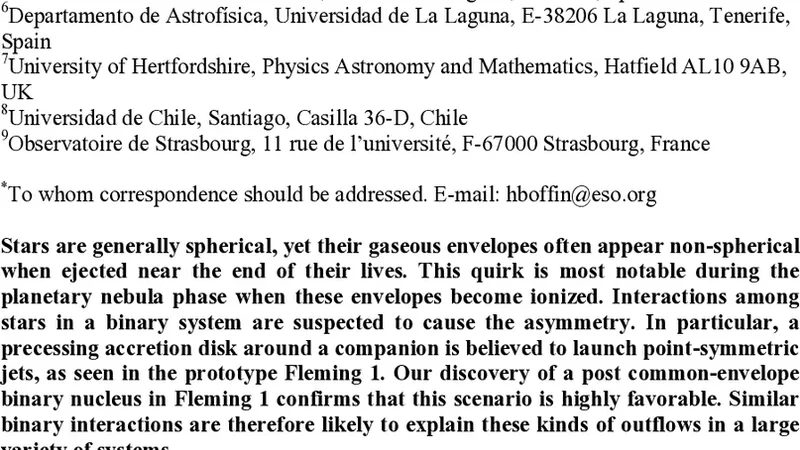
Stars are generally spherical, yet their gaseous envelopes often appear non-spherical when ejected near the end of their lives. This quirk is most notable during the planetary nebula phase when these envelopes become ionized. Interactions among stars in a binary system are suspected to cause the asymmetry. In particular, a precessing accretion disk around a companion is believed to launch point-symmetric jets, as seen in the prototype Fleming 1. Our discovery of a post common-envelope binary nucleus in Fleming 1 confirms that this scenario is highly favorable. Similar binary interactions are therefore likely to explain these kinds of outflows in a large variety of systems.
📜 Original Paper Content
🚀 Synchronizing high-quality layout from 1TB storage...