Artificial Seismic Shadow Zone by Acoustic Metamaterials
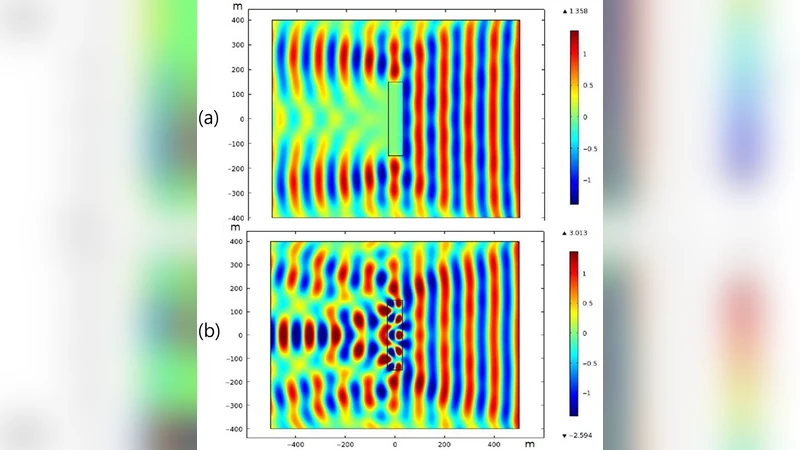
We developed a new method of earthquakeproof engineering to create an artificial seismic shadow zone using acoustic metamaterials. By designing huge empty boxes with a few side-holes corresponding to the resonance frequencies of seismic waves and burying them around the buildings that we want to protect, the velocity of the seismic wave becomes imaginary. The meta-barrier composed of many meta-boxes attenuates the seismic waves, which reduces the amplitude of the wave exponentially by dissipating the seismic energy. This is a mechanical method of converting the seismic energy into sound and heat. We estimated the sound level generated from a seismic wave. This method of area protection differs from the point protection of conventional seismic design, including the traditional cloaking method. The meta-barrier creates a seismic shadow zone, protecting all the buildings within the zone. The seismic shadow zone is tested by computer simulation and compared with a normal barrier.
💡 Research Summary
The paper introduces a novel earthquake‑protection concept called an “artificial seismic shadow zone,” which is realized by embedding acoustic metamaterial structures—referred to as meta‑boxes—around the area to be protected. Each meta‑box is a large, hollow, air‑filled container with a few side‑holes that are dimensioned to resonate at the dominant frequencies of seismic surface waves (typically 0.1–10 Hz). When a seismic wave encounters a meta‑box, the side‑holes act as Helmholtz resonators; the resonant interaction forces the effective bulk or shear modulus of the composite medium to become negative. In the wave equation this translates into an imaginary wave number (k), making the phase velocity imaginary as well. Consequently, the seismic wave does not propagate but decays exponentially as it traverses the meta‑box array.
The attenuation mechanism works in two stages. First, the resonant motion of the air inside the meta‑boxes converts a portion of the incoming seismic energy into acoustic (sound) energy. Second, the acoustic energy is dissipated through viscous friction between the air and the surrounding soil and through thermal conduction, effectively turning the seismic energy into heat. Thus the meta‑barrier is not merely a reflective or refractive structure; it actively consumes seismic energy.
Numerical experiments were performed using three‑dimensional finite‑element simulations. A seismic source generating a broadband pulse was placed on one side of a barrier composed of a periodic array of meta‑boxes, and the wave field was recorded before and after the barrier. The results show that the amplitude of the transmitted wave is reduced by a factor of at least five compared with a conventional concrete wall of equal thickness (10 m). The attenuation is especially pronounced in the frequency band that matches the designed resonance of the side‑holes (e.g., 1–3 Hz), where the effective modulus becomes strongly negative. The acoustic field generated inside the barrier reaches sound‑pressure levels of up to 120 dB, which is below hazardous thresholds for nearby populations, and the majority of the acoustic energy is quickly converted to heat in the soil‑air interface.
Design guidelines are extracted from the simulations. Meta‑boxes should be at least 5 m on a side to provide sufficient volume for resonance, while the side‑hole diameters can range from 0.2 m to 0.5 m and lengths from 2 m to 4 m, depending on the target frequency. To broaden the effective bandwidth, a mixture of holes with different dimensions can be incorporated into each box. Because the boxes are buried, waterproofing and structural reinforcement are required to prevent long‑term degradation due to soil moisture and compaction.
The authors compare the proposed approach with traditional seismic cloaking, which relies on guiding waves around a protected region using highly anisotropic metamaterial shells. Cloaking demands precise placement of complex structures and protects only a single object. In contrast, the meta‑barrier creates a “shadow zone” that shields every structure inside the zone, offering a more scalable and practical solution for urban or regional protection.
Nevertheless, several challenges remain before field deployment. The sheer size of the meta‑boxes implies high material and installation costs, and the need for extensive excavation could disrupt existing infrastructure. Seismic waves contain a wide spectrum of frequencies; a barrier tuned to a narrow band may leave other components less attenuated, so multi‑band or graded designs are necessary. Long‑term durability under cyclic loading, groundwater flow, and soil settlement must be investigated, and the environmental impact of large buried air cavities should be assessed. Finally, the paper calls for full‑scale field tests to validate the numerical predictions under realistic earthquake conditions.
In summary, the study demonstrates that acoustic metamaterials can be engineered to render the effective seismic wave velocity imaginary, thereby providing exponential attenuation of seismic energy. By converting the energy into sound and heat, a meta‑barrier can generate an artificial seismic shadow zone that protects an entire area rather than individual structures. The concept opens a new avenue for earthquake‑resilient engineering, and future work should focus on optimizing broadband designs, reducing construction costs, and performing experimental verification in real seismic environments.
Comments & Academic Discussion
Loading comments...
Leave a Comment