Quantizing the discrete Painleve VI equation : The Lax formalism
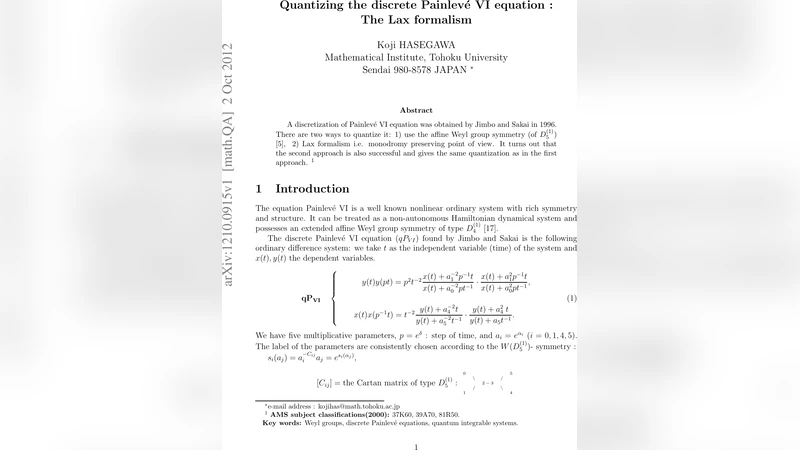
A discretization of Painlev'e VI equation was obtained by Jimbo and Sakai in 1996. There are two ways to quantize it: 1) use the affine Weyl group symmetry (of $D_5^{(1)}$) (Hasegawa, 2011), 2) Lax formalism i.e. monodromy preserving point of view. It turns out that the second approach is also successful and gives the same quantization as in the first approach.
💡 Research Summary
The paper addresses the quantization of the discrete Painlevé VI equation originally introduced by Jimbo and Sakai in 1996. Two distinct quantization schemes have been proposed in the literature. The first, due to Hasegawa (2011), exploits the affine Weyl group symmetry of type (D_{5}^{(1)}); the second adopts a Lax‑formalism viewpoint, i.e., the monodromy‑preserving (isomonodromic) perspective. The central claim of the article is that the Lax‑formalism approach succeeds and yields exactly the same quantum system as the Weyl‑group method.
The authors begin by recalling the discrete Painlevé VI equation: a nonlinear second‑order difference equation defined on a two‑dimensional lattice, depending on four continuous parameters. In the continuous limit it reduces to the classical Painlevé VI equation, which is known to arise from monodromy‑preserving deformations of a linear Fuchsian system. Jimbo and Sakai’s discretization preserves this monodromy structure at the level of difference equations.
To quantize the system via the Lax formalism, the paper introduces a pair of quantum Lax matrices (L_n(z)) and (M_n(z)), each a (2\times2) matrix whose entries are non‑commuting operators built from (q)-shift operators and generators of the quantum group (U_q(\mathfrak{sl}_2)). The fundamental exchange relation is encoded by the universal (R)-matrix of (U_q(\mathfrak{sl}_2)): \