Confluence of apparent singularities in multi-indexed orthogonal polynomials: the Jacobi case
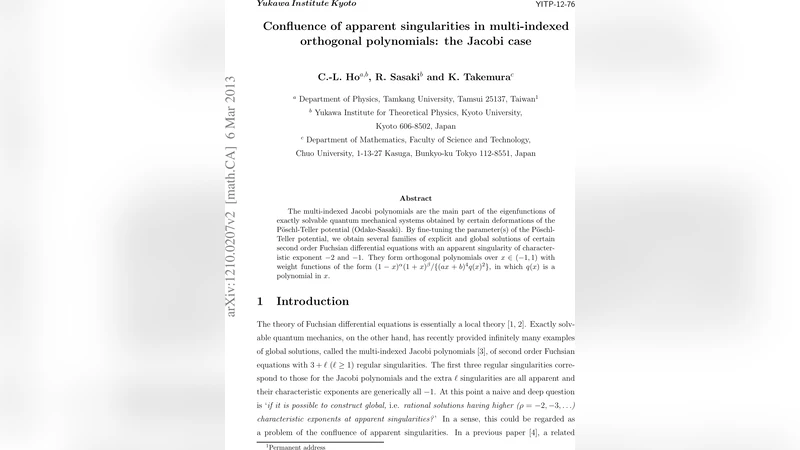
The multi-indexed Jacobi polynomials are the main part of the eigenfunctions of exactly solvable quantum mechanical systems obtained by certain deformations of the P"oschl-Teller potential (Odake-Sasaki). By fine-tuning the parameter(s) of the P"oschl-Teller potential, we obtain several families of explicit and global solutions of certain second order Fuchsian differential equations with an apparent singularity of characteristic exponent -2 and -1. They form orthogonal polynomials over $x\in(-1,1)$ with weight functions of the form $(1-x)^\alpha(1+x)^\beta/{(ax+b)^4q(x)^2}$, in which $q(x)$ is a polynomial in $x$.
💡 Research Summary
The paper investigates a novel class of multi‑indexed Jacobi polynomials that arise as the main part of eigenfunctions of exactly solvable quantum‑mechanical systems obtained by deforming the Pöschl‑Teller potential through multiple Darboux–Crum transformations. By a careful fine‑tuning of the potential parameters (g) and (h), the authors cause two or more regular singularities of the associated second‑order Fuchsian differential equation to coalesce into a single apparent singularity. This confluence produces characteristic exponents (-2) and (-1), which are atypical for ordinary Fuchsian equations but nevertheless correspond to globally regular solutions because the singularity is apparent (the monodromy is trivial).
The construction proceeds as follows. Starting from the standard Pöschl‑Teller Hamiltonian
\
Comments & Academic Discussion
Loading comments...
Leave a Comment