Magnetic Field Configuration Models and Reconstruction Methods for Interplanetary Coronal Mass Ejections
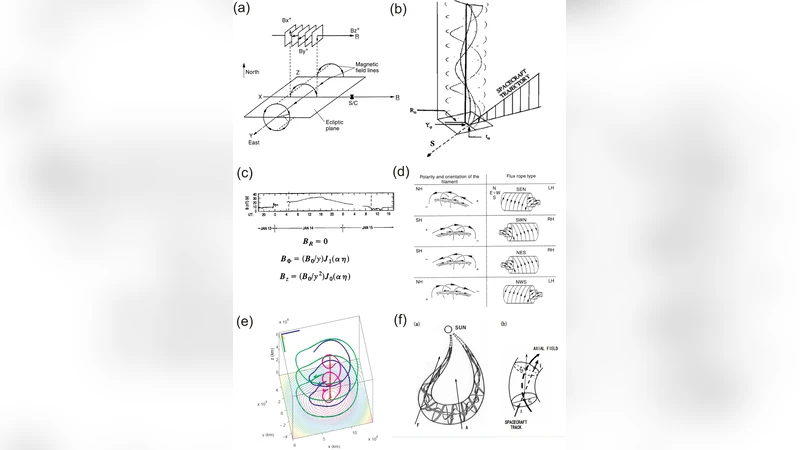
This study aims to provide a reference to different magnetic field models and reconstruction methods for interplanetary coronal mass ejections (ICMEs). In order to understand the differences in the outputs of those models and codes, we analyze 59 events from the Coordinated Data Analysis Workshop (CDAW) list, using four different magnetic field models and reconstruction techniques; force-free fitting (Goldstein,1983,Burlaga,1988,Lepping et al.,1990), magnetostatic reconstruction using a numerical solution to the Grad-Shafranov equation (Hu and Sonnerup, 2001), fitting to a self-similarly expanding cylindrical configuration (Marubashi and Lepping, 2007) and elliptical, non-force free fitting (Hidalgo,2003). The resulting parameters of the reconstructions for the 59 events are compared statistically, as well as in selected case studies. The ability of a method to fit or reconstruct an event is found to vary greatly: the Grad-Shafranov reconstruction is successful for most magnetic clouds (MCs) but for less than 10% of the non-MC ICMEs; the other three methods provide a successful fit for more than 65% of all events. The differences between the reconstruction and fitting methods are discussed, and suggestions are proposed as to how to reduce them. We find that the magnitude of the axial field is relatively consistent across models but not the orientation of the axis of the ejecta. We also find that there are a few cases for which different signs of the magnetic helicity are found for the same event when we do not fix the boundaries, illustrating that this simplest of parameters is not necessarily always well constrained by fitting and reconstruction models. Finally, we look at three unique cases in depth to provide a comprehensive idea of the different aspects of how the fitting and reconstruction codes work.
💡 Research Summary
This paper provides a systematic comparison of four widely used magnetic‑field models and reconstruction techniques applied to interplanetary coronal mass ejections (ICMEs). The authors selected 59 events from the Coordinated Data Analysis Workshop (CDAW) list, classifying each as a magnetic cloud (MC) or a non‑MC ICME, and then processed every event with (1) a classic force‑free cylindrical fitting (Goldstein 1983; Burlaga 1988; Lepping et al. 1990), (2) a Grad‑Shafranov (GS) magnetostatic reconstruction (Hu & Sonnerup 2001), (3) a self‑similar expanding cylindrical model (Marubashi & Lepping 2007), and (4) an elliptical, non‑force‑free fitting (Hidalgo 2003).
The statistical analysis shows that the axial magnetic field strength (B0) is relatively robust across all methods, varying by less than about 10 % on average. In contrast, the orientation of the flux‑rope axis (latitude and longitude) and the sign of magnetic helicity exhibit substantial scatter. When the temporal boundaries of the structure are not fixed, the same event can be assigned opposite helicity signs by different techniques, indicating that helicity is poorly constrained in many cases.
Success rates differ markedly among the methods. The GS reconstruction succeeds for the majority of MCs (≈80 % of MC events) but fails for more than 90 % of non‑MC ICMEs, reflecting its reliance on a well‑defined, two‑dimensional equilibrium. The three other approaches—force‑free fitting, expanding cylindrical fitting, and elliptical non‑force‑free fitting—achieve successful fits for over 65 % of the total sample, including a substantial fraction of non‑MC events. This demonstrates that relaxing the force‑free assumption or allowing for expansion and elliptical cross‑sections makes the models more adaptable to real, often irregular, ICME structures.
The authors discuss the sources of discrepancy. The force‑free model assumes zero plasma pressure and a perfectly cylindrical geometry, which can be unrealistic for many ICMEs. The expanding cylindrical model adds a time‑dependent radius, improving the fit to events that show a clear magnetic‑field decay with time. The elliptical model introduces additional degrees of freedom (aspect ratio, non‑zero current density) that can capture asymmetries but also increase the risk of over‑fitting. The GS method, while physically rigorous, is highly sensitive to the chosen boundaries and to the quality of the plasma pressure data; small errors can prevent convergence.
To reduce model‑dependent differences, the paper recommends (i) using multi‑spacecraft observations to define more objective boundaries, (ii) cross‑validating parameters obtained from different techniques, and (iii) imposing physical constraints such as continuity of plasma flow or energy conservation during the fitting process. The authors illustrate these points with three detailed case studies, highlighting how each method responds to specific data features and where each excels or fails.
In summary, the study underscores that no single reconstruction technique can universally capture all ICME magnetic structures. A combined approach, leveraging the strengths of each model while carefully handling boundary selection and incorporating additional physical constraints, offers the most reliable path toward accurate determination of ICME magnetic geometry, orientation, and helicity. This multi‑method strategy is especially important for space‑weather forecasting, where precise knowledge of the magnetic field orientation determines the geoeffectiveness of an incoming CME.
Comments & Academic Discussion
Loading comments...
Leave a Comment