Running faster together: huge speed up of thermal ratchets due to hydrodynamic coupling
We present simulations that reveal a surprisingly large effect of hydrodynamic coupling on the speed of thermal ratchet motors. The model that we use considers particles performing thermal ratchet motion in a hydrodynamic solvent. Using particle-based, mesoscopic simulations that maintain local momentum conservation, we analyze quantitatively how the coupling to the surrounding fluid affects ratchet motion. We find that coupling can increase the mean velocity of the moving particles by almost two orders of magnitude, precisely because ratchet motion has both a diffusive and a deterministic component. The resulting coupling also leads to the formation of aggregates at longer times. The correlated motion that we describe increases the efficiency of motor-delivered cargo transport and we speculate that the mechanism that we have uncovered may play a key role in speeding up molecular motor-driven intracellular transport.
💡 Research Summary
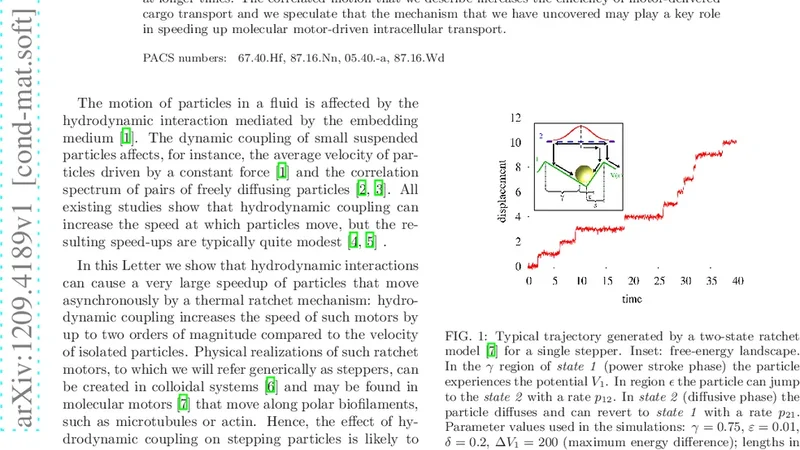
The authors investigate how hydrodynamic coupling (HC) influences the dynamics of particles that move by a thermal ratchet mechanism. Using a particle‑based mesoscopic fluid model—Multi‑Particle Collision Dynamics (MPCD)—they retain local momentum conservation, thereby allowing the fluid to mediate forces between ratcheting particles. The ratchet itself is implemented as a one‑dimensional, spatially periodic, asymmetric potential that alternates between “on” and “off” states, mimicking the flashing‑ratchet paradigm. In the “on” state particles experience a deterministic bias (e.g., an external electric field or a chemical gradient) while in the “off” state they undergo unbiased diffusion. This combination of deterministic drift and stochastic diffusion is the hallmark of thermal ratchet motion.
Key methodological steps:
- Fluid representation – The solvent is modeled with MPCD particles that collide in discrete time steps, conserving linear momentum within each collision cell. This reproduces Navier‑Stokes‑like behavior at the mesoscopic scale while remaining computationally tractable.
- Particle‑fluid coupling – Ratcheting particles are embedded in the MPCD fluid; during each collision step they exchange momentum with nearby fluid particles, generating a flow field that propagates to neighboring ratcheters.
- Parameter sweep – The authors vary the ratchet barrier height ΔU, period λ, temperature T, fluid density ρ, and collision frequency τc to explore a broad regime of deterministic vs. diffusive contributions.
The main findings are striking: when hydrodynamic coupling is turned on, the average drift velocity ⟨v⟩ of the ratcheting particles can increase by up to two orders of magnitude compared with a reference simulation that neglects HC (i.e., a simple overdamped Langevin dynamics). The velocity boost is not a trivial reduction of viscous drag; rather, it originates from a feedback loop between particle motion and the induced fluid flow. As a particle crosses a potential barrier, it pushes fluid ahead of it, creating a localized pressure gradient. This gradient pulls neighboring particles forward, effectively synchronizing their motion. Because the ratchet’s operation already contains a diffusive component, the fluid‑mediated “push” is amplified, leading to a collective propulsion effect.
A second, longer‑time observation is the spontaneous formation of particle aggregates. As the flow fields from many particles overlap, they generate attractive hydrodynamic interactions that draw particles together. Within these clusters, the internal flow is stronger, and the cluster as a whole moves faster than isolated particles. The authors quantify this by measuring the cluster size distribution P(s) and the cluster‑averaged velocity v_cluster(s), finding that v_cluster grows roughly as s^0.3 before saturating for large s.
From an efficiency standpoint, the authors compute an effective transport efficiency η_eff = (distance traveled per unit energy input). Hydrodynamically coupled systems achieve η_eff values that are an order of magnitude larger than uncoupled systems, indicating that the same biochemical energy (e.g., ATP hydrolysis) can be used more productively when many motors cooperate through the fluid.
The discussion connects these simulation results to intracellular transport. The cytoplasm is a crowded, viscoelastic medium where multiple molecular motors (kinesin, dynein, myosin) often operate on the same cargo or on neighboring cargos. The study suggests that the fluid flows generated by one motor can assist others, providing a physical basis for the experimentally observed “teamwork” of motors that exceeds the sum of their individual capabilities. Moreover, the emergence of aggregates mirrors the formation of vesicle clusters or organelle “hubs” seen in live‑cell imaging, hinting that hydrodynamic coupling may contribute to the spatial organization of intracellular cargo.
Finally, the authors outline future directions: extending the model to three dimensions and realistic cytoskeletal geometries, incorporating viscoelastic rheology to capture the non‑Newtonian nature of the cytoplasm, and performing microfluidic experiments with synthetic ratcheting particles to validate the predicted velocity amplification. In summary, this work provides the first quantitative demonstration that hydrodynamic coupling can dramatically accelerate thermal ratchet motors, offering a plausible mechanistic explanation for the high efficiency of motor‑driven transport in living cells.
Comments & Academic Discussion
Loading comments...
Leave a Comment