Spectral Comparison of Weak Short Bursts to the Persistent X-rays from the Magnetar 1E 1547.0-5408 in its 2009 Outburst
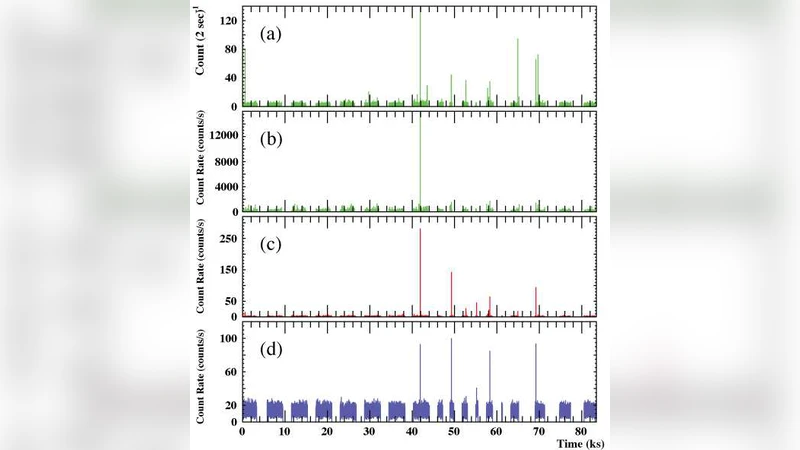
In January 2009, the 2.1-sec anomalous X-ray pulsar 1E 1547.0-5408 evoked intense burst activity. A follow-up Suzaku observation on January 28 recorded enhanced persistent emission both in soft and hard X-rays (Enoto et al. 2010b). Through re-analysis of the same Suzaku data, 18 short bursts were identified in the X-ray events recorded by the Hard X-ray Detector (HXD) and the X-ray Imaging Spectrometer (XIS). Their spectral peaks appear in the HXD-PIN band, and their 10-70 keV X-ray fluences range from ~2e-9 erg cm-2 to 1e-7 erg cm-2. Thus, the 18 events define a significantly weaker burst sample than was ever obtained, ~1e-8-1e-4 erg cm-2. In the ~0.8 to ~300 keV band, the spectra of the three brightest bursts can be represented successfully by a two-blackbody model, or a few alternative ones. A spectrum constructed by stacking 13 weaker short bursts with fluences in the range (0.2-2)e-8 erg s-1 is less curved, and its ratio to the persistent emission spectrum becomes constant at ~170 above ~8 keV. As a result, the two-blackbody model was able to reproduce the stacked weaker-burst spectrum only after adding a power-law model, of which the photon index is fixed at 1.54 as measured is the persistent spectrum. These results imply a possibility that the spectrum composition employing an optically-thick component and a hard power-law component can describe wide-band spectra of both the persistent and weak-burst emissions, despite a difference of their fluxes by two orders of magnitude. Based on the spectral similarity, a possible connection between the unresolved short bursts and the persistent emission is discussed.
💡 Research Summary
In January 2009 the anomalous X‑ray pulsar 1E 1547.0‑5408 entered a phase of intense bursting activity. A Suzaku observation performed on 28 January captured both an enhanced persistent emission and a series of short, weak bursts. By re‑examining the same HXD‑PIN and XIS data, the authors identified 18 short bursts whose 10–70 keV fluences lie between ≈2 × 10⁻⁹ and 1 × 10⁻⁷ erg cm⁻², i.e., one to two orders of magnitude fainter than any previously studied bursts from this source. The three brightest events (fluence ≳10⁻⁸ erg cm⁻²) were analyzed over the full 0.8–300 keV band. Their spectra are well described by a two‑blackbody (2BB) model, with a hot component (kT≈10 keV) and a cooler component (kT≈0.5 keV). Alternative fits (BB+power‑law, BB+Comptonization) give statistically comparable results, confirming that a thermal, optically thick component dominates the burst emission.
The remaining 13 weaker bursts (fluence 0.2–2 × 10⁻⁸ erg cm⁻²) were stacked to improve statistics. The stacked spectrum is noticeably less curved than the 2BB model predicts. When the authors added a hard power‑law component with photon index fixed at Γ = 1.54—the value measured for the persistent emission—the fit improves dramatically, and the ratio of the stacked burst spectrum to the persistent spectrum becomes flat at ≈170 above ∼8 keV. This indicates that the hard tail observed in the persistent emission is already present in the weak bursts, with essentially the same spectral shape.
A systematic investigation of the fluence‑spectral‑parameter relations shows that the temperatures and emitting areas of the blackbody components increase with burst fluence, while the hard power‑law component remains essentially unchanged. This suggests that the thermal component scales with the energy released in each burst, whereas the hard tail originates from a separate, perhaps magnetospheric, process that is insensitive to the burst strength.
The authors argue that the similarity between the persistent spectrum and the weak‑burst spectra supports a scenario in which numerous unresolved short bursts collectively contribute to the persistent hard X‑ray emission. If the rate of sub‑threshold bursts is high enough, their cumulative hard power‑law tail could account for the observed persistent hard component, bridging the gap between burst and persistent phenomenology.
In summary, the paper demonstrates that (1) weak short bursts from 1E 1547.0‑5408 share the same two‑component spectral architecture as the persistent emission—a thermal, optically thick component plus a hard power‑law tail; (2) the hard tail’s photon index is invariant across a fluence range spanning two orders of magnitude; and (3) this spectral continuity provides quantitative support for models that link the persistent hard X‑ray output of magnetars to the integrated contribution of a large population of faint, unresolved bursts. The work thus advances our understanding of magnetar energy release mechanisms and highlights the importance of high‑sensitivity, broadband observations for disentangling burst‑persistent connections.