The first massive black holes
I briefly outline recent theoretical developments on the formation of the first massive black holes (MBHs) that may grow into the population of MBHs powering quasars and inhabiting galactic centers today. I also touch upon possible observational tests that may give insights on what the properties of the first MBHs were.
💡 Research Summary
The paper provides a concise yet comprehensive review of the theoretical landscape surrounding the birth and early growth of the first massive black holes (MBHs) that later evolve into the supermassive black holes powering high‑redshift quasars and residing in the centers of present‑day galaxies. It begins by highlighting the observational challenge posed by quasars at redshifts z ≈ 6–7, whose inferred black‑hole masses of ∼10⁹ M☉ demand rapid assembly within the first few hundred million years after the Big Bang. This tension motivates a detailed examination of the possible “seed” formation channels.
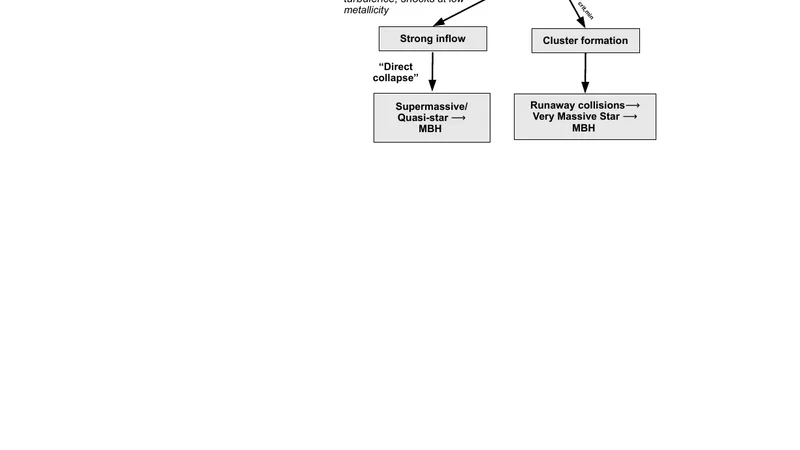
Three principal seed‑formation pathways are discussed. The first is the remnants of Population III stars, metal‑free massive stars that collapse into black holes of ∼10²–10³ M☉. Their growth to supermassive scales requires sustained, near‑Eddington or super‑Eddington accretion and efficient suppression of radiative feedback. The second pathway is direct collapse of pristine, atomic‑cooling gas clouds in halos with virial temperatures above ∼10⁴ K, where H₂ cooling is inhibited by a strong Lyman‑Werner background. In this scenario, the gas can collapse quasi‑isothermally, forming a massive (10⁴–10⁶ M☉) seed without fragmenting. The third channel involves dense stellar clusters or quasi‑star phases, where runaway collisions or a short‑lived, radiation‑supported envelope lead to a seed of intermediate mass (10³–10⁴ M☉). Each channel carries distinct predictions for the initial mass function, environmental metallicity, and the required halo mass.
The growth phase is treated in detail. The authors emphasize that the availability of super‑critical gas inflows—driven by cold streams, major mergers, or gravitational torques—can enable accretion rates exceeding the classical Eddington limit, especially when the accretion flow adopts a slim‑disk geometry that reduces radiative efficiency. Super‑Eddington episodes, possibly regulated by photon‑bubble instabilities or anisotropic radiation, can boost black‑hole mass by orders of magnitude on Myr timescales. In addition to gas accretion, hierarchical black‑hole mergers contribute significantly to mass buildup, particularly in the dense early universe where merger rates are high. The paper discusses how gravitational‑wave recoil, spin alignment, and feedback from jets or winds can either aid or hinder subsequent accretion.
Observational prospects are a central focus. The James Webb Space Telescope (JWST) will be capable of detecting faint host galaxies and accreting black holes at z > 10, allowing direct constraints on seed masses and early growth histories through spectral energy distributions and emission line diagnostics. 21 cm cosmology, via experiments such as HERA and the SKA, can probe the thermal and ionization state of the intergalactic medium, indirectly testing the prevalence of strong Lyman‑Werner backgrounds required for direct collapse. The Laser Interferometer Space Antenna (LISA) will detect mergers of MBHs in the 10⁴–10⁶ M☉ range out to high redshift, providing a direct measurement of the merger rate and mass distribution of early black‑hole populations. Complementary X‑ray missions (e.g., Athena) and radio facilities will further constrain accretion physics and feedback.
Finally, the authors argue that progress hinges on a synergistic approach: next‑generation cosmological simulations must incorporate full radiation‑hydrodynamics, magnetic fields, and realistic sub‑grid models for star formation and feedback to capture the delicate balance between cooling, fragmentation, and inflow. Simultaneously, the multi‑messenger observational data set expected in the coming decade will enable stringent tests of each seed‑formation scenario, potentially distinguishing whether the first MBHs arose predominantly from light Pop III remnants, massive direct‑collapse objects, or intermediate‑mass quasi‑stars. By integrating theory, simulation, and observation, the community can move toward a unified picture of how the universe’s first massive black holes formed, grew, and set the stage for the co‑evolution of galaxies and their central black holes.