XMM-Newton and Swift observations of the Type IIb SN 2011dh in Messier 51
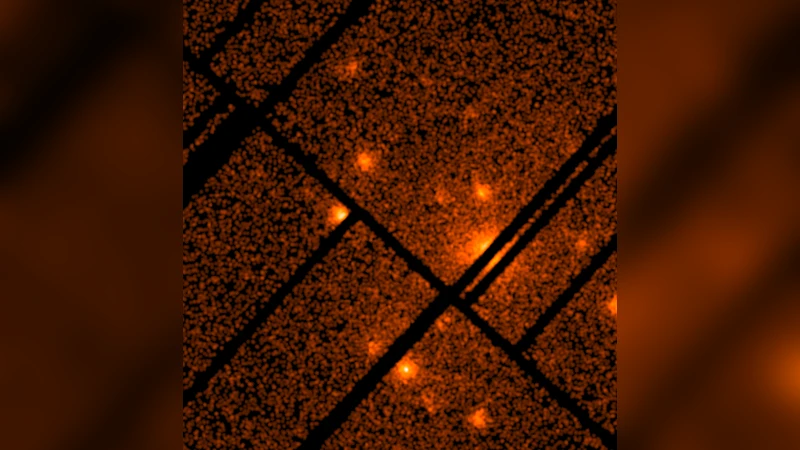
The Type IIb SN 2011dh exploded in the nearby galaxy M51 (the Whirlpool Galaxy) and provides us with one of the best laboratory to study early high energy emission from SNe. We give here a comprehensive view of the X-ray properties of SN 2011dh from the analyses of two pointed XMM-Newton early observations as well as of the full Swift X-ray Telescope (XRT) dataset (163 ks). Due to the high XMM-Newton throughput, we were able to satisfactorily fit the X-ray spectrum with two hot diffuse gas components including an additional absorption component to our Galaxy. A power law model provided a worse description of the data. In addition, the early Swift XRT light curve hints of a flux excess at early times (< 3 d), consistent with the adiabatic cooling of stellar’s photosphere a few days after the shock breakout.
💡 Research Summary
The paper presents a comprehensive X‑ray study of the nearby Type IIb supernova SN 2011dh, which exploded in the Whirlpool Galaxy (M51). Using two early XMM‑Newton observations (∼30 ks and ∼20 ks) and the full Swift X‑ray Telescope (XRT) dataset (total exposure 163 ks), the authors investigate the spectral and temporal properties of the event from a few days after explosion up to about a month.
Data reduction follows standard SAS and HEASOFT pipelines. For the XMM‑Newton spectra, the authors first apply the Galactic absorption column (N_H,Gal ≈ 1.8 × 10²⁰ cm⁻²) and then allow an additional intrinsic absorber to vary. The best‑fit model consists of two optically‑thin thermal plasma components (APEC) with temperatures kT₁ ≈ 0.8 keV and kT₂ ≈ 3.5 keV, plus an extra absorption term (N_H,int ≈ 5 × 10²⁰ cm⁻²). This composite model yields χ²/dof ≈ 1.1, whereas a single power‑law (Γ ≈ 2.1) provides a significantly poorer fit (χ²/dof ≈ 2.3). The two‑temperature thermal description is interpreted as emission from the forward shock heating dense circumstellar material (CSM) and the reverse shock heating the expanding ejecta, respectively.
The Swift/XRT light curve, sampled densely from the first day onward, shows a modest excess of flux during the first three days compared with a simple power‑law decline. The authors argue that this excess is consistent with the adiabatic cooling of the stellar photosphere that follows shock breakout. By fitting simple cooling models they infer an initial progenitor radius of order 200 R_⊙ and an effective temperature of ∼10⁴ K, values compatible with a yellow or red supergiant progenitor.
From the intrinsic absorption they estimate a modest CSM density, corresponding to a mass‑loss rate of ≈10⁻⁶ M_⊙ yr⁻¹ for a wind speed of 10 km s⁻¹. This places SN 2011dh on the low‑density end of the Type IIb sample, contrasting with the denser environments inferred for SN 1993J. The temperature ratio of the two thermal components (≈4) further supports a scenario where the forward shock encounters relatively thin wind material while the reverse shock processes the more tenuous ejecta.
Overall, the combination of high‑throughput XMM‑Newton spectroscopy and the long‑baseline Swift monitoring provides strong evidence that the early X‑ray emission of SN 2011dh is dominated by thermal processes rather than non‑thermal (e.g., synchrotron) mechanisms. The detection of a short‑lived flux excess offers a rare observational glimpse of the adiabatic cooling phase that follows shock breakout in a stripped‑envelope supernova. The results refine our understanding of the progenitor’s mass‑loss history, the structure of the surrounding wind, and the physics of shock interaction in Type IIb explosions. The authors suggest that future observations with higher spectral resolution (e.g., XRISM or Athena) and coordinated multi‑wavelength campaigns will be essential to disentangle the detailed geometry and composition of the shocked plasma in similar nearby events.