Ortho-to-Para Ratio Studies of Shocked H2 Gas in the Two Supernova Remnants IC 443 and HB 21
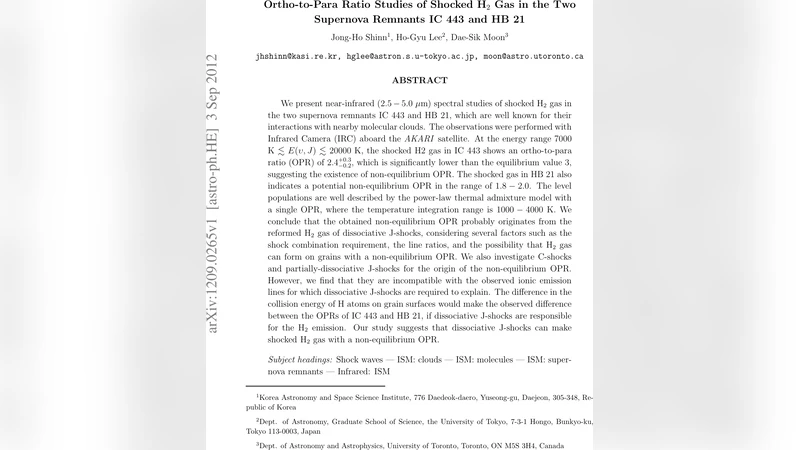
We present near-infrared (2.5-5.0 {\mu}m) spectral studies of shocked H2 gas in the two supernova remnants IC 443 and HB 21, which are well known for their interactions with nearby molecular clouds. The observations were performed with Infrared Camera (IRC) aboard the AKARI satellite. At the energy range 7000 K <= E(v,J) <= 20000 K, the shocked H2 gas in IC 443 shows an ortho-to-para ratio (OPR) of 2.4+0.3-0.2, which is significantly lower than the equilibrium value 3, suggesting the existence of non-equilibrium OPR. The shocked gas in HB 21 also indicates a potential non-equilibrium OPR in the range of 1.8-2.0. The level populations are well described by the power-law thermal admixture model with a single OPR, where the temperature integration range is 1000-4000 K. We conclude that the obtained non-equilibrium OPR probably originates from the reformed H2 gas of dissociative J-shocks, considering several factors such as the shock combination requirement, the line ratios, and the possibility that H2 gas can form on grains with a non-equilibrium OPR. We also investigate C-shocks and partially-dissociative J-shocks for the origin of the non-equilibrium OPR. However, we find that they are incompatible with the observed ionic emission lines for which dissociative J-shocks are required to explain. The difference in the collision energy of H atoms on grain surfaces would make the observed difference between the OPRs of IC 443 and HB 21, if dissociative J-shocks are responsible for the H2 emission. Our study suggests that dissociative J-shocks can make shocked H2 gas with a non-equilibrium OPR.
💡 Research Summary
This paper presents a comprehensive near‑infrared spectroscopic investigation of shocked molecular hydrogen (H₂) in two well‑studied supernova remnants (SNRs), IC 443 and HB 21, using the Infrared Camera (IRC) aboard the AKARI satellite. The observations cover the 2.5–5.0 µm wavelength range, which includes a suite of H₂ rotational–vibrational transitions spanning upper‑level energies from 7 000 K to 20 000 K. By measuring the fluxes of fifteen H₂ lines (including the 0‑0 S(0)–S(7) and 1‑0 Q series) in representative shock‑excited regions of each remnant, the authors construct level‑population diagrams that reveal a clear departure from a single‑temperature Boltzmann distribution.
To interpret the non‑thermal population, the authors adopt a power‑law thermal admixture model in which the gas temperature distribution follows dN/dT ∝ T⁻ᵇ over a range of 1 000–4 000 K. The best‑fit parameters are remarkably consistent for both remnants: a power‑law index b≈3.6, an H₂ column density N(H₂)≈(1–2) × 10¹⁹ cm⁻², and, crucially, a single ortho‑to‑para ratio (OPR) that governs the entire temperature mixture. The fitted OPR values are 2.4 ⁺⁰·³_₋₀·₂ for IC 443 and 1.8–2.0 for HB 21, both significantly below the high‑temperature equilibrium value of 3. This indicates that the shocked H₂ gas retains a non‑equilibrium spin‑isomer distribution.
The paper proceeds to explore the physical origin of the sub‑equilibrium OPR. Three shock scenarios are examined: (i) C‑type (continuous) shocks, which heat the gas magnetically without dissociating H₂; (ii) partially dissociative J‑type (jump) shocks, where a fraction of H₂ is destroyed and reforms; and (iii) fully dissociative J‑type shocks, in which H₂ is completely dissociated at the shock front and subsequently reforms in the cooling post‑shock flow. The authors argue that C‑type shocks cannot produce the observed low OPR because the spin conversion timescale is much longer than the cooling time, and the model fails to reproduce the strong ionic lines (e.g.,