Magneto-elastic oscillations of neutron stars: exploring different magnetic field configurations
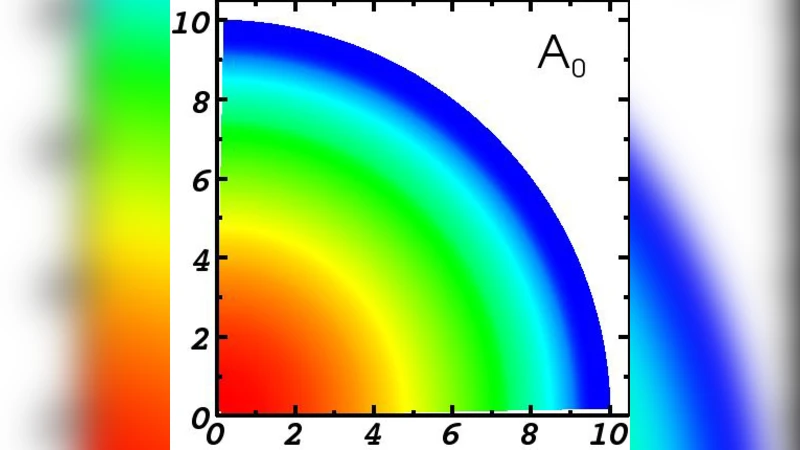
We study magneto-elastic oscillations of highly magnetized neutron stars (magnetars) which have been proposed as an explanation for the quasi-periodic oscillations (QPOs) appearing in the decaying tail of the giant flares of soft gamma-ray repeaters (SGRs). We extend previous studies by investigating various magnetic field configurations, computing the Alfv'en spectrum in each case and performing magneto-elastic simulations for a selected number of models. By identifying the observed frequencies of 28 Hz (SGR 1900+14) and 30 Hz (SGR 1806-20) with the fundamental Alfv'en QPOs, we estimate the required surface magnetic field strength. For the magnetic field configurations investigated (dipole-like poloidal, mixed toroidal-poloidal with a dipole-like poloidal component and a toroidal field confined to the region of field lines closing inside the star, and for poloidal fields with an additional quadrupole-like component) the estimated dipole spin-down magnetic fields are between 8x10^14 G and 4x10^15 G, in broad agreement with spin-down estimates for the SGR sources producing giant flares. A number of these models exhibit a rich Alfv'en continuum revealing new turning points which can produce QPOs. This allows one to explain most of the observed QPO frequencies as associated with magneto-elastic QPOs. In particular, we construct a possible configuration with two turning points in the spectrum which can explain all observed QPOs of SGR 1900+14. Finally, we find that magnetic field configurations which are entirely confined in the crust (if the core is assumed to be a type I superconductor) are not favoured, due to difficulties in explaining the lowest observed QPO frequencies (f<30 Hz).
💡 Research Summary
The paper investigates magneto‑elastic oscillations in highly magnetized neutron stars (magnetars) as a possible origin of the quasi‑periodic oscillations (QPOs) observed in the decaying tails of giant flares from soft gamma‑ray repeaters (SGRs). While earlier works mainly considered a simple dipolar poloidal magnetic field, the authors explore a broader set of magnetic configurations to assess how the internal field geometry influences the Alfvén continuum and the resulting QPO spectrum.
Three families of magnetic fields are examined: (1) a pure poloidal dipole, (2) a mixed poloidal‑toroidal field where the toroidal component is confined to the region of closed field lines inside the star, and (3) a poloidal field supplemented by a quadrupolar component, again possibly combined with a toroidal part. For each configuration the Alfvén spectrum is computed by solving the two‑dimensional eigenvalue problem for perturbations propagating along magnetic field lines. Particular attention is paid to turning points (local extrema) in the continuum, because at these frequencies wave packets can be trapped and form discrete, long‑lived QPOs.
The authors then perform time‑domain magneto‑elastic simulations for a selected subset of models. The neutron‑star background is built from the APR equation of state, with a mass of 1.4 M⊙ and a radius of ~12 km. The core is assumed to be a type‑I superconductor, which forces the magnetic field to be continuous across the core‑crust boundary. The crust’s shear modulus is taken from modern nuclear‑physics calculations, ensuring realistic elastic response. The coupled magneto‑elastic equations are integrated using a high‑resolution finite‑difference scheme in axisymmetry, starting from a small shear perturbation that excites both Alfvén and shear modes.
By identifying the observed 28 Hz QPO of SGR 1900+14 and the 30 Hz QPO of SGR 1806‑20 with the fundamental turning‑point Alfvén QPOs of the models, the required surface dipole field strength is inferred to lie between 8 × 10¹⁴ G and 4 × 10¹⁵ G. This range is consistent with spin‑down estimates for the two SGRs, lending credibility to the magneto‑elastic interpretation.
The study finds that more complex field geometries generate richer Alfvén continua. In the mixed toroidal‑poloidal case, the toroidal component shifts the continuum to higher frequencies and creates an additional turning point, allowing simultaneous explanation of low‑frequency (≈30 Hz) and higher‑frequency (≈90 Hz) QPOs. The quadrupole‑augmented models exhibit two distinct turning points, which can be associated with several observed frequencies (28 Hz, 53 Hz, 84 Hz, 155 Hz) in SGR 1900+14, providing a unified explanation for the entire observed QPO set.
Conversely, configurations in which the magnetic field is completely confined to the crust (as would be required if the core were a perfect type‑I superconductor with no field penetration) fail to produce turning points below ~30 Hz. Consequently, such models cannot account for the lowest observed QPOs and are deemed unfavorable.
In summary, the paper demonstrates that realistic, multi‑component magnetic field configurations substantially modify the Alfvén spectrum, introduce multiple turning points, and thereby enable a magneto‑elastic model to reproduce the full range of QPOs observed in magnetar giant flares. The results support the view that magnetars possess internal magnetic fields of order 10¹⁵ G with both poloidal and toroidal components, and that the coupling between magnetic and elastic stresses is essential for interpreting the rich QPO phenomenology.