Accretion flow diagnostics with X-ray spectral-timing: the hard state of SWIFT J1753.5-0127
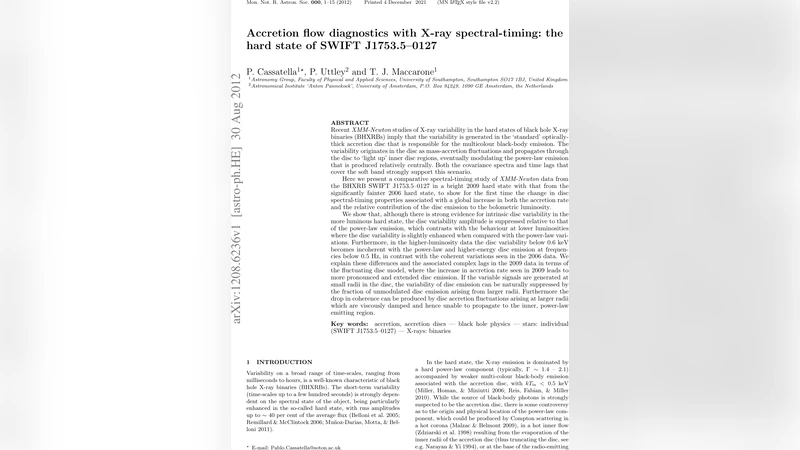
(Abridged) Recent XMM-Newton studies of X-ray variability in the hard states of black hole X-ray binaries (BHXRBs) imply that the variability is generated in the ‘standard’ optically-thick accretion disc. The variability originates in the disc as mass-accretion fluctuations and propagates through the disc to ’light up’ inner disc regions, eventually modulating the power-law emission that is produced relatively centrally. We present a comparative spectral-timing study of XMM-Newton data from the BHXRB SWIFT J1753.5-0127 in a bright 2009 hard state with that from the significantly fainter 2006 hard state, to show for the first time the change in disc spectral-timing properties associated with a global increase in both the accretion rate and the relative contribution of the disc emission to the bolometric luminosity. We show that, although there is strong evidence for intrinsic disc variability in the more luminous hard state, the disc variability amplitude is suppressed relative to that of the power-law emission, which contrasts with the behaviour at lower luminosities where the disc variability is slightly enhanced when compared with the power-law variations. In the higher-luminosity data, the disc variability below 0.6 keV becomes incoherent with the power-law and higher-energy disc emission at frequencies below 0.5 Hz, in contrast with the coherent variations seen in the 2006 data. We explain these differences and the associated complex lags in the 2009 data in terms of the fluctuating disc model. If the variable signals are generated at small radii in the disc, the variability of disc emission can be naturally suppressed by the fraction of unmodulated disc emission from larger radii. The drop in coherence can be produced by disc accretion fluctuations arising at larger radii which are viscously damped and hence unable to propagate to the inner, power-law emitting region.
💡 Research Summary
This paper presents a detailed spectral‑timing analysis of the black‑hole X‑ray binary SWIFT J1753.5‑0127, focusing on two XMM‑Newton observations that sample the source in a bright hard state (2009) and a much fainter hard state (2006). By applying identical data‑reduction procedures, the authors compare energy‑dependent power spectra, rms spectra, cross‑spectra, coherence, and phase‑lag as functions of Fourier frequency (0.01–10 Hz). The main goal is to understand how a global increase in mass‑accretion rate (and consequently a larger contribution of the thermal disc to the bolometric luminosity) modifies the variability properties of the accretion disc and the centrally produced power‑law (corona) emission.
In the 2009 bright state the disc component dominates the soft X‑ray band (0.3–0.6 keV) and contributes roughly 30 % of the total 0.5–10 keV luminosity, a factor of three higher than in 2006. Despite this, the fractional rms of the disc is lower than that of the power‑law: the disc shows ~4 % rms while the power‑law reaches 7–9 % rms. This “suppressed disc variability” is a key observational result. In contrast, the 2006 low‑luminosity data display a modestly enhanced disc rms relative to the power‑law, consistent with earlier findings that disc fluctuations dominate the variability at low accretion rates.
Coherence analysis further differentiates the two epochs. In 2006 the soft (disc) and hard (power‑law) bands remain highly coherent (coherence >0.8) across a broad frequency range (0.1–5 Hz), and the phase‑lag spectrum shows a simple soft‑lead (the disc variations precede the hard variations by ~0.1 s). By 2009, coherence drops dramatically below ~0.5 Hz, falling to <0.3, while at higher frequencies it recovers. The lag spectrum becomes more complex, with multiple components suggesting that different variability processes dominate at different frequencies.
The authors interpret these findings within the framework of the fluctuating accretion‑disc model. In this picture, local mass‑accretion rate fluctuations are generated at each radius and propagate inward on the viscous timescale, modulating the emission from progressively smaller radii. When the disc is faint, fluctuations generated at large radii survive viscous damping and reach the innermost region, producing a coherent signal that drives both the soft disc and the hard power‑law variability. As the accretion rate rises, the outer disc emits a larger fraction of steady (non‑fluctuating) photons. Fluctuations arising at small radii still modulate the inner disc and the power‑law, but their fractional contribution to the total disc flux is diluted by the steady outer‑disc emission, leading to the observed suppression of disc rms. Simultaneously, fluctuations generated at larger radii are more strongly damped and fail to propagate inward; they remain confined to the outer disc, producing low‑frequency variability that is incoherent with the power‑law. This naturally explains the loss of coherence below 0.5 Hz in the bright state.
To account for the complex lag structure, the authors propose a “multi‑origin” scenario: fast, high‑frequency fluctuations arise close to the black hole (r ≈ 5–10 R_g) and are tightly coupled to the corona, while slower, low‑frequency fluctuations originate farther out (r ≈ 30 R_g) and affect only the disc emission. The superposition of these two components yields the observed frequency‑dependent lag and coherence behaviour.
The paper also quantifies the change in the disc‑to‑total luminosity ratio (L_disc/L_tot) from ~0.1 in 2006 to ~0.3 in 2009, emphasizing that this increase is the primary driver of the altered variability properties. By demonstrating that a higher disc contribution can both suppress disc rms and decouple disc variability from the power‑law at low frequencies, the study provides strong observational support for models that incorporate viscous damping and radial propagation of fluctuations.
In conclusion, the work shows that hard‑state variability is not a monolithic process but evolves with accretion rate: at low luminosities the disc acts as the dominant variability source, while at higher luminosities the disc’s steady emission masks its intrinsic fluctuations and the corona becomes the primary driver of rapid variability. These results refine our understanding of the disc‑corona coupling in black‑hole binaries and set constraints for future theoretical models of accretion‑flow turbulence and propagation.