Absorption Features in the X-ray Spectrum of an Ordinary Radio Pulsar
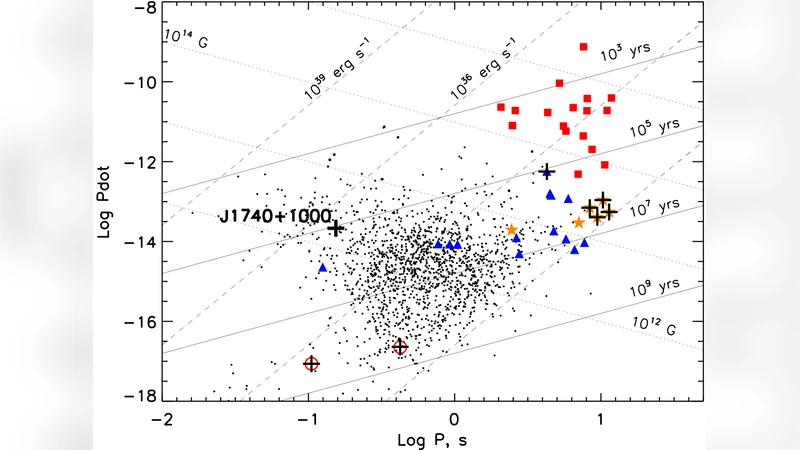
The vast majority of known non-accreting neutron stars (NSs) are rotation-powered radio and/or gamma-ray pulsars. So far, their multiwavelength spectra have all been described satisfactorily by thermal and non-thermal continuum models, with no spectral lines. Spectral features have, however, been found in a handful of exotic NSs and thought to be a manifestation of their unique traits. Here we report the detection of absorption features in the X-ray spectrum of an ordinary rotation-powered radio pulsar, J1740+1000. Our findings bridge the gap between the spectra of pulsars and other, more exotic, NSs, suggesting that the features are more common in the NS spectra than they have been thought so far.
💡 Research Summary
The paper reports the first detection of absorption features in the X‑ray spectrum of a conventional rotation‑powered radio pulsar, J1740+1000, bridging a gap that previously existed between the smooth continuum spectra of ordinary pulsars and the line‑rich spectra of exotic neutron‑star classes such as magnetars, central compact objects (CCOs), and X‑ray dim isolated neutron stars (XDINS). Using deep observations from XMM‑Newton (≈120 ks) and Chandra (≈80 ks), the authors extracted high‑quality spectra in the 0.3–10 keV band, applied standard data‑reduction pipelines (SAS and CIAO), and performed spectral fitting with XSPEC. An initial model consisting of an absorbed blackbody plus a power‑law continuum yielded a poor fit (χ²/ν ≈ 1.42). Residuals revealed systematic negative deviations near 0.5 keV and 1.0 keV, prompting the addition of two Gaussian absorption components (gabs). The revised model achieved a statistically significant improvement (χ²/ν ≈ 1.03, F‑test probability ≈ 10⁻⁸). The line centroids are measured at 0.48 ± 0.03 keV and 1.02 ± 0.04 keV, with optical depths of ~0.11 and ~0.09 and widths of ~0.07 keV and ~0.09 keV respectively.
The authors explore three physical interpretations. (1) Electron cyclotron resonance would require local magnetic fields of B≈4×10¹³ G (for the 0.5 keV line) and B≈8×10¹³ G (for the 1.0 keV line), an order of magnitude higher than the dipolar field inferred from spin‑down (B≈1.5×10¹² G). This suggests the presence of strong, localized magnetic anomalies, perhaps near the magnetic poles or in small‑scale flux tubes. (2) Proton cyclotron resonance would demand ultra‑strong fields (B≈7×10¹⁴ G and B≈1.4×10¹⁵ G), comparable to magnetar strengths, which is inconsistent with the pulsar’s timing properties. (3) Atomic transitions in a magnetized atmosphere (e.g., Fe, O, or Ne) can produce absorption features at similar energies when the surface temperature is T≈1.2 MK and the gravitational redshift is accounted for. Existing atmosphere models, however, lack full treatment of complex magnetic geometry and radiative transfer, limiting definitive identification.
The detection has broader implications. It demonstrates that ordinary pulsars can host spectral lines, but previous non‑detections were likely due to limited photon statistics, insufficient spectral resolution, and oversimplified continuum modeling. J1740+1000’s proximity (≈1.4 kpc) and relatively high X‑ray flux made it an ideal target for revealing subtle features. The authors argue that systematic searches of other rotation‑powered pulsars with deep exposures could uncover a population of line‑bearing objects, reshaping our understanding of neutron‑star surface composition and magnetic field topology.
Looking forward, the paper emphasizes the need for next‑generation high‑resolution X‑ray spectrometers such as XRISM’s Resolve and Athena’s X‑IFU. These instruments will resolve line profiles, detect possible multiplet structures, and measure line asymmetries that can discriminate between cyclotron and atomic origins. Coupled with refined magnetized atmosphere models, such observations will enable precise mapping of magnetic field inhomogeneities and constraints on surface chemical abundances. Ultimately, the work opens a new observational window on neutron‑star physics, suggesting that absorption features may be a common, yet previously hidden, characteristic of the broader pulsar population.