Particle-in-cell simulations of shock-driven reconnection in relativistic striped winds
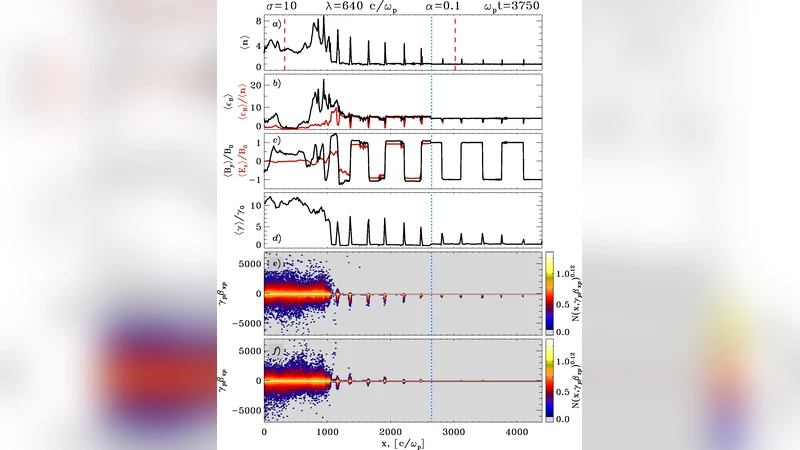
By means of two- and three-dimensional particle-in-cell simulations, we investigate the process of driven magnetic reconnection at the termination shock of relativistic striped flows. In pulsar winds and in magnetar-powered relativistic jets, the flow consists of stripes of alternating magnetic field polarity, separated by current sheets of hot plasma. At the wind termination shock, the flow compresses and the alternating fields annihilate by driven magnetic reconnection. Irrespective of the stripe wavelength “lambda” or the wind magnetization “sigma” (in the regime sigma»1 of magnetically-dominated flows), shock-driven reconnection transfers all the magnetic energy of alternating fields to the particles, whose average Lorentz factor increases by a factor of sigma with respect to the pre-shock value. In the limit lambda/(r_L*sigma)»1, where r_L is the relativistic Larmor radius in the wind, the post-shock particle spectrum approaches a flat power-law tail with slope around -1.5, populated by particles accelerated by the reconnection electric field. The presence of a current-aligned “guide” magnetic field suppresses the acceleration of particles only when the guide field is stronger than the alternating component. Our findings place important constraints on the models of non-thermal radiation from Pulsar Wind Nebulae and relativistic jets.
💡 Research Summary
This paper presents a comprehensive investigation of shock‑driven magnetic reconnection in relativistic striped winds using two‑ and three‑dimensional particle‑in‑cell (PIC) simulations. Striped winds, characteristic of pulsar winds and magnetar‑powered relativistic jets, consist of alternating magnetic field polarity separated by hot current sheets. When such a flow encounters its termination shock, the plasma is compressed, forcing the opposite polarity fields to reconnect and annihilate.
The authors explore a wide parameter space, varying the stripe wavelength λ, the wind magnetization σ (with σ≫1, i.e., magnetically dominated flows), and the presence of a guide magnetic field B_g aligned with the current sheet. They also examine the effect of dimensionality by comparing 2‑D and 3‑D simulations.
Key findings are:
-
Complete magnetic‑to‑particle energy conversion – Regardless of λ or σ, the entire magnetic energy stored in the alternating fields is transferred to the particles at the shock. The mean Lorentz factor of the downstream plasma increases by a factor of σ relative to the upstream value (γ_down ≈ σ γ_up). This demonstrates that reconnection at the shock is an extremely efficient accelerator in high‑σ plasmas.
-
Spectral formation controlled by λ/(r_L σ) – When the dimensionless ratio λ/(r_L σ)≫1 (r_L is the relativistic Larmor radius in the upstream wind), the reconnection electric field (E_rec≈β_rec B) accelerates particles continuously, producing a downstream energy distribution that follows a power‑law dN/dγ ∝ γ^p with p≈‑1.5. This flat spectrum is populated by particles that spend many gyro‑periods in the reconnection layer, gaining energy each time they cross the reconnection electric field. If λ/(r_L σ)≲1, the acceleration is less efficient and the resulting spectrum is closer to a thermal distribution.
-
Guide‑field suppression – Introducing a uniform guide field B_g parallel to the current sheet reduces the reconnection electric field and thus the acceleration efficiency. Acceleration remains robust as long as B_g < B₀ (the amplitude of the alternating component). When B_g ≥ B₀, particle energization is strongly quenched, indicating that the relative strength of the guide field can act as a switch for non‑thermal particle production.
-
Three‑dimensional effects – 3‑D simulations reproduce the same overall energy conversion and spectral slopes as the 2‑D runs, confirming that the essential physics is not an artifact of reduced dimensionality. However, the reconnection geometry becomes more complex, featuring flux ropes and turbulent islands that provide additional pathways for particle trapping and acceleration. The presence of these structures does not significantly diminish the efficiency of the process.
-
Astrophysical implications – The results have direct relevance for the interpretation of non‑thermal emission from pulsar wind nebulae (PWNe) and magnetar‑driven jets. In PWNe, the observed flat particle spectra (spectral index ≈ 1.5) and high radiative efficiencies can be naturally explained by shock‑driven reconnection operating in the regime λ/(r_L σ)≫1, which is expected for typical pulsar spin periods and wind parameters. Similarly, in relativistic jets where striped magnetic structures may arise from kink‑driven instabilities, the same mechanism can supply the ultra‑relativistic electrons required for high‑energy synchrotron and inverse‑Compton emission.
-
Modeling outlook – By providing a quantitative mapping between upstream wind parameters (λ, σ, B_g) and downstream particle spectra, the study offers a valuable input for global magnetohydrodynamic (MHD) models that include sub‑grid prescriptions for particle acceleration. Future work should incorporate radiative cooling and feedback to assess how the accelerated particles shape the observable spectra over time.
In summary, the paper establishes that in highly magnetized relativistic outflows, the termination shock acts as a catalyst for rapid, large‑scale magnetic reconnection that converts essentially all alternating magnetic energy into a non‑thermal particle population with a characteristic p≈‑1.5 power‑law. The efficiency of this process is governed by the stripe wavelength relative to the Larmor scale and is sensitive to the presence of a strong guide field. These insights place stringent constraints on theoretical models of high‑energy emission from pulsar wind nebulae and magnetar‑powered jets, and they highlight shock‑driven reconnection as a universal engine for particle acceleration in extreme astrophysical environments.