Nuclear X-ray properties of the peculiar radio-loud hidden AGN 4C+29.30
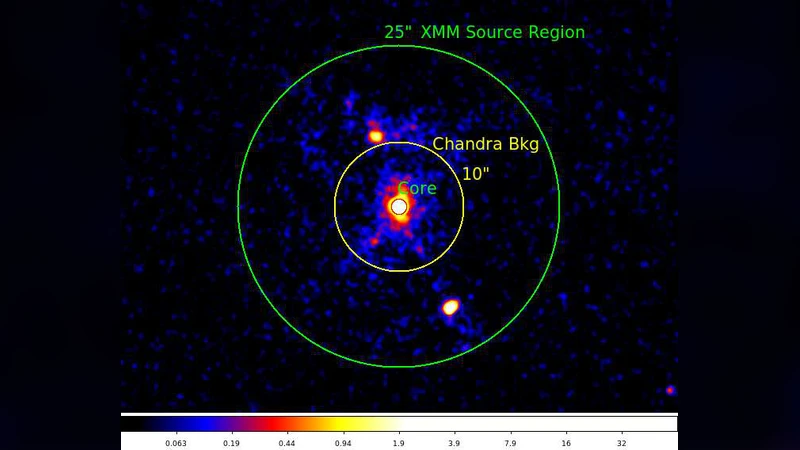
We present results from a study of a nuclear emission of a nearby radio galaxy, 4C+29.30, over a broad 0.5-200 keV X-ray band. This study used new XMM-Newton (~17 ksec) and Chandra (~300 ksec) data, and archival Swift/BAT data from the 58-month catalog. The hard (>2 keV) X-ray spectrum of 4C+29.30 can be decomposed into an intrinsic hard power-law (Gamma ~ 1.56) modified by a cold absorber with an intrinsic column density N_{H,z} ~ 5x10^{23} cm^{-2}, and its reflection (|Omega/2pi| ~ 0.3) from a neutral matter including a narrow iron Kalpha emission line at the rest frame energy ~6.4 keV. The reflected component is less absorbed than the intrinsic one with an upper limit on the absorbing column of N^{refl}{H,z} < 2.5x10^{22} cm^{-2}. The X-ray spectrum varied between the XMM-Newton and Chandra observations. We show that a scenario invoking variations of the normalization of the power-law is favored over a model with variable intrinsic column density. X-rays in the 0.5-2 keV band are dominated by diffuse emission modeled with a thermal bremsstrahlung component with temperature ~0.7 keV, and contain only a marginal contribution from the scattered power-law component. We hypothesize that 4C+29.30 belongs to a class of `hidden’ AGN containing a geometrically thick torus. However, unlike the majority of them, 4C+29.30 is radio-loud. Correlations between the scattering fraction and Eddington luminosity ratio, and the one between black hole mass and stellar velocity dispersion, imply that 4C+29.30 hosts a black hole with ~10^8 M{Sun} mass.
💡 Research Summary
This paper presents a comprehensive X‑ray study of the nearby radio galaxy 4C+29.30, focusing on its nuclear emission across the broad 0.5–200 keV band. The authors combine new observations from XMM‑Newton (≈17 ks) and Chandra (≈300 ks) with archival Swift/BAT data from the 58‑month catalog, thereby achieving simultaneous coverage of both the soft (0.5–2 keV) and hard (>2 keV) X‑ray regimes.
The hard X‑ray spectrum (>2 keV) is best described by two distinct components. The primary component is an intrinsic power‑law with photon index Γ≈1.56, heavily attenuated by a cold absorber with a column density N_H,z≈5×10^23 cm⁻². This high column places 4C+29.30 firmly in the class of “hidden” or heavily obscured AGN, where the line‑of‑sight is blocked by a geometrically thick torus. Superimposed on this is a reflected component arising from neutral material, characterized by a reflection fraction Ω/2π≈0.3. The reflected spectrum includes a narrow Fe Kα emission line at a rest‑frame energy of ~6.4 keV, confirming the neutral nature of the reflector. Importantly, the reflected component experiences far less absorption (N_H,ref<2.5×10^22 cm⁻²), indicating that the reflected photons escape through a less obscured path, possibly the torus’ far side or an opening in the torus.
Temporal analysis reveals that the spectrum changed between the XMM‑Newton and Chandra epochs. By fitting alternative models, the authors demonstrate that a change in the normalization of the intrinsic power‑law provides a statistically superior explanation compared with a model invoking variations in the intrinsic column density. This suggests that the intrinsic continuum luminosity varied, while the obscuring column remained essentially constant over the timescale of the observations.
In the soft band (0.5–2 keV), the emission is dominated by diffuse thermal plasma, well described by a bremsstrahlung component with temperature kT≈0.7 keV. This component likely originates from gas heated by shocks, possibly induced by the radio jet interacting with the interstellar medium. The contribution from a scattered fraction of the primary power‑law is minimal, with an upper limit of ≲1 %, consistent with the low scattering fractions observed in other hidden AGN.
The authors argue that 4C+29.30 belongs to the hidden‑AGN population characterized by a thick torus, low scattering fraction, and strong absorption, yet it is unusual because it is radio‑loud. The presence of a powerful radio jet, confirmed by high‑resolution VLA and VLBI imaging, coexists with the thick torus, challenging simple unification schemes that often separate radio‑quiet hidden AGN from radio‑loud objects.
Using the correlation between scattering fraction and Eddington ratio, together with the M–σ relation (black‑hole mass versus stellar velocity dispersion), the authors estimate a central black‑hole mass of ~10^8 M_⊙. The inferred Eddington ratio is low (L_bol/L_Edd ≈ 10⁻³–10⁻²), consistent with the low scattering fraction and the overall picture of a modestly accreting, heavily obscured nucleus.
In summary, the paper provides strong evidence that 4C+29.30 hosts a geometrically thick, Compton‑thin torus (N_H≈5×10^23 cm⁻²) that blocks the direct view of the nucleus, while a modest reflection component and a weak scattered continuum are observable. The soft X‑ray emission is dominated by jet‑driven thermal plasma. The coexistence of a radio jet with a hidden nucleus underscores the need to consider both jet physics and torus geometry when interpreting the multi‑wavelength properties of radio‑loud AGN. Future high‑resolution X‑ray spectroscopy and deeper radio interferometry will be essential to map the torus structure, measure the ionization state of the reflecting material, and elucidate the impact of the jet on the surrounding interstellar medium.