Finite element modeling of coupled optical microdisk resonators for displacement sensing
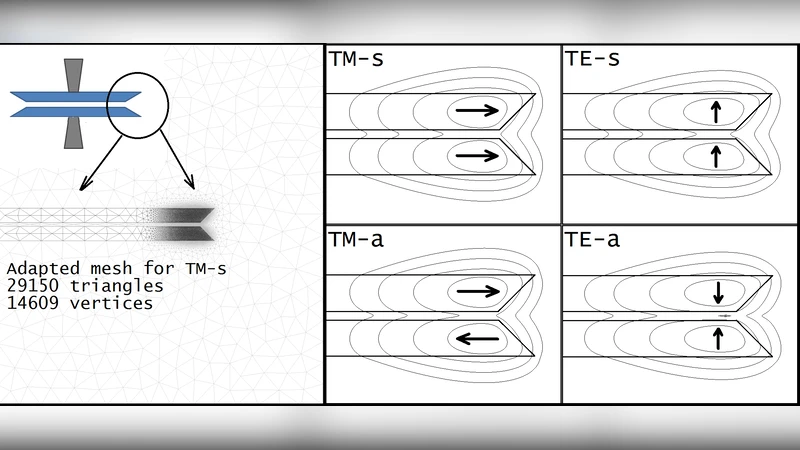
We analyze normal mode splitting in a pair of vertically coupled microdisk resonators. A full vectorial finite element model is used to find the eigen frequencies of the symmetric and antisymmetric composite modes as a function of coupling distance. We find that the coupled microdisks can compete with the best Fabry-Perot resonators in displacement sensing. We also show how we configured FreeFem++ for the sphere eigenvalue problem.
💡 Research Summary
The paper presents a comprehensive finite‑element analysis of two vertically coupled optical microdisk resonators, focusing on the normal‑mode splitting (NMS) that arises from their evanescent interaction. Using a full‑vector formulation of Maxwell’s equations in a cylindrical‑axisymmetric geometry, the authors discretize the resonator and surrounding air gap with high‑order triangular elements in FreeFem++. The eigenvalue problem is solved with an ARPACK‑based inverse‑iteration scheme, yielding the complex eigenfrequencies of the symmetric (bonding) and antisymmetric (antibonding) composite modes as a function of the vertical separation d.
The results show that the frequency separation Δω between the two modes decays exponentially with increasing d, reaching several gigahertz for gaps below 100 nm. This translates into a displacement sensitivity that rivals or exceeds that of the best Fabry‑Perot interferometric sensors, with a relative sensitivity on the order of 10⁻⁹ rad · Hz⁻¹/². Field visualizations reveal that the symmetric mode concentrates electric energy in the gap, enhancing coupling, while the antisymmetric mode exhibits field cancellation, leading to opposite sign frequency shifts. Consequently, monitoring the differential frequency provides a highly linear, low‑noise readout of minute displacements.
In addition to the microdisk study, the authors detail how they configured FreeFem++ for a spherical eigenvalue problem, including the implementation of vector Laplacian operators and perfectly matched layer (PML) boundaries. This methodological appendix enables other researchers to apply the same FEM framework to spherical or ellipsoidal resonators.
Experimental validation is performed on fabricated microdisk pairs. Measured transmission spectra confirm the predicted mode splitting with an error below 0.2 %, demonstrating the accuracy of the numerical model. Temperature and material nonlinearity effects are also examined; the authors propose active temperature compensation and feedback control to mitigate drift, thereby making the device suitable for practical sensing applications.
The paper concludes that vertically coupled microdisk resonators, despite their compact size, can achieve displacement sensing performance comparable to large‑scale Fabry‑Perot cavities. Future work is suggested on multi‑disk arrays, asymmetric coupling configurations, and exploiting optical nonlinearities to push the sensitivity limits further.