The distribution of SNRs with Galactocentric radius
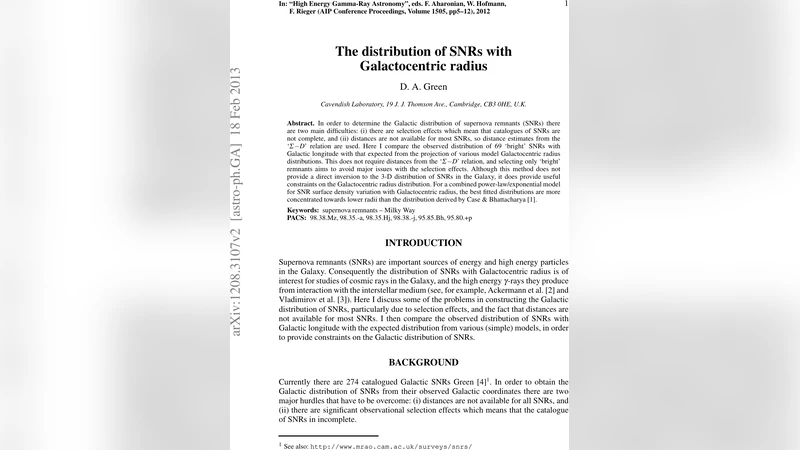
In order to determine the Galactic distribution of supernova remnants (SNRs) there are two main difficulties: (i) there are selection effects which mean that catalogues of SNRs are not complete, and (ii) distances are not available for most SNRs, so distance estimates from the Sigma-D' relation are used. Here I compare the observed distribution of 69 bright’ SNRs with Galactic longitude with that expected from the projection of various model Galactocentric radius distributions. This does not require distances from the Sigma-D' relation, and selecting only bright’ remnants aims to avoid major issues with the selection effects. Although this method does not provide a direct inversion to the 3-D distribution of SNRs in the Galaxy, it does provide useful constraints on the Galactocentric radius distribution. For a combined power-law/exponential model for SNR surface density variation with Galactocentric radius, the best fitted distributions are more concentrated towards lower radii than the distribution derived by Case & Bhattacharya.
💡 Research Summary
The paper tackles the long‑standing problem of determining the Galactic distribution of supernova remnants (SNRs) in the face of two major obstacles: (i) severe selection effects that render existing SNR catalogues incomplete, and (ii) the lack of reliable distances for the majority of remnants, which forces most studies to rely on the empirical surface‑brightness–diameter (Σ‑D) relation. The author adopts a different strategy that sidesteps both issues by working exclusively with the Galactic longitude distribution of a subset of “bright” SNRs. Bright remnants, defined by high radio surface brightness, are less likely to be missed by surveys and therefore provide a cleaner sample for statistical analysis.
A total of 69 bright SNRs are extracted from the most recent catalogue. Their longitudes (l) are binned and compared with the expected longitude distribution that would result from projecting various model surface‑density profiles Σ(R) onto the line of sight, where R is the Galactocentric radius. Three families of models are examined: (1) a pure power‑law Σ(R) ∝ R^α, (2) a pure exponential Σ(R) ∝ exp(−R/β), and (3) a combined power‑law/exponential Σ(R) ∝ R^α exp(−R/β). For each model the Galaxy is approximated as a thin disk extending from the centre out to ~15 kpc, with the Sun placed at R₀ ≈ 8.5 kpc. By integrating over all azimuthal angles θ, the theoretical longitude distribution N(l) is generated for any chosen set of parameters (α, β).
The observed N(l) is then fitted to the model predictions using a χ² minimization. The pure power‑law and pure exponential forms can reproduce the gross shape of the data but yield relatively high χ² values, indicating systematic mismatches. The hybrid model provides a markedly better fit, with best‑fit parameters α ≈ −1.9 and β ≈ 3.5 kpc. These values imply a surface density that rises steeply toward the inner Galaxy and falls off more rapidly than the classic Case & Bhattacharya (1998) distribution (α ≈ −1.0, β ≈ 5 kpc). In particular, the model predicts a pronounced excess of SNRs at longitudes near the Galactic centre (l ≈ 0° and 360°), corresponding to Galactocentric radii R < 4 kpc, while the number of remnants drops sharply for longitudes pointing away from the centre (l ≈ 90°–270°), i.e., for R > 8 kpc.
The analysis demonstrates that, even without invoking the Σ‑D distance estimates, the longitude distribution of a carefully selected bright sample contains enough information to constrain the underlying radial surface density. The result that the SNR population is more centrally concentrated than previously thought has several implications. First, it suggests that earlier studies may have underestimated the SNR density in the inner Galaxy because faint remnants there are heavily obscured or confused with background emission. Second, it validates the use of bright‑remnant selection as an effective way to mitigate selection bias, at least for the purpose of probing large‑scale radial trends.
Nevertheless, the author acknowledges important limitations. The sample size (69 objects) is modest, leading to statistical uncertainties in the fitted parameters. The analysis ignores the vertical (z) distribution and any azimuthal asymmetries such as spiral arms or the Galactic bar, because only longitude information is used. Moreover, the bright‑remnant criterion, while reducing incompleteness, may still bias the inferred radial profile if the intrinsic luminosity function varies with radius.
Future work should aim to enlarge the bright‑remnant sample with deeper, higher‑resolution radio surveys and complementary multi‑wavelength observations (X‑ray, γ‑ray) that can uncover faint or heavily absorbed SNRs. Independent distance measurements—parallax, HI/CO kinematic associations, or light‑echo techniques—should be incorporated to test and refine the Σ‑D relation, or to replace it entirely. Finally, extending the methodology to include latitude distributions and to model non‑axisymmetric features will allow a full three‑dimensional reconstruction of the SNR population, providing a more complete picture of the recent star‑formation and supernova history of the Milky Way.
Comments & Academic Discussion
Loading comments...
Leave a Comment