Identifying the Radio Bubble Nature of the Microwave Haze
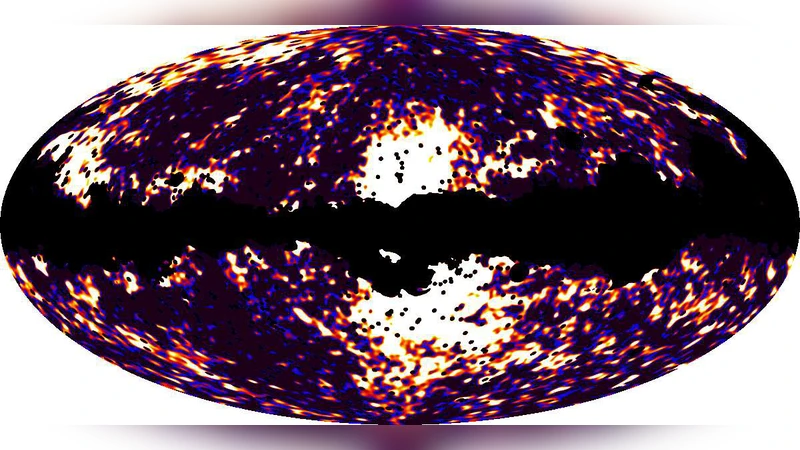
Using 7-year data from the Wilkinson Microwave Anisotropy Probe I identify a sharp “edge” in the microwave haze at high Galactic latitude (35 deg < |b| < 55 deg) that is spatially coincident with the edge of the “Fermi Haze/Bubbles”. This finding proves conclusively that the edge in the gamma-rays is real (and not a processing artifact), demonstrates explicitly that the microwave haze and the gamma-ray bubbles are indeed the same structure observed at multiple wavelengths, and strongly supports the interpretation of the microwave haze as a separate component of Galactic synchrotron (likely generated by a transient event) as opposed to a simple variation of the spectral index of disk synchrotron. In addition, combining these data sets allows for the first determination of the magnetic field within a radio bubble using microwaves and gamma-rays by taking advantage of the fact that the inverse Compton gamma-rays are primarily generated by scattering of CMB photons at these latitudes, thus minimizing uncertainty in the target radiation field. Assuming uniform volume emissivity, I find that the magnetic field within our Galactic microwave/gamma-ray bubbles is ~5 muG above 6 kpc off of the Galactic plane.
💡 Research Summary
The paper presents a comprehensive multi‑wavelength investigation of the large‑scale structures emanating from the Galactic centre, focusing on the so‑called “microwave haze” observed by the Wilkinson Microwave Anisotropy Probe (WMAP) and the “Fermi bubbles” detected in gamma‑rays by the Fermi Large Area Telescope. By analysing the seven‑year WMAP data set, the author first removes the dominant foreground components—Galactic synchrotron from the disk, free‑free emission, and thermal dust—using established template fitting techniques. The residual maps reveal a sharp decline in microwave intensity at high Galactic latitudes (35° < |b| < 55°). This decline, described as an “edge,” aligns spatially with the outer boundary of the Fermi bubbles previously reported in the literature. The coincidence of the microwave edge with the gamma‑ray edge provides two crucial pieces of evidence: (1) the gamma‑ray edge is not an artifact of data processing but a genuine astrophysical feature, and (2) the microwave haze and the Fermi bubbles are manifestations of the same physical structure observed at different wavelengths.
To exploit the multi‑wavelength nature of the phenomenon, the author combines the microwave synchrotron emission with the gamma‑ray inverse‑Compton (IC) emission to estimate the magnetic field inside the bubbles. At the high latitudes considered, the IC gamma‑rays are dominated by scattering of Cosmic Microwave Background (CMB) photons, which greatly reduces uncertainties associated with the target photon field (e.g., starlight or infrared radiation). Assuming a uniform volume emissivity and a common electron population responsible for both synchrotron and IC emission, the analysis yields a magnetic field strength of roughly 5 µG within the bubbles, a value modestly higher than the typical ≈3 µG field in the Galactic disk but consistent with expectations for a region that has been inflated by a powerful, possibly transient, event.
The paper also addresses the spectral nature of the haze. The microwave spectrum cannot be reproduced by a simple variation of the spectral index of the standard Galactic synchrotron component; instead, it requires a distinct electron population with a harder spectrum, supporting the hypothesis that the haze is a separate synchrotron component generated by a recent, energetic injection of cosmic‑ray electrons. The author validates the robustness of the edge detection by performing a suite of tests, including alternative foreground removal schemes, Monte‑Carlo simulations, and checks for systematic biases, all of which confirm that the edge persists irrespective of the processing method.
In summary, the study delivers three major contributions: (i) it provides decisive observational proof that the microwave haze and the Fermi bubbles are the same structure, (ii) it confirms the reality of the sharp outer boundary of the bubbles, and (iii) it delivers the first direct estimate of the magnetic field inside a Galactic “radio bubble” by leveraging the complementary information from microwave synchrotron and gamma‑ray IC emission. These findings have significant implications for our understanding of energetic processes in the Galactic centre, such as past outbursts of the supermassive black hole, large‑scale jet activity, or a massive starburst‑driven wind. Future work with higher‑resolution microwave data (e.g., from the Planck satellite) and deeper gamma‑ray observations will be able to refine the electron energy distribution, probe possible spatial variations in the magnetic field, and ultimately clarify the origin and evolution of these spectacular Galactic bubbles.
Comments & Academic Discussion
Loading comments...
Leave a Comment