Heliospheric Transport of Neutron-Decay Protons
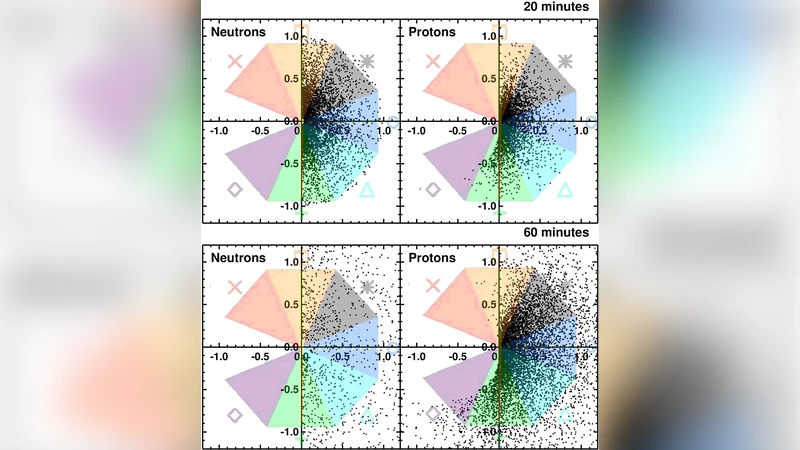
We report on new simulations of the transport of energetic protons originating from the decay of energetic neutrons produced in solar flares. Because the neutrons are fast-moving but insensitive to the solar wind magnetic field, the decay protons are produced over a wide region of space, and they should be detectable by current instruments over a broad range of longitudes for many hours after a sufficiently large gamma-ray flare. Spacecraft closer to the Sun are expected to see orders-of magnitude higher intensities than those at the Earth-Sun distance. The current solar cycle should present an excellent opportunity to observe neutron-decay protons with multiple spacecraft over different heliographic longitudes and distances from the Sun.
💡 Research Summary
The paper presents a comprehensive numerical study of how energetic protons, produced by the β‑decay of fast neutrons generated in solar flares, propagate throughout the heliosphere. Because neutrons are electrically neutral they travel essentially unhindered by the interplanetary magnetic field, spreading over tens of solar radii before decaying. The authors employ a three‑dimensional test‑particle code that follows the trajectories of both the parent neutrons and the daughter protons in a Parker‑spiral solar‑wind magnetic field. The initial neutron spectrum is taken to be a power‑law (∼E⁻⁴) consistent with gamma‑ray observations of large flares, and the neutron half‑life (≈886 s) is explicitly accounted for.
The simulations reveal that neutron‑decay protons are generated over a broad spatial volume, leading to a nearly isotropic distribution of proton fluxes at any given heliocentric distance. Immediately after a flare, the proton intensity rises sharply as the bulk of the neutrons decay at distances of roughly 10–30 R☉. The time profile then decays over several hours, governed primarily by the neutron decay timescale and the subsequent diffusive transport of the protons along the heliospheric magnetic field.
A key result is the strong radial dependence of the observed flux. At 0.3 AU (the orbit of Solar Orbiter) the proton intensity can be 10 to 100 times larger than at 1 AU, while at 0.1 AU (Parker Solar Probe) the enhancement can reach two orders of magnitude. This scaling arises because the decay region is much closer to the Sun than the observer, so the particle density falls off roughly as 1/r² before magnetic focusing effects become significant.
Longitudinally, the model predicts detectable proton fluxes over a wide range of heliographic longitudes, including the far side of the Sun relative to the flare site. Even at longitudes 180° away, the simulated flux remains above the detection thresholds of current energetic particle instruments such as ACE/EPAM, STEREO/SEPT, and the Solar Orbiter Energetic Particle Detector. Consequently, a single large gamma‑ray flare should produce a multi‑hour, multi‑spacecraft signature that can be used to probe the structure of the interplanetary magnetic field.
The authors argue that the ongoing solar cycle 25, which is expected to deliver several high‑energy gamma‑ray flares, offers an unprecedented opportunity to test these predictions. By coordinating observations from spacecraft at different heliocentric distances and longitudes, it will be possible to reconstruct the three‑dimensional decay region, quantify magnetic field asymmetries, and refine diffusion coefficients used in space‑weather models.
In summary, the study demonstrates that neutron‑decay protons constitute a robust, widely observable tracer of flare‑accelerated particles. Their detection across the heliosphere can provide new constraints on particle acceleration, transport, and the large‑scale geometry of the solar‑wind magnetic field, thereby enriching our understanding of solar energetic particle events and improving predictive capabilities for space‑weather forecasting.
Comments & Academic Discussion
Loading comments...
Leave a Comment