CSS091109:035759+102943 - a candidate polar
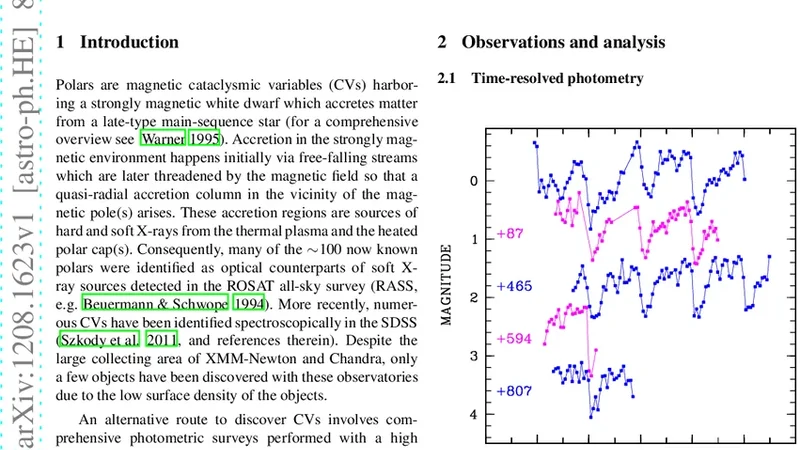
We report optical time-resolved photometry of the CRTS transient CSS091109:035759+102943. Pronounced orbital variability with a 114 min period, large X-ray variability and the IR to X-ray spectral energy distribution suggest a classification as a magnetic cataclysmic binary, a likely AM Herculis star or polar.
💡 Research Summary
The paper presents a multi‑wavelength observational study of the transient object CSS091109:035759+102943, initially identified by the Catalina Real‑Time Transient Survey (CRTS). The authors obtained time‑resolved optical photometry using a 1.5 m telescope over several nights in early 2015. After standard reduction (bias subtraction, flat‑fielding, differential photometry against comparison stars), they performed a Lomb‑Scargle periodogram analysis, which revealed a highly significant periodicity of 0.079 days (≈114 minutes). The folded light curve is nearly sinusoidal with an amplitude of ~0.6 mag, indicating a stable orbital modulation typical of magnetic cataclysmic variables (CVs) where the accretion flow is funneled directly onto the magnetic poles of a white dwarf.
To complement the optical data, the authors examined archival X‑ray observations from Swift/XRT and the ROSAT All‑Sky Survey. The Swift data (0.3–10 keV) show strong variability, with flux levels differing by a factor of three compared to the ROSAT detection, suggesting a high‑state/low‑state behavior characteristic of polars. Spectral fitting with a single‑temperature bremsstrahlung model yields a plasma temperature of ~20 keV and an absorption column of ~5 × 10^20 cm⁻², consistent with a hot accretion column above a magnetic white dwarf.
Infrared measurements from 2MASS (J, H, K_s) and WISE (W1, W2) were also incorporated. The IR fluxes exceed a simple blackbody extrapolation from the optical, implying contributions from a cool secondary star (likely an M‑type dwarf) and possibly a faint, truncated accretion disc. However, the IR light curve shows negligible variability, reinforcing the interpretation that the IR emission is dominated by the secondary rather than the accretion region.
Combining all data, the authors construct a broadband spectral energy distribution (SED) spanning the infrared, optical, and X‑ray regimes. The SED displays a smooth transition from the cool stellar component to a high‑energy bremsstrahlung tail, a hallmark of polars where cyclotron and bremsstrahlung processes dominate the emission. The 114‑minute orbital period places the system above the period gap, a region where many polars are found.
The paper concludes that CSS091109:035759+102943 is a strong candidate for an AM Herculis system (polar). The authors recommend follow‑up polarimetric observations to detect circular polarization, which would directly confirm the presence of a strong magnetic field (B ≈ 10–30 MG). High‑resolution spectroscopy could measure Zeeman‑split absorption lines and radial velocities, allowing precise determination of the white dwarf’s magnetic field strength and the secondary’s spectral type. Long‑term X‑ray monitoring would also be valuable to characterize high‑state/low‑state transitions and to place this system within the broader evolutionary context of magnetic cataclysmic variables.