The Elephant Trunk Nebula and the Trumpler 37 cluster: Contribution of triggered star formation to the total population of an HII region
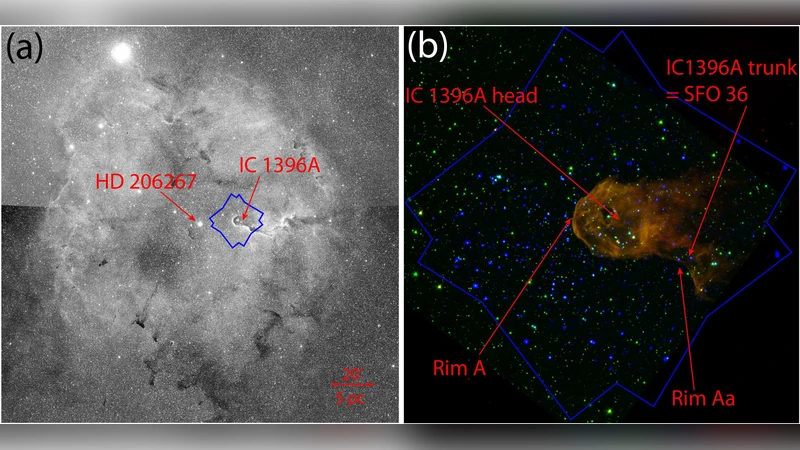
Rich young stellar clusters produce HII regions whose expansion into the nearby molecular cloud is thought to trigger the formation of new stars. However, the importance of this mode of star formation is uncertain. This investigation seeks to quantify triggered star formation (TSF) in IC 1396A (a.k.a., the Elephant Trunk Nebula), a bright rimmed cloud (BRC) on the periphery of the nearby giant HII region IC 1396 produced by the Trumpler 37 cluster. X-ray selection of young stars from Chandra X-ray Observatory data is combined with existing optical and infrared surveys to give a more complete census of the TSF population. Over 250 young stars in and around IC 1396A are identified; this doubles the previously known population. A spatio-temporal gradient of stars from the IC 1396A cloud toward the primary ionizing star HD 206267 is found. We argue that the TSF mechanism in IC 1396A is the radiation-driven implosion process persisting over several million years. Analysis of the X-ray luminosity and initial mass functions indicates that >140 stars down to 0.1 Msun were formed by TSF. Considering other BRCs in the IC 1396 HII region, we estimate the TSF contribution for the entire HII region exceeds 14-25% today, and may be higher over the lifetime of the HII region. Such triggering on the periphery of HII regions may be a significant mode of star formation in the Galaxy.
💡 Research Summary
The paper investigates the contribution of triggered star formation (TSF) to the stellar population of the IC 1396 H II region, focusing on the bright‑rimmed cloud IC 1396A (the “Elephant Trunk Nebula”) that lies on the periphery of the massive H II region ionized by the Trumpler 37 cluster. The authors combine deep Chandra X‑ray observations with existing optical (UBV), near‑infrared (2MASS), and mid‑infrared (Spitzer IRAC/MIPS) surveys to produce a more complete census of young stellar objects (YSOs) than previous studies that relied solely on photometric selection.
From the X‑ray data they identify 250+ YSOs in and around IC 1396A, roughly doubling the number known from earlier work. X‑ray emission is a robust indicator of pre‑main‑sequence activity, especially for low‑mass stars that may be heavily extincted in optical/IR bands; thus the combined catalog includes many faint, low‑mass members down to ~0.1 M⊙ that were previously missed.
Spatial analysis reveals a clear age gradient: stars embedded deep in the cloud have median ages of ~4 Myr, those near the bright rim are younger (~2–3 Myr), and the population closest to the primary ionizing source HD 206267 (an O6 V star) shows ages ≤1 Myr. This systematic progression is consistent with the radiation‑driven implosion (RDI) scenario, in which intense UV radiation from the massive star compresses the cloud surface, drives a shock into the cloud, and triggers successive generations of star formation as the ionization front advances.
The authors construct an X‑ray‑based initial mass function (IMF) using the L_X–mass relation for pre‑main‑sequence stars. The IMF follows a Salpeter‑like slope at higher masses but shows a modest excess in the 0.1–0.5 M⊙ range, indicating that the triggered component efficiently produces low‑mass stars. By separating stars that are spatially and temporally associated with the advancing ionization front, they estimate that at least 140 stars (≈55 % of the identified YSO sample) were formed via RDI‑driven TSF.
Extending the analysis to the entire IC 1396 complex, which contains several other bright‑rimmed clouds (BRC 36, BRC 37, etc.), the authors use published YSO counts for those regions together with their own results to infer that TSF presently accounts for 14–25 % of the total stellar content of the H II region. Because the RDI process can operate over several Myr, the cumulative contribution of TSF over the lifetime of the region could be substantially higher.
In summary, the study demonstrates that (1) X‑ray selection dramatically improves the completeness of YSO inventories, especially for low‑mass, highly extincted members; (2) IC 1396A provides a clear, multi‑Myr example of sustained RDI‑driven star formation, producing at least 140 new stars down to the sub‑solar regime; and (3) triggered star formation on the peripheries of H II regions may represent a non‑negligible, perhaps dominant, mode of star formation in the Galaxy. These findings have important implications for models of star formation efficiency, the evolution of molecular clouds under feedback, and the overall stellar budget of galactic disks.