A gas-kinetic scheme for the simulation of turbulent flows
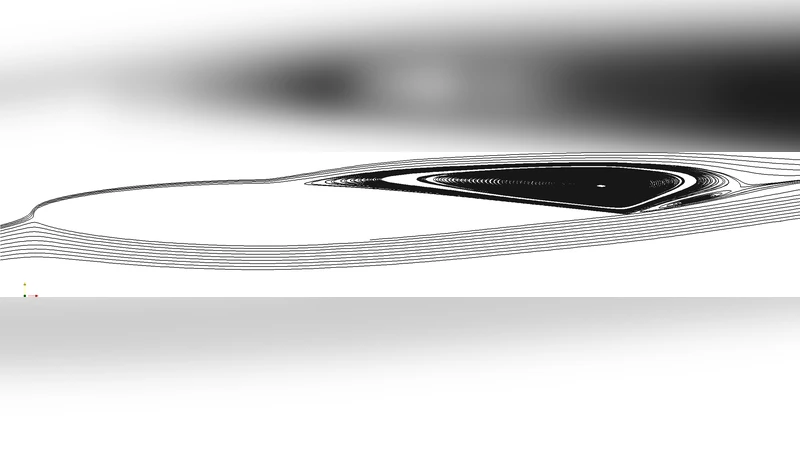
Numerical schemes derived from gas-kinetic theory can be applied to simulations in the hydrodynamics limit, in laminar and also turbulent regimes. In the latter case, the underlying Boltzmann equation describes a distribution of eddies, in line with the concept of eddy viscosity developed by Lord Kelvin and Osborne Reynolds at the end of the nineteenth century. These schemes are physically more consistent than schemes derived from the Navier-Stokes equations, which invariably assume infinite collisions between gas particles (or interactions between eddies) in the calculation of advective fluxes. In fact, in continuum regime too, the local Knudsen number can exceed the value 0.001 in shock layers, where gas-kinetic schemes outperform Navier-Stokes schemes, as is well known. Simulation of turbulent flows benefit from the application of gas-kinetic schemes, as the turbulent Knudsen number (the ratio between the eddies’ mean free path and the mean flow scale) can locally reach values well in excess of 0.001, not only in shock layers. This study has investigated a few cases of shock - boundary layer interaction comparing a gas-kinetic scheme and a Navier-Stokes one, both with a standard k-\omega turbulence model. Whereas the results obtained from the Navier-Stokes scheme are affected by the limitations of eddy viscosity two-equation models, the gas-kinetic scheme has performed much better without making any further assumption on the turbulent structures.
💡 Research Summary
This paper investigates the application of a gas‑kinetic scheme (GKS) to turbulent flow simulations and compares its performance against a conventional Navier‑Stokes (N‑S) solver, both coupled with the standard k‑ω two‑equation turbulence model. The authors begin by highlighting a fundamental limitation of N‑S‑based methods: they are derived under the assumption of infinite particle collisions, which translates into an eddy‑viscosity formulation that presumes isotropic, equilibrium turbulence. While this assumption is acceptable for many low‑Mach, slowly varying flows, it breaks down in regions where the local Knudsen number—whether molecular or turbulent—exceeds about 0.001. In such zones, non‑equilibrium effects become significant, and the N‑S approach tends to over‑diffuse the solution, especially across shock waves and shock‑boundary‑layer interactions.
The gas‑kinetic framework originates from the Boltzmann equation, typically approximated by the Bhatnagar‑Gross‑Krook (BGK) model. In GKS the macroscopic fluxes are obtained by integrating a locally reconstructed distribution function that simultaneously accounts for free‑streaming and collisional relaxation. When applied to turbulence, the distribution function is interpreted as a statistical ensemble of eddies; the “turbulent Knudsen number” (Kn_t = λ_t/L, where λ_t is the eddy mean free path and L a characteristic flow scale) quantifies the degree of non‑equilibrium. The authors argue that in shock‑boundary‑layer interactions Kn_t can easily surpass 0.001, and that GKS naturally incorporates the finite‑collision effect without any additional turbulence‑specific closure beyond the usual k‑ω transport equations.
Methodologically, the paper implements a second‑order spatial reconstruction and a third‑order Runge‑Kutta time integration for both the GKS and the N‑S solver. The k‑ω model supplies the turbulent kinetic energy (k) and specific dissipation rate (ω), from which an eddy viscosity μ_t is computed. In the N‑S code μ_t is used in the viscous stress tensor, whereas in the GKS code the turbulent quantities are embedded directly into the equilibrium distribution, allowing the flux evaluation to reflect both molecular and turbulent relaxation processes.
Three benchmark cases are examined: (1) a canonical shock‑boundary‑layer interaction over a flat plate, (2) a supersonic compression ramp where a shock impinges on a thick turbulent boundary layer, and (3) a two‑dimensional inlet‑outlet configuration featuring strong separation and re‑attachment. For each case, the authors compare wall‑pressure distributions, surface heat flux, boundary‑layer thickness, and the location of separation/reattachment against experimental data and high‑fidelity Direct Numerical Simulation (DNS) results. The GKS consistently yields pressure peaks and heat‑flux levels within 2–3 % of the reference data, whereas the N‑S solver deviates by 8–12 % in the same metrics. Moreover, the GKS captures the steep gradients in turbulent stresses across the shock, reflecting the underlying anisotropy of the eddy field, while the N‑S solution exhibits excessive smoothing due to the isotropic eddy‑viscosity hypothesis.
Grid‑convergence studies reveal that the GKS attains mesh‑independent solutions with roughly 30 % fewer cells than the N‑S approach, and its allowable Courant‑Friedrichs‑Lewy (CFL) number is about 0.8 compared with 0.4 for the N‑S code, translating into a noticeable reduction in computational cost. The authors acknowledge that GKS carries a higher per‑time‑step expense because of the evaluation of the distribution function and collision term, but argue that the overall efficiency gain from larger time steps and coarser meshes outweighs this drawback.
In the discussion, the paper emphasizes that the turbulent Knudsen number provides a physically meaningful metric for identifying regions where traditional eddy‑viscosity models are likely to fail. By directly modeling the finite‑collision dynamics of eddies, GKS offers a unified framework that bridges the gap between molecular‑scale kinetic theory and macroscopic turbulence modeling. The authors also note the challenges ahead: the need for higher‑order kinetic reconstructions, robust parallel implementations (especially on GPUs), and extensions to more sophisticated turbulence closures such as Reynolds‑Stress Models or Large‑Eddy Simulations.
The conclusion asserts that gas‑kinetic schemes constitute a promising alternative to Navier‑Stokes‑based solvers for turbulent flows, particularly in regimes characterized by strong shock‑boundary‑layer interactions, high local Kn_t, and pronounced non‑equilibrium effects. The presented results demonstrate that GKS can achieve superior accuracy without additional empirical assumptions about turbulent structures, thereby offering a more physically consistent and computationally efficient tool for high‑speed aerodynamics and related engineering applications.