Strong Gravitational Lensing of Quasi-Kerr Compact Object with Arbitrary Quadrupole Moments
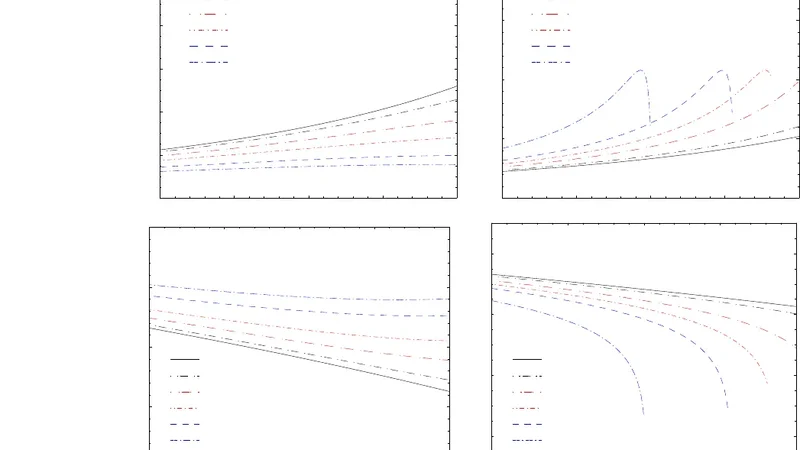
We study the strong gravitational lensing on the equatorial plane of a quasi-Kerr compact object with arbitrary quadrupole moments which can be used to model the super-massive central object of the galaxy. We find that, when the quadrupolar correction parameter $\xi$ takes the positive (negative) value, the photon-sphere radius $r_{ps}$, the minimum impact parameter $u_{ps}$, the coefficient $\bar{b}$, the relative magnitudes $r_m$ and the angular position of the relativistic images $\theta_{\infty}$ are larger (smaller) than the results obtained in the Kerr black hole, but the coefficient $\bar{a}$, the deflection angle $\alpha(\theta)$ and the angular separation $s$ are smaller (larger) than that in the Kerr black hole. These features may offer a way to probe special properties for some rotating compact objects by the astronomical instruments in the future.
💡 Research Summary
The paper investigates strong gravitational lensing by a rotating compact object described by the quasi‑Kerr metric, which extends the standard Kerr solution by introducing an arbitrary quadrupole‑moment correction parameter ξ. While the Kerr metric is fully determined by the mass M and spin a, the quasi‑Kerr spacetime adds a term of order (a^{2}) that modifies the mass distribution’s quadrupole moment, allowing the model to represent objects whose internal structure deviates from the ideal Kerr black hole (e.g., super‑massive compact objects with non‑standard matter distributions).
The authors focus on light propagation in the equatorial plane (θ = π/2) and adopt Bozza’s strong‑deflection‑limit (SDL) formalism. In this approach the deflection angle for a light ray with impact parameter u near the photon sphere can be written as
\