A Flux Rope Network and Particle Acceleration in Three Dimensional Relativistic Magnetic Reconnection
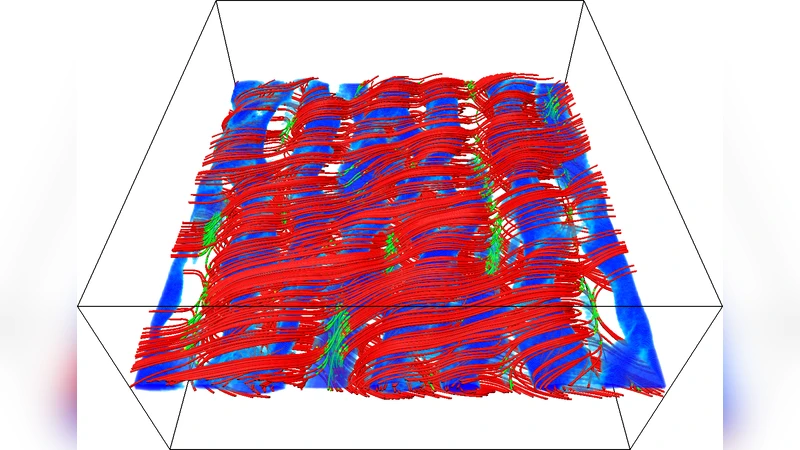
We investigate guide-field magnetic reconnection and particle acceleration in relativistic pair plasmas with three-dimensional particle-in-cell (PIC) simulations of a kinetic-scale current sheet in a periodic geometry at low magnetizations. The tearing instability is the dominant mode in the current sheet for all guide field strengths, while the linear kink mode is less important even without guide field. Oblique modes seem to be suppressed entirely. In its nonlinear evolution, the reconnection layer develops a network of interconnected and interacting magnetic flux ropes. As smaller flux ropes merge into larger ones, the reconnection layer evolves toward a three-dimensional, disordered state in which the resulting flux rope segments contain magnetic substructure on plasma skin depth scales. Embedded in the flux ropes, we detect spatially and temporally intermittent sites of dissipation reflected in peaks in the parallel electric field. Magnetic dissipation and particle acceleration persist until the end of the simulations, with simulations with higher magnetization and lower guide field strength exhibiting greater and faster energy conversion and particle energization. At the end of our largest simulation, the particle energy spectrum attains a tail extending to high Lorentz factors that is best modeled with a combination of two additional thermal components. We confirm that the primary energization mechanism is acceleration by the electric field in the X-line region. We discuss the implications of our results for macroscopic reconnection sites, and which of our results may be expected to hold in systems with higher magnetizations.
💡 Research Summary
This paper presents a comprehensive three‑dimensional particle‑in‑cell (PIC) investigation of relativistic magnetic reconnection in electron‑positron pair plasmas with a guide magnetic field. The authors focus on low magnetization regimes (σ≈0.1–1) and explore a range of guide‑field strengths (B_g/B_0 = 0, 0.1, 0.5, 1) using a periodic current‑sheet configuration that resolves kinetic scales down to the plasma skin depth. In the linear phase, the tearing instability dominates across all guide‑field values, growing fastest and dictating the initial breakup of the sheet. The kink mode, while present in the absence of a guide field, remains subdominant, and oblique modes are essentially suppressed. This confirms that even in fully three‑dimensional geometry the classic two‑dimensional tearing picture remains the primary driver of reconnection onset.
As the system enters the nonlinear stage, the tearing‑generated magnetic islands evolve into a tangled network of flux ropes. Small ropes continuously merge into larger structures, producing a disordered three‑dimensional state where individual rope segments exhibit sub‑skin‑depth magnetic sub‑structures. The network is characterized by multiple X‑lines and O‑lines that coexist and interact, breaking the notion of a single, planar reconnection layer. Within this complex topology, the authors identify intermittent, localized regions of strong parallel electric field (E_∥) that act as “dissipation hot spots.” These sites are most intense near the original X‑line but also appear along rope intersections, providing a spatially distributed engine for particle energization.
Particle acceleration is shown to be dominated by direct acceleration in the E_∥ regions. Particles entering the X‑line are rapidly boosted by the reconnection electric field, and many subsequently undergo further energization while trapped or reflected within the flux‑rope interiors. The efficiency of this process depends strongly on the guide‑field amplitude and the magnetization: simulations with higher σ and weaker guide fields produce larger E_∥ peaks, faster conversion of magnetic energy into particle kinetic energy, and a more pronounced high‑energy tail in the particle distribution.
The energy spectra evolve from an initial thermal Maxwellian to a composite distribution that is best fitted by the sum of three thermal components: the original background plasma and two hotter “populations” generated during reconnection. In the largest run (σ≈1, B_g/B_0=0.1) the high‑energy component extends to Lorentz factors γ≫10, yet it does not form a pure power‑law; instead, the spectrum reflects multiple heating episodes associated with successive rope mergers and localized E_∥ bursts. This multi‑thermal outcome suggests that reconnection in low‑σ, three‑dimensional settings may not always produce the classic non‑thermal power‑law tails often invoked for astrophysical flares, but can still generate a substantial population of ultra‑relativistic particles.
The authors discuss the broader astrophysical implications of their findings. The persistence of tearing‑driven reconnection and the formation of a flux‑rope network are expected to be robust even at higher magnetizations typical of pulsar winds, magnetar magnetospheres, or relativistic jets, where guide fields are often weak. The intermittent E_∥ structures could explain rapid variability observed in high‑energy emission, while the multi‑thermal particle spectra may be relevant for interpreting broadband radiation that shows both thermal and non‑thermal components. The study also highlights that the primary acceleration mechanism—direct electric‑field acceleration at X‑lines—remains valid in three dimensions, but the surrounding flux‑rope turbulence provides additional pathways for particle scattering and secondary energization.
In summary, this work demonstrates that relativistic reconnection in three dimensions naturally evolves into a complex, rope‑dominated system that continues to convert magnetic energy efficiently into particle kinetic energy. The balance between guide‑field strength and magnetization controls the rate of energy conversion, the intensity of parallel electric fields, and the ultimate shape of the particle energy distribution. These results provide a valuable bridge between kinetic PIC simulations and macroscopic models of high‑energy astrophysical phenomena, suggesting that many of the qualitative features observed here—flux‑rope networks, intermittent dissipation, and multi‑thermal particle populations—should persist in more extreme, higher‑σ environments.