Discovery of a Kiloparsec Scale X-ray/Radio Jet in the z=4.72 Quasar GB 1428+4217
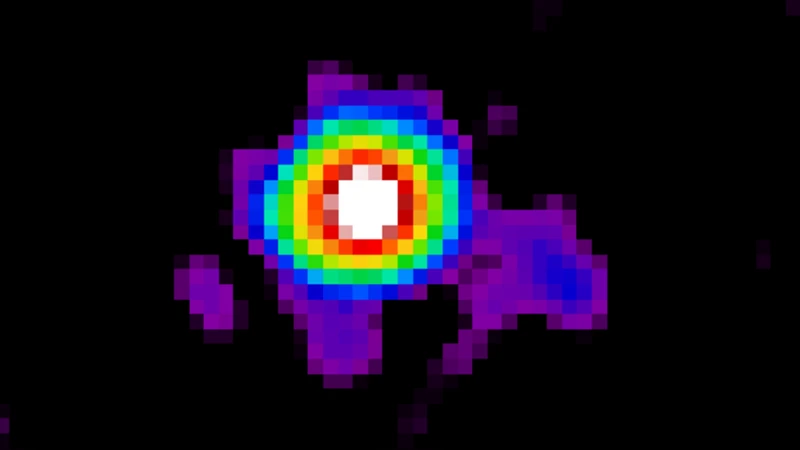
We report the discovery of a one-sided 3.6" (24 kpc, projected) long jet in the high-redshift, z=4.72, quasar GB 1428+4217 in new Chandra X-ray and VLA radio observations. This is the highest redshift kiloparsec-scale X-ray/radio jet known. Analysis of archival VLBI 2.3 and 8.6 GHz data reveal a faint one-sided jet extending out to ~200 parsecs and aligned to within ~30 deg of the Chandra/VLA emission. The 3.6" distant knot is not detected in an archival HST image, and its broad-band spectral energy distribution is consistent with an origin from inverse Compton scattering of cosmic microwave background photons for the X-rays. Assuming also equipartition between the radiating particles and magnetic field, the implied jet Lorentz factor is ~5. This is similar to the other two known z ~ 4 kpc-scale X-ray jet cases and smaller than typically inferred in lower-redshift cases. Although there are still but a few such very high-redshift quasar X-ray jets known, for an inverse Compton origin, the present data suggest that they are less relativistic on large-scales than their lower-redshift counterparts.
💡 Research Summary
The authors present the discovery of a kiloparsec‑scale jet associated with the high‑redshift quasar GB 1428+4217 (z = 4.72) using new Chandra X‑ray and VLA radio observations. The jet appears as a one‑sided knot located 3.6 arcseconds (projected ≈ 24 kpc) from the core. In the X‑ray band (0.5–7 keV) the knot yields ≈ 20 counts, corresponding to a flux of ~1.5 × 10⁻¹⁴ erg cm⁻² s⁻¹, while the radio counterpart is detected at 1.4 GHz (≈ 1.2 mJy) and 4.9 GHz (≈ 0.6 mJy) with a spectral index α_r ≈ 0.8. No optical counterpart is seen in archival HST WFPC2 F814W imaging, setting a 3σ limit of AB ≈ 26.5 mag.
Reanalysis of archival VLBI data at 2.3 and 8.6 GHz reveals a faint, one‑sided parsec‑scale jet extending to ∼200 pc from the nucleus. The position angle of this inner jet differs by less than 30° from the direction of the large‑scale X‑ray/radio knot, indicating that the jet maintains a broadly consistent orientation from sub‑kiloparsec to tens of kiloparsec scales.
The authors examine two possible mechanisms for the X‑ray emission: synchrotron radiation from ultra‑high‑energy electrons and inverse‑Compton scattering of cosmic microwave background (CMB) photons (IC/CMB). The synchrotron scenario would require a magnetic field B ≳ 200 µG and electrons with Lorentz factors γ ≈ 10⁷, which are inconsistent with the optical non‑detection and the observed radio‑to‑X‑ray flux ratio. In contrast, the IC/CMB model naturally accounts for the data because the CMB energy density at z = 4.72 is amplified by a factor (1 + z)⁴ ≈ 1.1 × 10³ relative to the local Universe. Assuming equipartition between particles and magnetic field, a magnetic field B ≈ 30 µG, a minimum electron Lorentz factor γ_min ≈ 10², and an electron energy index p ≈ 2.6 reproduce the observed spectral energy distribution.
From the equipartition analysis the jet’s bulk Lorentz factor is inferred to be Γ ≈ 5, with a viewing angle θ of roughly 20°–30°. This value is significantly lower than the Γ ≈ 10–15 typically derived for kiloparsec‑scale jets at lower redshifts (z < 2). The same low Γ is found in the only two other known z ≈ 4 X‑ray jets, suggesting that high‑redshift jets may be less relativistic on large scales, perhaps due to stronger interaction with the denser intergalactic medium of the early Universe or intrinsic differences in jet launching conditions.
The paper emphasizes that the detection of a kiloparsec‑scale X‑ray jet at z = 4.72 represents the most distant such structure known to date. It provides strong empirical support for the IC/CMB mechanism as the dominant X‑ray production process in early‑Universe jets and raises important questions about jet dynamics, deceleration, and energy transport over cosmological distances. Future high‑resolution VLBI, deeper optical/infrared imaging, and next‑generation X‑ray observatories (e.g., Athena, Lynx) will be essential to map the jet’s morphology, measure its proper motions, and refine constraints on magnetic fields and particle content, thereby advancing our understanding of jet physics in the epoch of early galaxy formation.