The magnetar candidate AX J1818.8-1559
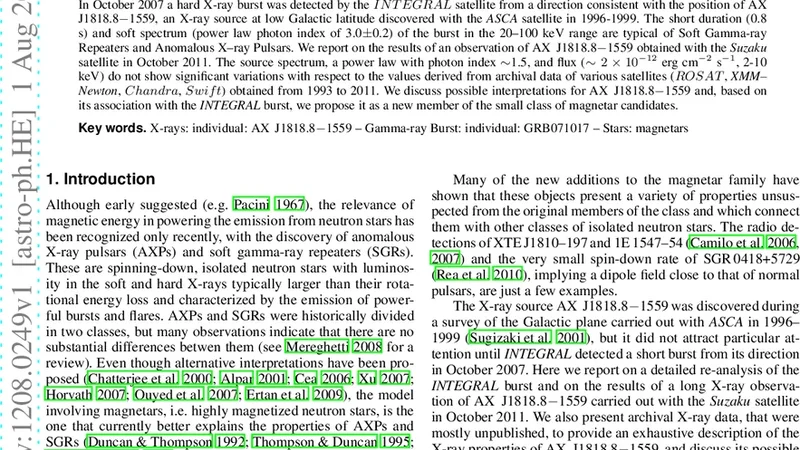
In October 2007 a hard X-ray burst was detected by the INTEGRAL satellite from a direction consistent with the position of AX J1818.8-1559, an X-ray source at low Galactic latitude discovered with the ASCA satellite in 1996-1999. The short duration (0.8 s) and soft spectrum (power law photon index of 3.0+/-0.2) of the burst in the 20-100 keV range are typical of Soft Gamma-ray Repeaters and Anomalous X-ray Pulsars. We report on the results of an observation of AX J1818.8-1559 obtained with the Suzaku satellite in October 2011. The source spectrum, a power law with photon index 1.5, and flux 2x10^{-12} erg cm^-2 s^-1 (2-10 keV), do not show significant variations with respect to the values derived from archival data of various satellites (ROSAT, XMM-Newton, Chandra, Swift) obtained from 1993 to 2011. We discuss possible interpretations for AX J1818.8-1559 and, based on its association with the INTEGRAL burst, we propose it as a new member of the small class of magnetar candidates.
💡 Research Summary
The paper investigates the nature of the X‑ray source AX J1818.8‑1559, originally discovered by ASCA in the late 1990s, in light of a hard X‑ray burst detected by INTEGRAL on 2007 October 17. The burst lasted only 0.8 s and exhibited a very soft spectrum in the 20–100 keV band, with a photon index of 3.0 ± 0.2. Such temporal and spectral characteristics are typical of the short, soft bursts emitted by Soft Gamma‑ray Repeaters (SGRs) and Anomalous X‑ray Pulsars (AXPs), the two observational manifestations of magnetars—highly magnetized neutron stars whose emission is powered by magnetic field decay rather than rotation.
To assess whether AX J1818.8‑1559 could be the persistent counterpart of the burst, the authors compiled all available X‑ray observations spanning nearly two decades: ROSAT (1993), XMM‑Newton (2003), Chandra (2007), Swift (2009) and a dedicated Suzaku observation performed in October 2011. Across all epochs the source displayed a stable 2–10 keV flux of roughly 2 × 10⁻¹² erg cm⁻² s⁻¹ and a spectrum well described by an absorbed power‑law. The Suzaku data, which have the best statistical quality, yield a photon index Γ ≈ 1.5 and an absorption column NH ≈ 4 × 10²² cm⁻². These values are consistent, within uncertainties, with those derived from the earlier missions, indicating that the source has not undergone any major spectral or flux variations over an 18‑year interval.
The combination of a soft, short burst and a persistent, relatively hard (Γ ≈ 1.5) X‑ray emitter with little long‑term variability matches the phenomenology of known magnetars. The measured NH is somewhat higher than the average Galactic value at this low latitude, suggesting that the source resides in a dense interstellar environment, a circumstance often observed for magnetars that are associated with supernova remnants or star‑forming regions.
Nevertheless, the authors acknowledge that a definitive magnetar classification requires detection of pulsations and measurement of a spin‑down rate, which would directly reveal the ultra‑strong magnetic field. No periodicity has been reported for AX J1818.8‑1559 to date, likely because the existing data lack the timing resolution or sensitivity needed to detect the typically few‑second periods of magnetars. Future observations with high‑time‑resolution instruments such as NICER, XMM‑Newton EPIC‑pn in timing mode, or even radio searches for transient pulsations could provide the missing timing information.
In summary, the paper presents four lines of evidence supporting the magnetar hypothesis for AX J1818.8‑1559: (1) positional coincidence with an INTEGRAL burst whose temporal and spectral properties are characteristic of SGR/AXP bursts; (2) a persistent X‑ray spectrum that is stable over nearly two decades; (3) a hard power‑law index typical of magnetar persistent emission; and (4) an absorption column indicating a dense surrounding medium, consistent with known magnetar environments. Based on these arguments, the authors propose AX J1818.8‑1559 as a new member of the small but growing class of magnetar candidates. They stress that further timing and multi‑wavelength observations are essential to confirm the source’s magnetic nature and to explore its role in the broader context of neutron‑star astrophysics.