The XMM-Newton survey of the Small Magellanic Cloud
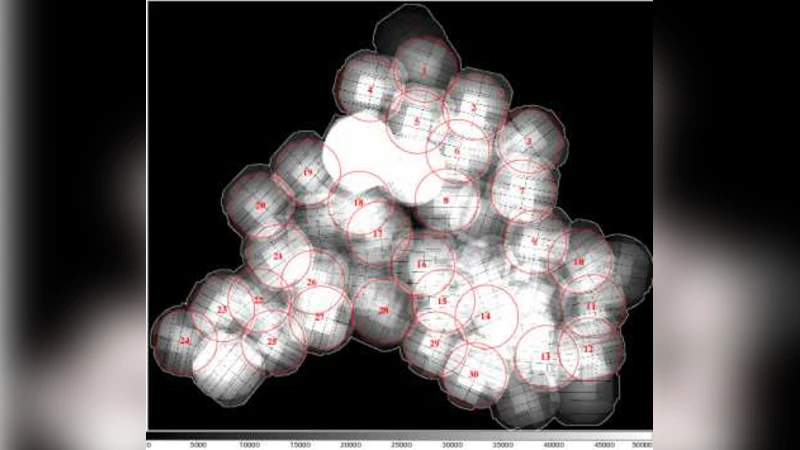
Although numerous archival XMM-Newton observations existed towards the Small Magellanic Cloud (SMC) before 2009, only a fraction of the whole galaxy was covered. Between May 2009 and March 2010 we carried out an XMM-Newton survey of the SMC, in order to obtain a complete overage of both its bar and wing. Thirty-three observations of 30 different fields with a total exposure of about ne Ms filled the missing parts. We systematically processed all available SMC data from the European Photon Imaging Camera. After rejecting observations with very high background we included 53 archival and the 33 survey observations. We produced images in five different energy bands. We applied astrometric boresight corrections using secure identifications of X-ray sources and combine all the images to produce a mosaic, which covers the main body of the SMC. We present an overview of the XMM-Newton observations, describe their analysis and summarise first results which will be presented in follow-up papers in detail. Here, we mainly focus on extended X-ray sources like supernova remnants (SNRs) and clusters of galaxies which are seen in our X-ray images. The XMM-Newton survey represents the deepest complete survey of the SMC in the 0.15-12.0 keV X-ray band. We propose three new SNRs with low surface brightness of a few 10^-14 erg s^-1 cm^-2 arcmin^-2 and large extent. Also several known remnants appear larger than previously measured from X-rays or other wavelengths extending the size distribution of SMC SNRs to larger values.
💡 Research Summary
The authors present the first complete, deep X‑ray survey of the Small Magellanic Cloud (SMC) carried out with XMM‑Newton between May 2009 and March 2010. By adding 33 new pointings that fill the gaps left by earlier observations, and by re‑processing 53 archival observations after discarding high‑background intervals, they achieve a homogeneous coverage of both the bar and the wing of the SMC. The total useful exposure amounts to roughly one megasecond, providing unprecedented sensitivity in the 0.15–12 keV band.
Data reduction follows the standard EPIC pipeline. After filtering out soft‑proton flares, images are produced in five energy bands (0.2–0.5, 0.5–1.0, 1.0–2.0, 2.0–4.5, 4.5–12 keV). Astrometric boresight corrections are derived by cross‑matching bright X‑ray sources with secure optical or radio counterparts, reducing the absolute positional uncertainty to ≤2 arcseconds. All images are then mosaicked, yielding a seamless map that spans roughly 5.5° × 5.0° and contains a uniform exposure of >30 ks across most of the field.
Source detection combines multi‑scale wavelet filtering with a maximum‑likelihood algorithm, allowing the authors to separate point‑like objects from extended emission. Extended sources with radii larger than ~30 arcseconds are examined in detail. The survey uncovers three previously unknown supernova remnants (SNRs) characterized by very low surface brightness (∼10⁻¹⁴ erg s⁻¹ cm⁻² arcmin⁻²) and large angular extents, which were essentially invisible in earlier radio or optical surveys. Moreover, several known SNRs appear significantly larger in X‑rays than previously measured, extending the SMC SNR size distribution up to ∼100 pc. This suggests that many remnants have expanded into low‑density interstellar medium, and that the census of older, faint SNRs has been incomplete.
In addition to SNRs, the authors identify a handful of candidate galaxy clusters. These objects are distinguished by hard X‑ray emission (>2 keV) and centrally peaked surface brightness, consistent with thermal plasma temperatures of several keV. Optical confirmation is pending, but their X‑ray properties make them strong cluster candidates.
The paper emphasizes that this mosaic represents the deepest, most uniform X‑ray view of the SMC to date. It provides a valuable database for follow‑up studies, including detailed spectral modeling of individual remnants, timing analyses of variable sources, and multi‑wavelength cross‑identifications. The new SNR detections and the revised size estimates have important implications for the SMC’s star‑formation history, supernova rate, and the feedback of mechanical energy into the interstellar medium. Future work will exploit the survey data to refine the physical parameters of the remnants, assess the metallicity enrichment of the SMC, and confirm the nature of the cluster candidates, thereby advancing our understanding of dwarf galaxy evolution in the Local Group.