Evolution of Massive Stars along the Cosmic History
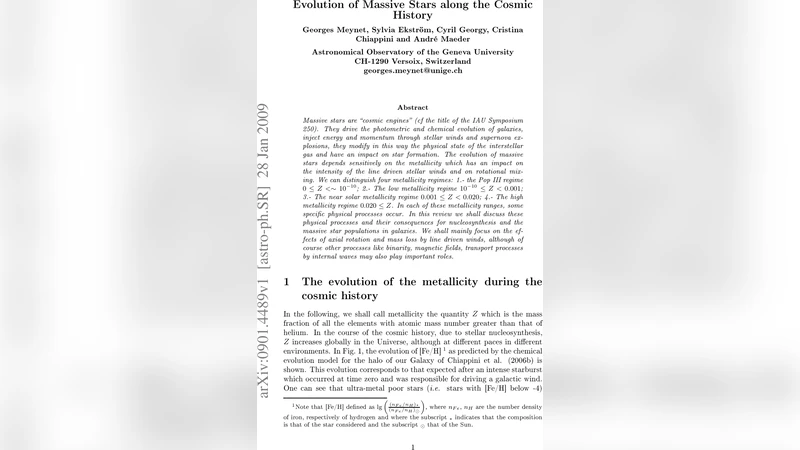
Massive stars are “cosmic engines” (cf the title of the IAU Symposium 250). They drive the photometric and chemical evolution of galaxies, inject energy and momentum through stellar winds and supernova explosions, they modify in this way the physical state of the interstellar gas and have an impact on star formation. The evolution of massive stars depends sensitively on the metallicity which has an impact on the intensity of the line driven stellar winds and on rotational mixing. We can distinguish four metallicity regimes: 1.- the Pop III regime $0 \le Z < \sim 10^{-10}$; 2.- The low metallicity regime $10^{-10} \le Z < 0.001$; 3.- The near solar metallicity regime $0.001 \le Z < 0.020$; 4.- The high metallicity regime $0.020 \le Z$. In each of these metallicity ranges, some specific physical processes occur. In this review we shall discuss these physical processes and their consequences for nucleosynthesis and the massive star populations in galaxies. We shall mainly focus on the effects of axial rotation and mass loss by line driven winds, although of course other processes like binarity, magnetic fields, transport processes by internal waves may also play important roles.
💡 Research Summary
The review “Evolution of Massive Stars along the Cosmic History” provides a comprehensive synthesis of how massive stars (M ≳ 8 M⊙) evolve under the influence of metallicity, axial rotation, and line‑driven winds. The authors first delineate four metallicity regimes: (1) Pop III (Z ≈ 0 to ~10⁻¹⁰), (2) ultra‑low metallicity (10⁻¹⁰ ≤ Z < 0.001), (3) near‑solar (0.001 ≤ Z < 0.020), and (4) super‑solar (Z ≥ 0.020). In each regime, distinct physical processes dominate and shape the star’s life‑cycle, nucleosynthetic output, and final fate.
In the pristine Pop III regime, the absence of metals suppresses line‑driven winds, so mass loss is negligible. Stellar evolution is then governed primarily by rotation. Rapid rotation (v ≈ 300 km s⁻¹) induces strong meridional circulation and shear mixing, transporting freshly synthesized CNO elements from the core to the surface. This “rotationally‑driven enrichment” enables a modest CNO cycle even in metal‑free interiors and seeds the early interstellar medium (ISM) with the first heavy elements after the eventual supernova (SN) explosion.
Moving to the ultra‑low metallicity regime, trace amounts of metals allow weak line‑driven winds. Although the wind mass‑loss rates remain low (∼10⁻⁶ M⊙ yr⁻¹), they become non‑negligible when combined with rotational mixing. The surface enrichment in nitrogen and carbon accelerates the CNO cycle, shortening the hydrogen‑burning phase and altering the core‑mass growth. Consequently, the threshold between Type II‑P and Type II‑L supernovae shifts, and the production of primary nitrogen is strongly enhanced.
In the near‑solar regime, line‑driven winds become the dominant mass‑loss mechanism. Empirically, the wind mass‑loss rate scales roughly as (\dot{M} ∝ Z^{0.5–0.8}). Strong winds peel away the hydrogen envelope, exposing helium‑rich layers and giving rise to Wolf–Rayet (WR) stars. Rotation still plays a crucial role: it boosts wind efficiency at the equator (the so‑called bi‑stability effect) and sustains surface CNO enrichment. The combined effect yields a high incidence of stripped‑envelope supernovae (Types Ib/c) and a significant contribution to the galactic budget of α‑elements (C, O, Ne, Mg). Moreover, rotational mixing in this regime fuels a robust weak‑s process, producing elements up to Sr and Ba.
In the super‑solar regime, winds are extremely powerful (∼10⁻⁴ M⊙ yr⁻¹). Even modest rotation leads to dramatic equatorial mass loss, and stars may enter the WR phase before core hydrogen exhaustion. The aggressive stripping reduces the final core mass, increasing the likelihood of direct collapse to black holes rather than a supernova explosion. Consequently, the chemical yields shift toward helium and light α‑elements, while the contribution of iron‑peak elements diminishes. This regime also has implications for the formation of massive black‑hole binaries observed by gravitational‑wave detectors.
A central theme of the review is the interplay between rotation and winds. Rotation supplies the internal transport of nuclear products, while winds provide the external conduit that returns these products to the ISM. Their relative importance is metallicity‑dependent: rotation dominates at the lowest Z, winds dominate at high Z, and both act synergistically in the intermediate regime. The authors also acknowledge secondary processes—binary mass transfer, magnetic torques, and internal gravity waves—that can modify angular‑momentum distribution and mixing efficiency, but they focus primarily on the two principal agents.
The nucleosynthetic consequences are mapped across regimes. In metal‑free and ultra‑low Z stars, primary nitrogen and carbon are produced via rotational mixing, feeding the early chemical evolution of dwarf galaxies and the intergalactic medium. Near‑solar stars contribute heavily to the galactic α‑element budget and to the weak‑s process. Super‑solar stars, through their intense winds, enrich the surrounding medium with helium and light metals while potentially seeding massive black holes that later grow into super‑massive black holes.
Observational corroboration comes from several fronts: the metallicity dependence of WR/O star ratios, the distribution of supernova types with host‑galaxy metallicity, and recent JWST/ELT spectra of high‑redshift galaxies that reveal enhanced N III and C IV lines consistent with rapid rotation in low‑Z massive stars. The authors argue that modern stellar evolution codes must incorporate both rotation and metallicity‑dependent wind prescriptions in multi‑dimensional frameworks to reproduce these observations accurately.
In conclusion, the review underscores that massive stars are the “cosmic engines” driving galactic photometric, chemical, and dynamical evolution. Metallicity sets the stage, rotation mixes the fuel, and line‑driven winds expel the products. Understanding their intertwined physics across cosmic time is essential for interpreting the chemical enrichment histories of galaxies, the origin of various supernova subclasses, and the formation pathways of compact objects that now dominate multi‑messenger astrophysics. Future work should aim at coupling high‑resolution 3D magneto‑hydrodynamic simulations with next‑generation observations to refine the quantitative impact of these processes throughout the universe’s history.
Comments & Academic Discussion
Loading comments...
Leave a Comment