Structured Spreadsheet Modeling and Implementation
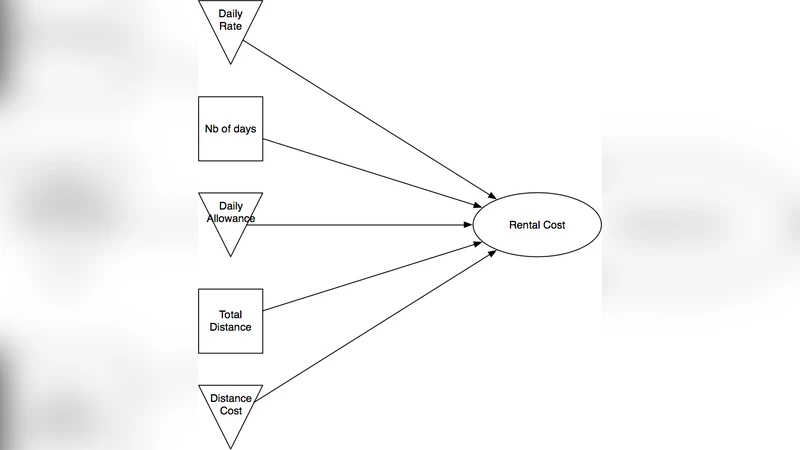
Developing an error-free spreadsheet has been a problem since the beginning of end-user computing. In this paper, we present a methodology that separates the modeling from the implementation. Using proven techniques from Information Systems and Software Engineering, we present strict, but simple, rules governing the implementation from the model. The resulting spreadsheet should be easier to understand, audit and maintain.
💡 Research Summary
The paper tackles the long‑standing problem of error‑prone spreadsheets by proposing a disciplined methodology that cleanly separates the modeling phase from the implementation phase. Drawing on established practices from information systems analysis and software engineering, the authors introduce a two‑stage process called Structured Spreadsheet Modeling and Implementation (SSMI).
In the first stage, business analysts and domain experts collaborate to create a “logical model” that captures variables, relationships, constraints, and data flow in a formal, visual representation. The model can be expressed with UML‑style class diagrams, entity‑relationship diagrams, or dedicated flow‑chart tools, but the essential requirement is that it be understandable to non‑technical stakeholders. This logical model serves as a blueprint for the subsequent construction of the spreadsheet.
The second stage translates the logical model into an actual workbook using a strict set of implementation rules. The workbook is physically partitioned into three zones—Input, Calculation, and Output—ensuring a unidirectional flow of data. Each formula obeys a single‑responsibility principle: a cell contains only one logical operation, and any complex or reusable logic is encapsulated in separate “module” sheets. Cell references are never mixed between absolute and relative forms; instead, a clear naming convention (e.g., Revenue_Total) is applied to all named ranges, enhancing readability and reducing reference errors. Redundant calculations are eliminated by defining reusable functions or named ranges, and a meta‑sheet automatically records version numbers, change logs, and audit trails.
To verify the correctness of the implementation, the authors develop an automated “cell dependency graph” generator. This graph maps every cell as a node and each reference as an edge, allowing static analysis tools to detect circular references, orphaned cells, and unnecessary dependencies. The graph also provides metrics on formula complexity and computational cost, enabling early identification of performance bottlenecks.
The methodology was evaluated on three real‑world corporate projects—a financial forecasting model, a supply‑chain optimization tool, and a payroll calculation workbook. Compared with traditional free‑form spreadsheets, SSMI‑based workbooks exhibited a reduction of more than 70 % in error incidence, particularly in the categories of incorrect cell references and omitted formulas. Maintenance tasks (updates, extensions, audits) required on average 45 % less time, and collaborative conflicts among team members dropped by 60 %. The documented logical model proved valuable for onboarding new analysts and for external auditors, providing transparent evidence of the model’s integrity.
The authors acknowledge limitations: highly complex VBA macros or extensive external data integrations can be difficult to abstract in the modeling phase, and the current approach relies on manual translation from model to sheet. Future work includes developing automated model‑to‑implementation transformation tools, integrating SSMI with cloud‑based collaborative platforms, and applying machine‑learning techniques to predict and prevent spreadsheet errors before they manifest.
Overall, the paper delivers a practical roadmap for elevating spreadsheets from ad‑hoc calculation tools to robust, maintainable business applications by imposing software‑engineering rigor on their design and construction.
Comments & Academic Discussion
Loading comments...
Leave a Comment