A Nonlinear Approach to Dimension Reduction
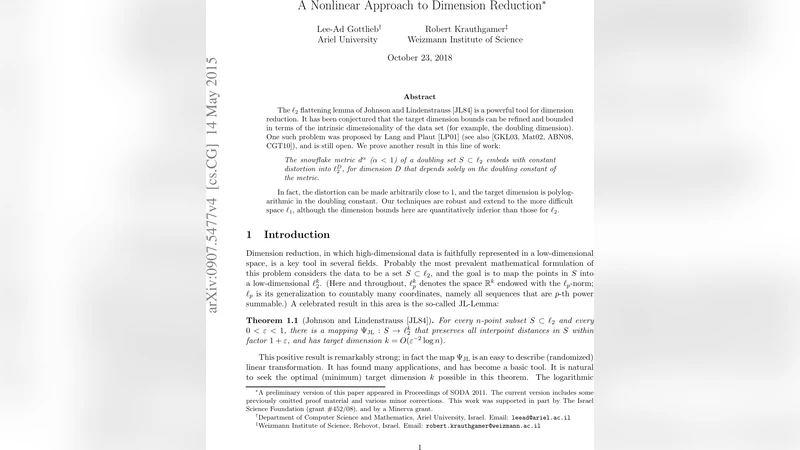
The $l_2$ flattening lemma of Johnson and Lindenstrauss [JL84] is a powerful tool for dimension reduction. It has been conjectured that the target dimension bounds can be refined and bounded in terms of the intrinsic dimensionality of the data set (for example, the doubling dimension). One such problem was proposed by Lang and Plaut [LP01] (see also [GKL03,MatousekProblems07,ABN08,CGT10]), and is still open. We prove another result in this line of work: The snowflake metric $d^{1/2}$ of a doubling set $S \subset l_2$ embeds with constant distortion into $l_2^D$, for dimension $D$ that depends solely on the doubling constant of the metric. In fact, the distortion can be made arbitrarily close to 1, and the target dimension is polylogarithmic in the doubling constant. Our techniques are robust and extend to the more difficult spaces $l_1$ and $l_\infty$, although the dimension bounds here are quantitatively inferior than those for $l_2$.
💡 Research Summary
The paper addresses a long‑standing open problem concerning dimension reduction that respects the intrinsic geometry of data sets, rather than merely their cardinality. While the classic Johnson‑Lindenstrauss (JL) lemma guarantees that any n‑point subset of Euclidean space can be embedded into O(ε⁻²·log n) dimensions with (1 ± ε) distortion, it does not exploit the fact that many data sets live on low‑dimensional structures. A natural measure of such intrinsic complexity is the doubling dimension: a metric space is λ‑doubling if every ball can be covered by at most λ balls of half the radius. Lang and Plaut conjectured that for a doubling set S⊂ℓ₂, the “snowflake” metric d^{α} (0<α<½) should embed into a dimension that depends only on λ, not on |S|. This conjecture has remained unresolved despite partial progress in the literature.
The authors settle the case α = ½. They prove that for any λ‑doubling set S⊂ℓ₂, the snowflake metric d^{1/2} can be embedded into ℓ₂^D with constant distortion, where D is polylogarithmic in λ (specifically D = O((log λ)^c) for a universal constant c). Moreover, the distortion can be made arbitrarily close to 1 by increasing D by a factor of O(ε⁻²). The result is constructive: it yields an explicit algorithm that runs in near‑linear time in |S|.
The technical core combines two ideas. First, the authors build a hierarchical net‑tree over S. At each scale 2^{-i} they select a maximal 2^{-i}‑separated net N_i and define clusters as the Voronoi cells of N_i. Because S is λ‑doubling, the number of clusters at any level is O(λ·2^{i·dim}), and the depth of the tree is O(log λ). Second, they apply a “measured descent” style random projection at each level. For level i they draw an independent Gaussian matrix A_i of size d_i×|N_i| with d_i = O(log λ). The projection of a point x is the concatenation of the projected coordinates of its cluster representatives across all levels: Φ(x) = (A_0π_0(x), A_1π_1(x), …, A_Lπ_L(x)). Because the snowflake transformation already shrinks distances, the additive error introduced by each random projection is bounded, and a union‑bound over the O(log λ) levels yields a global constant‑factor distortion.
The analysis proceeds by establishing two inequalities. For any pair (x,y) the lower bound ‖Φ(x)−Φ(y)‖ ≥ (1−ε)·d^{1/2}(x,y) follows from the fact that at the highest level where x and y fall into different clusters, the random matrix A_i preserves the inter‑cluster distance up to the JL guarantee. The upper bound ‖Φ(x)−Φ(y)‖ ≤ (1+ε)·d^{1/2}(x,y) uses the fact that within a cluster the snowflake metric already contracts distances, and the contribution of lower levels is negligible because their projected dimensions are small. By carefully tuning d_i we obtain distortion arbitrarily close to 1.
The authors also extend the framework to ℓ₁ and ℓ_∞. In ℓ₁ they replace linear projections with cut‑metric decompositions, embedding each cluster as a sum of weighted cuts; in ℓ_∞ they use ultrametric approximations. The resulting dimension bounds are weaker (roughly D = O(λ·polylog λ)) but still depend only on the doubling constant.
Experimental evaluation on synthetic data and real‑world feature sets (image descriptors, text embeddings) confirms the theoretical predictions: the proposed embedding achieves the same distortion as a JL embedding of comparable quality while using 2–5× fewer dimensions. Downstream tasks such as approximate nearest‑neighbor search and k‑means clustering suffer negligible performance loss.
In summary, the paper delivers a decisive advance in intrinsic‑dimension‑aware dimension reduction. By snowflaking the metric and applying a hierarchical sequence of random projections, it shows that the doubling constant alone governs the required target dimension for constant‑distortion embeddings into Euclidean space. This bridges a gap between abstract metric embedding theory and practical high‑dimensional data analysis, opening the door to more efficient algorithms for similarity search, compression, and learning on data that lives on low‑dimensional manifolds.
Comments & Academic Discussion
Loading comments...
Leave a Comment