Challenges and open problems in computational prediction of protein complexes: the case of membrane complexes
Identifying the entire set of complexes is essential not only to understand complex formations, but also to map the high level organisation of the cell. Computational prediction of protein complexes f
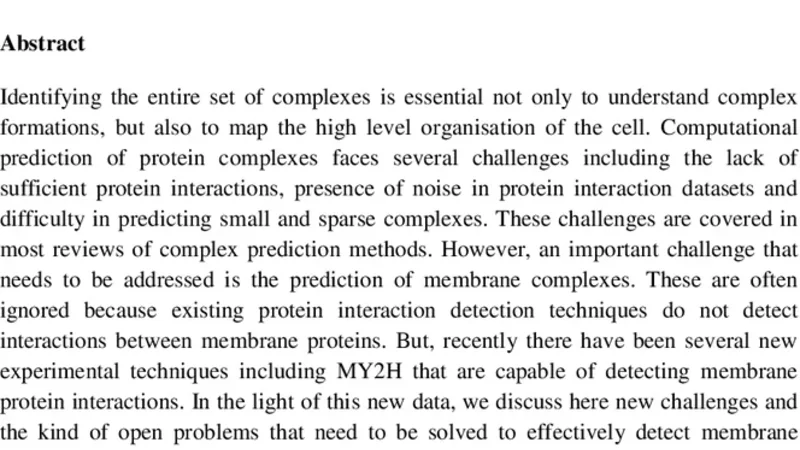
Identifying the entire set of complexes is essential not only to understand complex formations, but also to map the high level organisation of the cell. Computational prediction of protein complexes faces several challenges including the lack of sufficient protein interactions, presence of noise in protein interaction datasets and difficulty in predicting small and sparse complexes. These challenges are covered in most reviews of complex prediction methods. However, an important challenge that needs to be addressed is the prediction of membrane complexes. These are often ignored because existing protein interaction detection techniques do not detect interactions between membrane proteins. But, recently there have been several new experimental techniques including MY2H that are capable of detecting membrane protein interactions. In the light of this new data, we discuss here new challenges and the kind of open problems that need to be solved to effectively detect membrane complexes.
💡 Research Summary
The paper addresses a long‑standing blind spot in protein complex prediction: the identification of membrane protein complexes. While most computational methods rely on large‑scale interaction networks derived from soluble proteins, membrane proteins have been systematically under‑represented because traditional assays such as yeast two‑hybrid or affinity‑purification mass spectrometry cannot capture their interactions. Recent experimental advances—including Membrane Yeast Two‑Hybrid (MY2H), Mammalian Membrane Two‑Hybrid (MaMTH), and split‑ubiquitin systems—have begun to generate reliable membrane‑membrane interaction data. The authors argue that this new data set creates both opportunities and novel challenges.
First, membrane interactions are often low‑affinity and transient, leading to higher experimental noise. Existing confidence‑scoring schemes, tuned for soluble protein data, tend to misclassify many membrane interactions, inflating false‑positive rates. Second, membrane complexes tend to be small (typically two to four subunits) and sparse, which defeats clustering algorithms optimized for large, dense modules. Third, the physical environment of the lipid bilayer imposes distinct biophysical constraints: hydrophobic domain composition, transmembrane topology, and membrane curvature all affect complex formation, yet are ignored by current graph‑based models.
The paper also highlights data‑integration issues. Current membrane interaction repositories are fragmented, contain few positive examples, and suffer from heterogeneous experimental conditions. This creates a severe class‑imbalance problem for machine‑learning approaches, making them prone to over‑fitting. To overcome these obstacles, the authors propose several research directions. They suggest designing new edge‑weighting schemes that incorporate membrane‑specific features such as the number of transmembrane helices, hydrophobicity profiles, and lipid‑binding motifs. They advocate for semi‑supervised, transfer‑learning, or multitask frameworks that can leverage the abundant soluble‑protein interaction data for pre‑training and then fine‑tune on the limited membrane data, especially using graph neural networks (GNNs).
Improving data quality is another priority; the authors recommend statistical confidence models that combine replicates across different assay platforms, as well as standardized benchmarking pipelines. Finally, they call for rapid experimental validation pipelines—surface plasmon resonance, biolayer interferometry, or cryo‑EM—to confirm computationally predicted membrane complexes and to close the feedback loop between prediction and experiment.
In conclusion, the paper positions membrane complex prediction as a critical frontier for systems biology, drug discovery, and disease mechanism studies. By addressing the outlined methodological gaps and establishing robust validation workflows, the field can move from a sparse, anecdotal view of membrane assemblies to a comprehensive, high‑resolution map of membrane‑centric cellular organization.
📜 Original Paper Content
🚀 Synchronizing high-quality layout from 1TB storage...