Classical and Quantum Integrability in Laplacian Growth
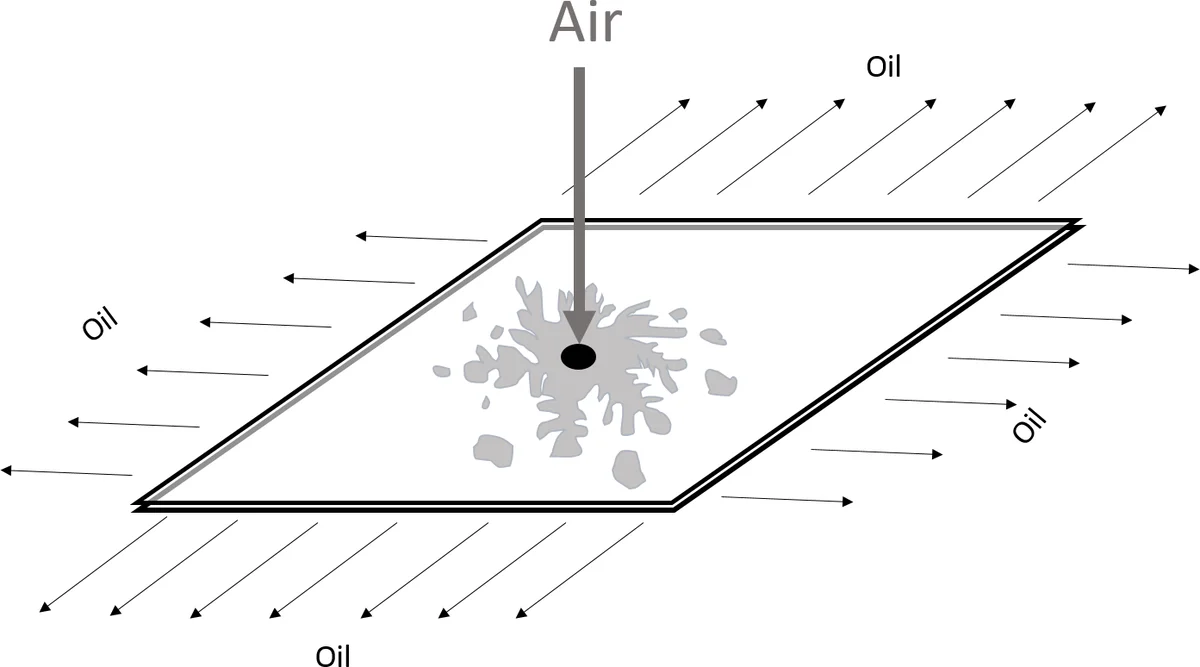
We review here particular aspects of the connection between Laplacian growth problems and classical integrable systems. In addition, we put forth a possible relation between quantum integrable systems and Laplacian growth problems. Such a connection, if confirmed, has the potential to allow for a theoretical prediction of the fractal properties of Laplacian growth clusters, through the representation theory of conformal field theory.
💡 Research Summary
The paper “Classical and Quantum Integrability in Laplacian Growth” surveys the deep connections between Laplacian growth phenomena—most prominently the Hele‑Shaw cell experiment—and both classical and quantum integrable systems. The authors begin by describing the physical setup: a low‑viscosity fluid (often air) is injected through a hole into a high‑viscosity fluid (oil) confined between two closely spaced glass plates. The interface between the two fluids develops intricate, fractal‑like fingers whose dimension has been measured experimentally to be around 1.71. The central theoretical problem is to predict this fractal dimension (and related multifractal properties) from first principles.
To this end, the authors formulate a probability density functional (P(C)) over possible interface shapes (C). Two key symmetries are imposed on (P): (i) time‑translation invariance, reflecting the fact that the dynamics is driven solely by the injection rate and the area of the low‑viscosity domain grows linearly in time; (ii) scale invariance, which directly encodes the fractal scaling law (R^D = t) (with (R) a characteristic linear size and (t) the area). Under these constraints, the marginal distribution of the linear size obeys (P(R) \propto R^{D-1}), linking the exponent (D) to the underlying statistical weight.
The paper then delves into the classical integrable structure underlying Laplacian growth. By introducing a complex analytic potential (\phi_t(z)=\theta - i\frac{\pi b^2}{6\mu Q} P) (where (\theta) is the stream function), the authors show that the dynamics can be recast as a conformal mapping problem: the inverse map (f_t(i\phi)=z) sends the strip (\phi\in
Comments & Academic Discussion
Loading comments...
Leave a Comment