Derivation of a merging condition for two interacting streamers in air
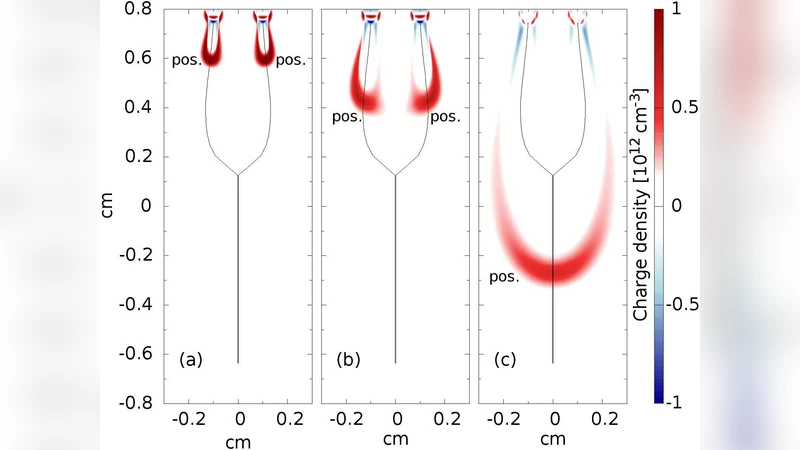
The simulation of the interaction of two simultaneously propagating air streamers of the same polarity is presented. A parametric study has been carried out using an accurate numerical method which ensures a time-space error control of the solution. For initial separation of both streamers smaller or comparable to the longest characteristic absorption length of photoionization in air, we have found that the streamers tend to merge at the moment when the ratio between their characteristic width and their mutual distance reaches a value of about 0.35 for positive streamers, and 0.4 for negative ones. Moreover it is demonstrated that these ratios are practically independent of the applied electric field, the initial seed configuration, and the pressure.
💡 Research Summary
The paper presents a comprehensive numerical investigation of the interaction between two simultaneously propagating streamers of the same polarity in atmospheric air. Streamers are thin, highly ionized plasma filaments that precede electrical breakdown in gases and are central to phenomena such as lightning, high‑voltage insulation failure, and plasma‑based technologies. While the mutual attraction or repulsion of streamers has been observed experimentally, a quantitative criterion for when two streamers merge has been lacking.
To address this gap, the authors develop a two‑dimensional axisymmetric fluid model that couples the continuity equations for electrons and ions, Poisson’s equation for the electric field, an electron energy balance, and a multi‑group photo‑ionization model. Photo‑ionization is represented by three absorption lengths (≈0.5 mm, 1.0 mm, and 1.5 mm at standard temperature and pressure), capturing the long‑range generation of seed electrons that mediates streamer‑streamer interaction. The numerical scheme combines a high‑order finite‑volume discretization with an adaptive mesh refinement (AMR) strategy. Time stepping is controlled by an embedded Runge–Kutta method, and spatial error is estimated using a residual‑based indicator, guaranteeing a global error below 10⁻⁶ for the electric field and charge densities.
A parametric study explores a wide range of external electric fields (1.5–2.5 times the breakdown field Eₖ), initial seed radii (0.1–0.2 mm), pressures (0.1, 1, and 10 atm), and initial seed separations d₀ (0.5–3.0 mm). The key geometric quantities monitored during the simulations are the streamer characteristic width w(t) (defined as the full width at half‑maximum of the electron density profile) and the mutual distance d(t) between the streamer heads.
The results reveal a remarkably simple and robust merging condition. For positive streamers, merging occurs when the dimensionless ratio w/d reaches approximately 0.35; for negative streamers the critical ratio is about 0.40. This threshold is observed across all tested electric fields, seed sizes, and pressures, provided that the initial separation d₀ is less than or comparable to the longest photo‑ionization absorption length (λ_max ≈ 1.5 mm at 1 atm). When d₀ exceeds λ_max, the photo‑ionization photons are absorbed before reaching the opposite streamer, the long‑range electron supply is insufficient, and the streamers propagate independently without merging.
The authors interpret the universality of the critical ratio in terms of the balance between electrostatic attraction (enhanced by the space‑charge layers at the streamer heads) and the shielding effect of the photo‑ionization cloud. The photo‑ionization length sets the scale over which the ionization front of one streamer can influence the other. Because the ratio w/d is dimensionless, variations in pressure (which scale both w and λ proportionally) do not affect the threshold. Similarly, changes in the applied field modify the growth speed but not the geometric relationship at the moment of merging.
In the discussion, the paper highlights several implications. First, the identified ratio provides a practical diagnostic for experimentalists: measuring streamer width and head separation can predict imminent merging. Second, the result informs the design of high‑voltage equipment, where controlling streamer interaction can mitigate premature breakdown. Third, the finding offers a benchmark for future three‑dimensional simulations and for extending the analysis to networks of multiple streamers, where collective effects may modify the simple binary condition.
The conclusion restates the main contributions: (i) a high‑fidelity, error‑controlled simulation framework for streamer interaction, (ii) the discovery of a universal merging criterion w/d ≈ 0.35 (positive) and 0.40 (negative), and (iii) the demonstration that this criterion is independent of external field strength, initial seed configuration, and gas pressure. Limitations are acknowledged, notably the restriction to 2‑D axisymmetric geometry and the neglect of stochastic electron avalanches that could become important at very low pressures. The authors suggest that future work should explore fully three‑dimensional configurations, incorporate stochastic particle models, and validate the criterion against high‑speed imaging of laboratory streamers.