Quasar feedback: accelerated star formation and chaotic accretion
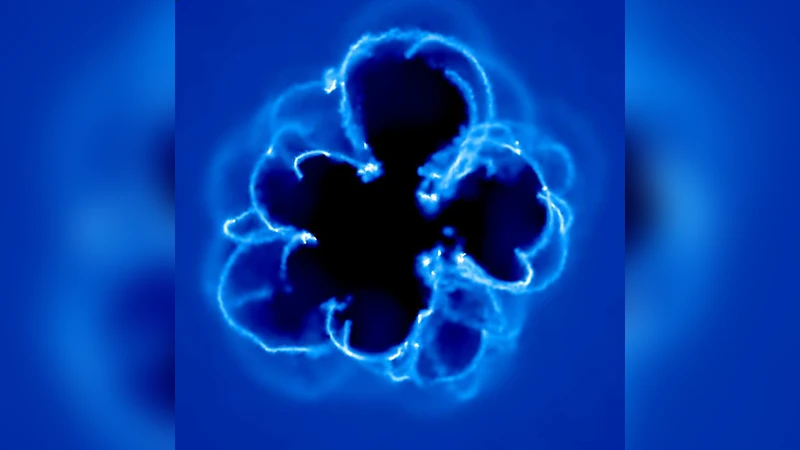
Growing Supermassive Black Holes (SMBH) are believed to influence their parent galaxies in a negative way, terminating their growth by ejecting gas out before it could turn into stars. Here we present some of the most sophisticated SMBH feedback simulations to date showing that quasar’s effects on galaxies are not always negative. We find that when the ambient shocked gas cools rapidly, the shocked gas is compressed into thin cold dense shells, filaments and clumps. Driving these high density features out is much more difficult than analytical models predict since dense filaments are resilient to the feedback. However, in this regime quasars have another way of affecting the host – by triggering a massive star formation burst in the cold gas by over-pressurising it. Under these conditions SMBHs actually accelerate star formation in the host, having a positive rather than negative effect on their host galaxies. The relationship between SMBH and galaxies is thus even more complex and symbiotic than currently believed. We also suggest that the instabilities found here may encourage the chaotic AGN feeding mode.
💡 Research Summary
The paper revisits the long‑standing view that active galactic nucleus (AGN) feedback from growing supermassive black holes (SMBHs) is predominantly negative, i.e., it expels or heats the interstellar medium (ISM) and thereby quenches star formation. Using state‑of‑the‑art three‑dimensional radiation‑hydrodynamic simulations that incorporate metal line cooling, radiative transfer, magnetic fields, and multi‑phase feedback (thermal, kinetic, and radiation pressure), the authors explore how the outcome depends critically on the cooling efficiency of the shocked gas surrounding the SMBH.
Two distinct regimes emerge. In the “hot‑gas” regime, where radiative losses are modest and the post‑shock temperature remains above ~10⁶ K, the quasar wind efficiently drives a high‑velocity outflow that clears the central kiloparsec of dense gas, suppressing further star formation in line with classic negative‑feedback models. In contrast, when the shocked gas cools rapidly—thanks to efficient metal line cooling and strong radiative losses—the gas collapses into thin, cold shells, filaments, and clumps with densities exceeding 10³ cm⁻³. These structures are highly resilient to the ram pressure of the quasar wind because their internal pressure and tensile strength far exceed the external force. Instead of being destroyed, the over‑pressurised filaments experience a rapid rise in internal pressure that triggers gravitational collapse. The simulations show that these dense filaments, containing 10⁶–10⁸ M☉ of gas, convert a large fraction (≥30 %) of their mass into stars within a few Myr, far above the typical star‑formation efficiencies assumed in galaxy‑evolution models.
The authors also identify a cascade of hydrodynamic instabilities—Rayleigh‑Taylor, Kelvin‑Helmholtz, and non‑linear thin‑shell instabilities—that shred the outflow front and generate a tangled network of streams and toroidal vortices. This chaotic flow pattern disrupts the angular‑momentum distribution of gas near the SMBH, leading to intermittent, highly anisotropic feeding events. Low‑density gas continues to be expelled, but the dense filaments linger on quasi‑stable orbits and intermittently rain onto the black hole in a stochastic manner. This “chaotic accretion” mode naturally explains rapid SMBH mass growth accompanied by spin‑down, as the accreted angular momentum vectors are randomly oriented.
Observationally, the coexistence of high‑velocity outflows and intense starbursts in many luminous quasars—often accompanied by irregular variability in optical and X‑ray bands—finds a natural explanation in this dual‑feedback picture. The paper suggests that high‑resolution ALMA and JWST observations of molecular gas could directly detect the predicted cold filaments and clumps, providing a decisive test of the model.
In summary, the study demonstrates that quasar feedback is not universally suppressive. When the ambient shocked gas can cool quickly, the feedback becomes a catalyst for star formation, while simultaneously fostering a chaotic, filament‑driven accretion flow onto the SMBH. This dual nature adds a layer of complexity to the co‑evolution of SMBHs and their host galaxies, implying that positive and negative feedback can operate concurrently, and that the interplay between cooling physics, hydrodynamic instabilities, and angular‑momentum transport is central to shaping galaxy evolution. Future work should aim to quantify the relative prevalence of these regimes across cosmic time and to integrate them into semi‑analytic and cosmological simulation frameworks.