First Stars IV: Summary Talk
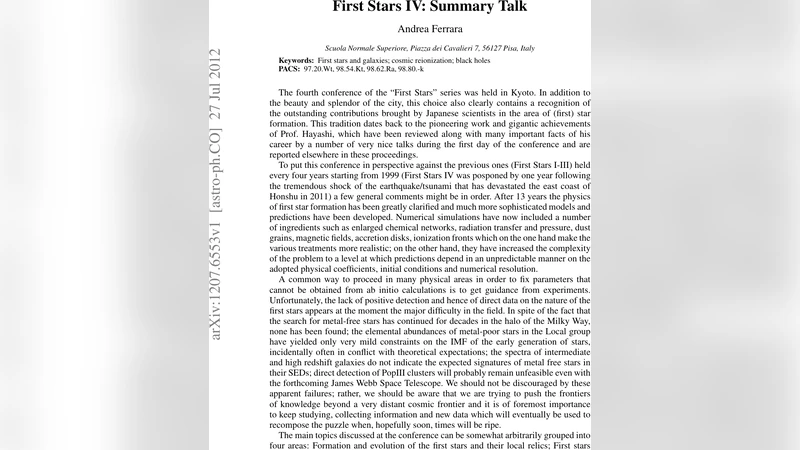
The paper contains the summary of the First Stars IV 2012 Conference held in Kyoto, Japan
💡 Research Summary
The “First Stars IV” conference, held in Kyoto in 2012, brought together theorists, simulators, and observers to review the state of knowledge on the very first generation of stars—Population III— and to outline the challenges and opportunities that lie ahead. The meeting was organized around four thematic sessions.
The first session focused on the theoretical foundations of primordial star formation. In a metal‑free universe, cooling is dominated by molecular hydrogen (H₂) and its isotopologue HD. Recent three‑dimensional radiation‑hydrodynamics simulations showed that H₂ cooling can bring gas temperatures down to ~200 K, leading to the formation of massive protostars with characteristic masses of tens of solar masses. However, when rotation and magnetic fields are included, fragmentation can be enhanced, allowing lower‑mass (≈10 M☉) stars to appear. The interplay between turbulence, angular momentum transport, and magnetic braking was highlighted as a key factor that determines the initial mass function (IMF) of the first stars.
The second session dealt with numerical techniques and sub‑grid modeling. High‑resolution adaptive‑mesh refinement (AMR) and smoothed‑particle hydrodynamics (SPH) runs now resolve the collapse of minihalos down to sub‑AU scales, yet the feedback from the first supernovae—metal enrichment, kinetic energy injection, and radiation—must still be treated with sub‑grid prescriptions. A critical metallicity of Z≈10⁻⁴ Z☉ was reaffirmed: once this threshold is crossed, dust cooling becomes efficient, dramatically altering fragmentation behavior and shifting the IMF toward lower masses. New approaches that couple star‑formation efficiency, IMF, and radiative feedback into a unified sub‑grid framework were presented, aiming to reduce the large uncertainties that have plagued earlier models.
The third session presented observational constraints. Ultra‑metal‑poor (UMP) halo stars in the Milky Way exhibit abundance patterns (e.g., high C, N, O, and r‑process elements) that match nucleosynthesis yields from massive Population III supernovae, providing indirect evidence of the first stellar generations. High‑redshift gamma‑ray bursts (GRBs) and quasar absorption line spectra were discussed as probes of early star formation and re‑ionization. Although no direct detection of a Population III star existed at the time, the community emphasized that the upcoming James Webb Space Telescope (JWST), Euclid, and future 30‑meter class ground‑based observatories would enable infrared searches for the faint signatures of metal‑free stellar populations.
The final session looked ahead to the next decade. Machine‑learning techniques are being integrated to infer model parameters from large simulation datasets, while advanced data‑science pipelines are required to handle the massive outputs of cosmological runs. The participants identified several priority research directions: (1) a more realistic treatment of dust formation and its cooling impact at ultra‑low metallicities, (2) coupled radiative‑hydrodynamic feedback that includes both ionizing and Lyman‑Werner photons, and (3) multi‑scale simulations that bridge the gap between cosmological structure formation and protostellar disk physics. The consensus was that, with the synergy of high‑performance computing, next‑generation telescopes, and sophisticated statistical tools, the community is poised to move from indirect inferences to direct observations of the first stars within the next ten years.