Bipolar jets launched from magnetically diffusive accretion disks. I. Ejection efficiency vs field strength and diffusivity
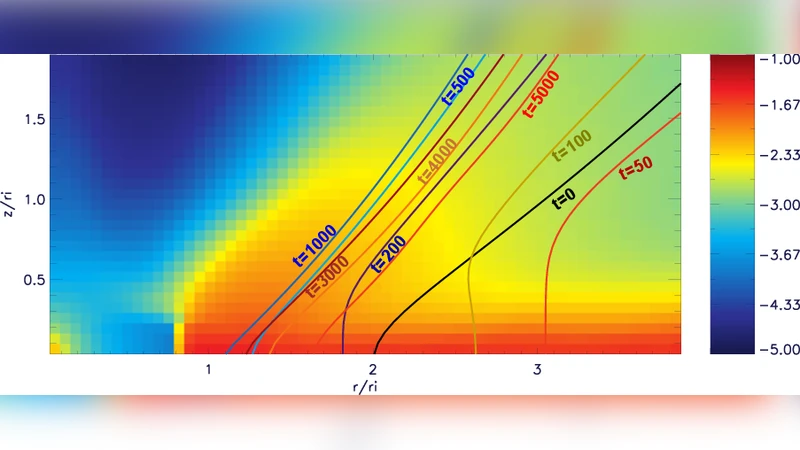
We investigate the launching of jets and outflows from magnetically diffusive accretion disks. Using the PLUTO code we solve the time-dependent resistive MHD equations taking into account the disk and jet evolution simultaneously. The main question we address is which kind of disks do launch jets and which kind of disks do not? In particular, we study how the magnitude and distribution of the (turbulent) magnetic diffusivity affect mass loading and jet acceleration. We have applied a turbulent magnetic diffusivity based on \alpha-prescription, but have also investigate examples where the scale height of diffusivity is larger than that of the disk gas pressure. We further investigate how the ejection efficiency is governed by the magnetic field strength. Our simulations last for up to 5000 dynamical time scales corresponding to 900 orbital periods of the inner disk. As a general result we observe a continuous and robust outflow launched from the inner part of the disk, expanding into a collimated jet of super fast magneto-sonic speed. For long time scales the disk internal dynamics changes, as due to outflow ejection and disk accretion the disk mass decreases. For magneto-centrifugally driven jets we find that for i) less diffusive disks, ii) a stronger magnetic field, iii) a low poloidal diffusivity, or a iv) lower numerical diffusivity (resolution), the mass loading of the outflow is increased - resulting in more powerful jets with high mass flux. For weak magnetization the (weak) outflow is driven by the magnetic pressure gradient. We further investigate the jet asymptotic velocity and the jet rotational velocity in respect of the different launching scenarios. We find a lower degree of jet collimation than previous studies, most probably due to our revised outflow boundary condition.
💡 Research Summary
This paper presents a comprehensive study of jet launching from magnetically diffusive accretion disks using long‑term, time‑dependent resistive magnetohydrodynamic (MHD) simulations performed with the PLUTO code. The authors solve the full set of resistive MHD equations in a single computational domain that contains both the disk and the emerging outflow, thereby allowing the disk’s internal evolution and the jet dynamics to interact self‑consistently over thousands of dynamical times (up to 5 000 inner‑disk orbital periods, ≈ 900 orbits at the inner radius).
Model setup
The disk is initialized as a Keplerian, vertically stratified structure with a prescribed gas pressure scale height. Turbulent magnetic diffusivity is introduced via an α‑prescription (α ranging from 0.1 to 0.5). Both radial (η_r) and vertical (η_z) components of the diffusivity are varied, and cases where the diffusivity scale height exceeds the gas pressure scale height are examined. The initial magnetic field is predominantly poloidal, and the plasma‑β (ratio of gas to magnetic pressure) is explored from strongly magnetized (β ≈ 0.1) to weakly magnetized (β ≈ 10) regimes. A modified outflow boundary condition is employed to minimise artificial reflections and to avoid excessive collimation caused by the boundary itself.
Simulation campaign
A suite of runs explores four key parameters: (i) the magnitude of the turbulent diffusivity, (ii) the strength of the initial magnetic field, (iii) the relative strength of the vertical diffusivity, and (iv) the numerical resolution (hence the level of numerical diffusivity). Each simulation is evolved for up to 5 000 inner‑disk dynamical times, allowing the disk mass to decline gradually due to accretion and jet ejection, and providing a realistic view of long‑term jet sustainability.
Principal findings
-
Robust jet formation – In every model a continuous, bipolar outflow originates from the inner few disk radii (r ≲ 5 r₀). The outflow quickly becomes super‑Alfvénic and super‑fast‑magnetosonic, forming a collimated jet that propagates over many tens of inner‑disk radii.
-
Impact of magnetic diffusivity – Lower turbulent diffusivity (α ≈ 0.1) preserves the magnetic field threading the disk, leading to a higher mass‑loading factor (Ṁ_jet/Ṁ_acc ≈ 0.1–0.3). Higher diffusivity (α ≈ 0.5) erodes the field, reduces the lever arm, and yields weaker jets with smaller mass fluxes.
-
Role of vertical diffusivity – When the vertical (poloidal) diffusivity η_z is smaller than the radial component, the vertical magnetic structure remains coherent, facilitating efficient mass loading from the disk surface. This condition markedly boosts both the jet mass flux and the kinetic power.
-
Magnetic field strength – Strong initial fields (β ≤ 0.1) generate high Alfvén speeds; the jet is magneto‑centrifugally driven (Blandford‑Payne type) and attains high terminal velocities (several times the Keplerian speed at the launch radius). Weak fields (β ≥ 1) produce outflows that are primarily pressure‑driven; the jets are slower, less massive, and display reduced collimation.
-
Numerical resolution – High‑resolution grids (Δr/r₀ ≈ 0.01) minimise artificial numerical diffusivity, allowing the physical diffusivity parameters to dominate the dynamics. Coarser grids introduce spurious diffusion that suppresses mass loading and leads to under‑estimated jet power.
-
Collimation and boundary effects – The revised outflow boundary condition yields jets that are less tightly collimated (opening angles ≈ 10°–15°) than reported in earlier studies that used more permissive boundaries. This demonstrates that boundary treatment can significantly bias the apparent degree of jet collimation.
Physical interpretation
The results confirm the classic magneto‑centrifugal launching picture: low diffusivity preserves the magnetic lever arm, enabling the disk’s rotational energy to be transferred efficiently along field lines. The vertical diffusivity controls how readily material can slip across field lines at the disk surface; a low η_z promotes “flaring” of field lines and enhances mass loading. In the weak‑field regime, magnetic pressure gradients dominate, producing a slower, pressure‑driven wind.
Implications and future work
By quantifying how α‑prescribed diffusivity, field strength, and vertical diffusivity affect jet mass loading, speed, and collimation, the study provides a framework for interpreting observed jet properties (e.g., mass‑loss rates, rotation signatures) in terms of underlying disk turbulence and magnetisation. The authors suggest extending the work to fully three‑dimensional simulations, incorporating radiative cooling and non‑ideal effects such as ambipolar diffusion, and performing direct comparisons with high‑resolution observations of young stellar object jets and AGN outflows.
In summary, the paper demonstrates that magnetically diffusive disks can launch robust, long‑lived jets, and that the efficiency of this process is tightly linked to the level of turbulent diffusivity, the strength and geometry of the magnetic field, and the numerical fidelity of the simulation. These insights refine our theoretical understanding of disk‑jet systems across a wide range of astrophysical contexts.