A Resonantly-Excited Disk-Oscillation Model of High-Frequency QPOs of Microquasars
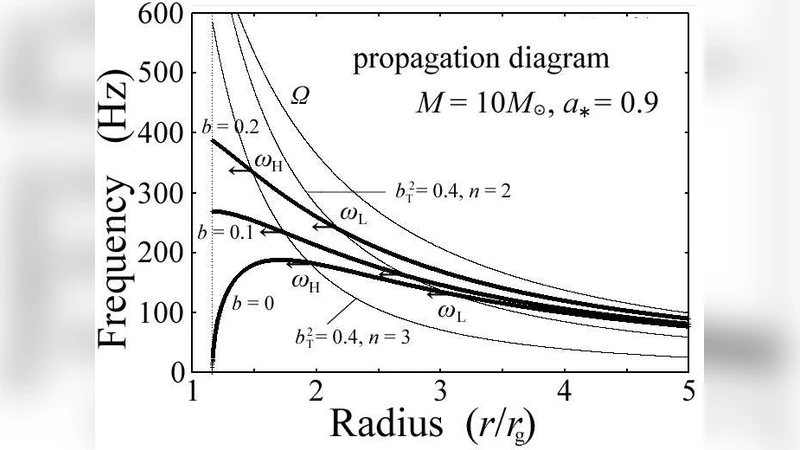
A possible model of twin high-frequency QPOs (HF QPOs) of microquasars is examined. The disk is assumed to have global magnetic fields and to be deformed with a two-armed pattern. In this deformed disk, set of a two-armed ($m=2$) vertical p-mode oscillation and an axisymmetric ($m=0$) g-mode oscillation are considered. They resonantly interact through the disk deformation when their frequencies are the same. This resonant interaction amplifies the set of the above oscillations in the case where these two oscillations have wave energies of opposite signs. These oscillations are assumed to be excited most efficiently in the case where the radial group velocities of these two waves vanish at the same place. The above set of oscillations is not unique, depending on the node number, $n$, of oscillations in the vertical direction. We consider that the basic two sets of oscillations correspond to the twin QPOs. The frequencies of these oscillations depend on disk parameters such as strength of magnetic fields. For observational mass ranges of GRS 1915+105, GRO J1655-40, XTE J1550-564, and H1743-322, spins of these sources are estimated. High spins of these sources can be described if the disks have weak poloidal magnetic fields as well as toroidal magnetic fields of moderate strength. In this model the 3 : 2 frequency ratio of high-frequency QPOs is not related to their excitation, but occurs by chance.
💡 Research Summary
**
The paper proposes a novel mechanism for the twin high‑frequency quasi‑periodic oscillations (HF QPOs) observed in microquasars. The authors assume that the accretion disk is permeated by global magnetic fields and is deformed into a two‑armed (m = 2) pattern. Within this deformed disk they consider a pair of oscillation modes: a two‑armed vertical p‑mode (m = 2) and an axisymmetric g‑mode (m = 0). The key idea is that these two modes can resonantly interact when their eigenfrequencies coincide. Because the two modes have opposite signs of wave energy—one carries positive energy while the other carries negative energy—the resonant coupling leads to mutual amplification: the negative‑energy wave supplies energy to the positive‑energy wave, and the total amplitude of both grows.
The resonance is most efficient at the radius where the radial group velocities of both waves vanish simultaneously. At this “stagnation” radius the waves are effectively trapped, allowing the non‑linear energy exchange to dominate over dissipative processes. The authors emphasize that this condition, rather than any imposed frequency ratio, determines where the oscillations are excited.
Vertical structure introduces a node number n. Different values of n generate distinct families of resonant mode pairs. The authors identify two fundamental families (n = 1 and n = 2) as the candidates for the observed upper and lower HF QPOs. The frequencies of these modes depend sensitively on the magnetic field configuration: the strength of the poloidal component Bz and the toroidal component Bφ, as well as their ratio. By varying these parameters, the model can reproduce a wide range of QPO frequencies.
To test the model, the authors apply it to four well‑studied microquasars—GRS 1915+105, GRO J1655‑40, XTE J1550‑564, and H1743‑322—using the observed mass ranges for each source. For each object they adjust Bz and Bφ (keeping the toroidal field at a moderate level, Bφ ≈ 0.1–0.3 of a reference field, and the poloidal field weak, Bz ≈ 0.01–0.05 Bφ) until the calculated resonant frequencies match the observed twin QPOs. The resulting spin parameters a are high (a ≈ 0.9–0.99), consistent with independent spin estimates from X‑ray spectral fitting. The analysis shows that weak poloidal fields are essential for achieving such high spins; stronger poloidal fields would shift the resonant frequencies and lead to lower inferred spins.
A striking conclusion is that the often‑cited 3:2 frequency ratio does not arise from the excitation mechanism itself. In this framework, the ratio appears only because, for realistic disk parameters, the two fundamental resonant frequencies frequently fall near a 3:2 relationship. Thus the ratio is a statistical coincidence rather than a necessary condition of the physics.
The paper’s contributions can be summarized as follows: (1) It introduces a resonant excitation mechanism based on the interaction of a two‑armed vertical p‑mode and an axisymmetric g‑mode in a magnetized, deformed disk. (2) It highlights the importance of opposite‑sign wave energies and the vanishing of radial group velocities for efficient amplification. (3) It demonstrates that the observed HF QPO frequencies and high black‑hole spins can be reproduced with modest toroidal magnetic fields and weak poloidal fields. (4) It challenges the conventional view that the 3:2 ratio is a fundamental signature of the QPO generation process, proposing instead that it is an incidental outcome of the parameter space.
Overall, the model offers a physically motivated, mathematically tractable alternative to existing resonance and relativistic precession models, and it opens new avenues for probing the magnetic structure of accretion disks through high‑frequency timing observations.