Multiwavelength spectral evolution during the 2011 outburst of the very faint X-ray transient Swift J1357.2-0933
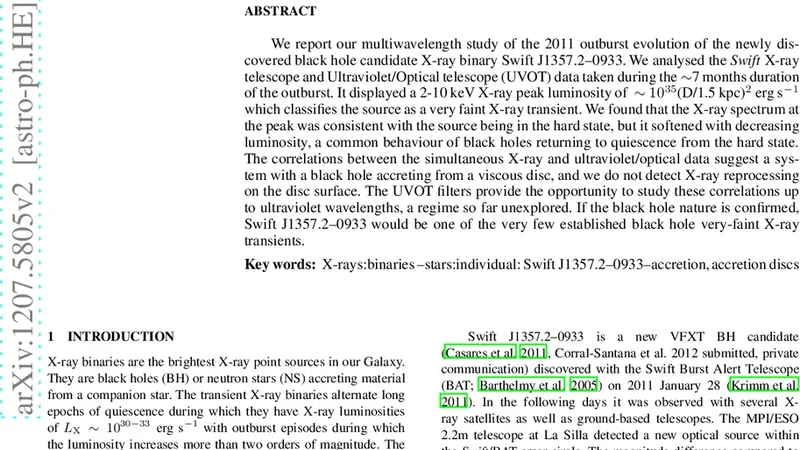
We report our multiwavelength study of the 2011 outburst evolution of the newly discovered black hole candidate X-ray binary Swift J1357.2-0933. We analysed the Swift X-ray telescope and Ultraviolet/Optical telescope (UVOT) data taken during the ~7 months duration of the outburst. It displayed a 2-10 keV X-ray peak luminosity of ~1E35(D/1.5 kpc)^2 erg s-1 which classifies the source as a very faint X-ray transient. We found that the X-ray spectrum at the peak was consistent with the source being in the hard state, but it softened with decreasing luminosity, a common behaviour of black holes at low luminosities or returning to quiescence from the hard state. The correlations between the simultaneous X-ray and ultraviolet/optical data suggest a system with a black hole accreting from a viscous disc that is not irradiated. The UVOT filters provide the opportunity to study these correlations up to ultraviolet wavelengths a regime so far unexplored. If the black hole nature is confirmed, Swift J1357.2-0933 would be one of the very few established black hole very-faint X-ray transients.
💡 Research Summary
The 2011 outburst of Swift J1357.2‑0933 was monitored for roughly seven months with the Swift satellite, using both the X‑ray Telescope (XRT) and the Ultraviolet/Optical Telescope (UVOT). The source reached a modest 2–10 keV peak luminosity of ≈1 × 10³⁵ (D/1.5 kpc)² erg s⁻¹, placing it firmly in the class of very‑faint X‑ray transients (VFXTs). Spectral analysis of the XRT data showed that at the outburst maximum the X‑ray spectrum was well described by a hard power‑law (photon index Γ≈1.5) with only modest Galactic absorption (N_H≈1.2 × 10²⁰ cm⁻²). As the source faded, the spectrum softened progressively, with Γ increasing to ≈2.3 when the luminosity dropped below 10³⁴ erg s⁻¹. This softening behaviour mirrors that observed in many black‑hole binaries as they transition from the hard state toward quiescence, and is interpreted as cooling of the Comptonising corona at low accretion rates.
Simultaneous UVOT observations were obtained in six filters (v, b, u, uvw1, uvm2, uvw2), covering the near‑UV to optical regime. After correcting for Galactic extinction (E(B–V)=0.04) and assuming a distance of ~1.5 kpc, the authors derived de‑reddened fluxes for each filter and constructed X‑ray/UV‑optical luminosity correlations. In log–log space the correlations are linear with slopes α ranging from 0.22 (uvm2) to 0.31 (v). These values are significantly shallower than the α≈0.5 expected for a disc whose outer regions are strongly irradiated by the central X‑ray source, but they agree well with the predictions of a purely viscous accretion disc (α≈0.15–0.25). The persistence of the correlation into the far‑UV indicates that the disc emission is dominated by internal viscous heating rather than re‑processing of X‑ray photons.
The authors discuss the implications of these findings. The hard‑state spectrum at peak, the gradual softening with decreasing luminosity, and the viscous‑disc dominated correlations together argue that Swift J1357.2‑0933 behaves like a typical black‑hole binary, despite its very low peak luminosity. The lack of a strong irradiation signature may be explained by a high orbital inclination: a tilted disc presents a smaller projected area to the central X‑ray source, reducing the re‑processing efficiency. This hypothesis is consistent with later optical studies that reported rapid dips and a high inclination for the system.
Because only a handful of VFXTs have been securely identified as black‑hole candidates, confirming the black‑hole nature of Swift J1357.2‑0933 would add a valuable data point to the low‑luminosity end of the black‑hole transient population. Moreover, the use of UVOT filters to extend the correlation analysis into the ultraviolet regime is novel; it demonstrates that UV observations can provide decisive constraints on the heating mechanisms of accretion discs in faint transients.
In summary, the paper presents a thorough multi‑wavelength characterization of a very‑faint outburst, showing (1) a hard‑state X‑ray spectrum that softens as the source dims, (2) a tight X‑ray/UV‑optical luminosity correlation indicative of a viscously heated, non‑irradiated disc, and (3) the potential role of high inclination in suppressing irradiation. If future dynamical measurements confirm a black‑hole primary, Swift J1357.2‑0933 will become one of the few well‑studied black‑hole VFXTs, offering a rare laboratory for probing accretion physics at accretion rates far below the canonical hard‑state regime.