Search for Diffuse X-rays from the Bow Shock Region of Runaway Star BD+43$^circ$3654 with Suzaku
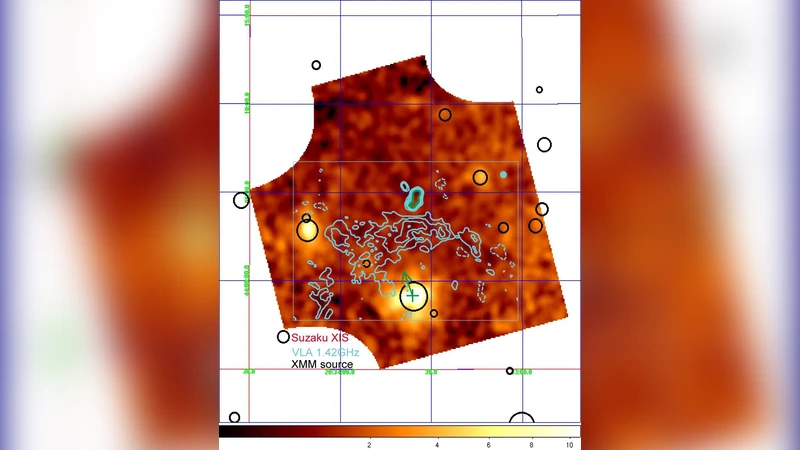
The bow shocks of runaway stars with strong stellar winds of over 2000 km s$^{-1}$ can serve as particle acceleration sites. The conversion from stellar wind luminosity into particle acceleration power has an efficiency of the same order of magnitude as those in supernova remnants, based on the radio emission from the bow shock region of runaway star BD+43$^\circ$3654 \citep{Benaglia10}.If this object exhibits typical characteristics, then runaway star systems can contribute a non-negligible fraction of Galactic cosmic-ray electrons. To constrain the maximum energy of accelerated particles from measurements of possible non-thermal emissions in the X-ray band, Suzaku observed BD+43$^\circ$3654 in April 2011 with an exposure of 99 ks. Because the onboard instruments have a stable and low background level, Suzaku detected a possible enhancement over the background of $7.6\pm 3.4$ cnt arcmin$^{-2}$ at the bow shock region, where the error represents the 3 sigma statistics only. However, the excess is not significant within the systematic errors of non-X-ray and cosmic-ray backgrounds of the X-ray Imaging Spectrometer, which are $\pm 6.0$ and $\pm 34$ cnt arcmin$^{-2}$, respectively, and the 3-sigma upper limit in the X-ray luminosity from the shock region, which is $1.1 \times 10^{32}$ erg s$^{-1}$ per 41.2 arcmin$^2$ in the 0.5 to 10 keV band. This result leads to three conclusions: (1) a shock-heating process is inefficient on this system; (2) the maximum energy of electrons does not exceed $\sim$ 10 TeV, corresponding to a Lorentz factor of less than $10^7$; and (3) the magnetic field in the shock acceleration site might not be as turbulent as those in pulsar wind nebulae and supernova remnants.
💡 Research Summary
The paper investigates whether the bow‑shock formed by the runaway O‑type star BD+43 3654 can accelerate particles to relativistic energies, as suggested by previous radio detections of synchrotron emission. The authors used the Suzaku X‑ray Imaging Spectrometer (XIS) to observe the shock region for a total exposure of 99 ks in April 2011, taking advantage of Suzaku’s low and stable non‑X‑ray background (NXB) to search for faint, non‑thermal X‑ray emission that would betray the presence of high‑energy electrons.
The analysis began with careful data reduction: the latest calibration database was applied, NXB was modeled from night‑Earth data, and the cosmic X‑ray background (CXB) was subtracted using standard models. The bow‑shock area, defined from infrared and radio maps, covers 41.2 arcmin² (≈3.5 pc²). Within this region the count rate was measured as 7.6 ± 3.4 cnt arcmin⁻² above the surrounding background. However, systematic uncertainties on the NXB (±6.0 cnt arcmin⁻²) and CXB (±34 cnt arcmin⁻²) dominate, rendering the excess statistically insignificant. Consequently the authors set a 3‑σ upper limit on the 0.5–10 keV X‑ray luminosity of the shock region at (1.1\times10^{32}) erg s⁻¹ (per 41.2 arcmin²).
Interpreting this limit in the context of diffusive shock acceleration yields three key conclusions. First, the shock‑heating process appears inefficient; the kinetic power of the stellar wind (∼2 × 10³⁶ erg s⁻¹) is not being converted into detectable thermal X‑ray emission. Second, the lack of X‑ray synchrotron or inverse‑Compton signatures constrains the maximum electron energy to ≲10 TeV (Lorentz factor γ ≲ 10⁷). This is consistent with the radio spectrum, which already indicates a steepening at high energies. Third, the magnetic field in the acceleration zone is likely less turbulent than in supernova remnants (SNRs) or pulsar wind nebulae (PWNe). Efficient acceleration to multi‑TeV energies in those environments requires amplified, chaotic fields; the Suzaku upper limit suggests that the bow‑shock magnetic field is weaker or more ordered, limiting particle scattering and energy gain.
Overall, the study demonstrates that, despite the presence of a strong stellar wind and a well‑defined bow‑shock, BD+43 3654 does not produce detectable non‑thermal X‑ray emission at the sensitivity of Suzaku. This implies that runaway‑star bow‑shocks, while capable of accelerating electrons to GeV energies (as seen in radio), are unlikely to contribute significantly to the Galactic cosmic‑ray electron population at TeV energies. The authors recommend future observations with next‑generation X‑ray missions (e.g., XRISM, Athena) and complementary radio polarization studies to probe magnetic turbulence and to push the detection limits lower, thereby clarifying the role of stellar‑wind bow‑shocks in the broader context of Galactic particle acceleration.