On the tau-functions of the Degasperis-Procesi equation
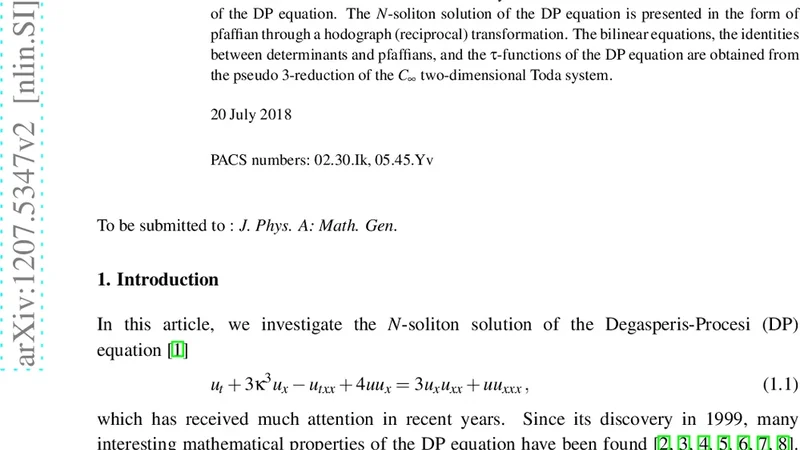
The DP equation is investigated from the point of view of determinant-pfaffian identities. The reciprocal link between the Degasperis-Procesi (DP) equation and the pseudo 3-reduction of the $C_{\infty}$ two-dimensional Toda system is used to construct the N-soliton solution of the DP equation. The N-soliton solution of the DP equation is presented in the form of pfaffian through a hodograph (reciprocal) transformation. The bilinear equations, the identities between determinants and pfaffians, and the $\tau$-functions of the DP equation are obtained from the pseudo 3-reduction of the $C_{\infty}$ two-dimensional Toda system.
💡 Research Summary
The paper investigates the Degasperis‑Procesi (DP) equation from the perspective of determinant‑pfaffian identities and constructs its N‑soliton solution in a compact pfaffian form. The authors begin by recalling that the DP equation, (u_t-u_{xxt}+4uu_x=3u_xu_{xx}+uu_{xxx}), is an integrable shallow‑water model that admits peaked solitons (peakons). While single‑peakon solutions are well known, a systematic description of multi‑soliton (N‑soliton) configurations has been lacking.
To fill this gap, the authors exploit a reciprocal (hodograph) transformation that links the DP equation to the pseudo‑3‑reduction of the (C_{\infty}) two‑dimensional Toda lattice. Introducing new independent variables ((y,s)) through
(dy = u,dx - u^2,dt,\quad ds = dt),
the DP equation is mapped to a bilinear Hirota equation for a (\tau)‑function:
((D_y D_s - 1),\tau\cdot\tau = 0).
This bilinear form is amenable to Hirota’s direct method, allowing the construction of soliton solutions via algebraic identities.
The core of the analysis lies in the pseudo‑3‑reduction of the (C_{\infty}) Toda system. By restricting the infinite lattice to three families of spectral parameters, the (\tau)‑function can be expressed as the determinant of an (N\times N) matrix (M). The authors then invoke the classical identity (\operatorname{pf}(A)^2 = \det(M)), where (A) is a skew‑symmetric matrix derived from (M). This identity enables the replacement of the determinant representation by a pfaffian, dramatically simplifying the algebraic structure of the solution.
Explicitly, the N‑soliton (\tau)‑function is written as
\