Lattice modified KdV hierarchy from a Lax pair expansion
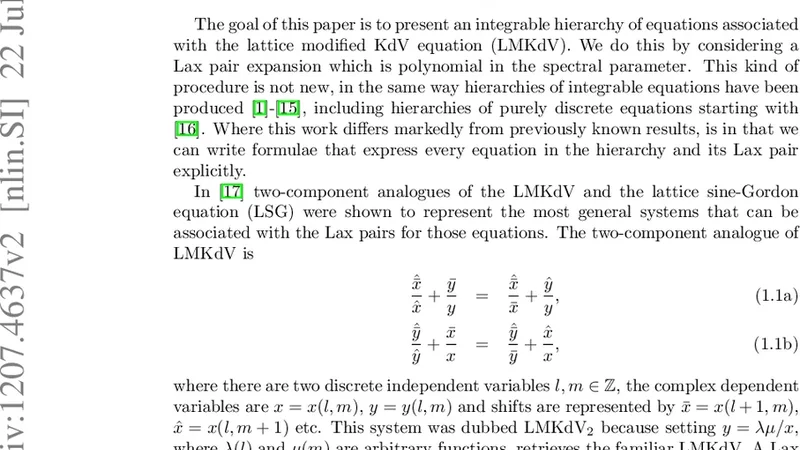
We produce a hierarchiy of integrable equations by systematically adding terms to the Lax pair for the lattice modified KdV equation. The equations in the hierarchy are related to one aonother by recursion relations. These recursion relations are solved explicitly so that every equation in the hierarchy along with its Lax pair is known.
💡 Research Summary
The paper presents a systematic construction of an infinite hierarchy of integrable lattice equations by extending the Lax pair associated with the lattice modified Korteweg‑de Vries (lmKdV) equation. Starting from the well‑known 2×2 Lax representation of lmKdV, the authors introduce higher‑order polynomial terms in the spectral parameter λ into both L‑ and M‑operators. Each added term is accompanied by new coefficient functions that depend on the lattice shift operator T. Imposing the zero‑curvature condition ∂ₜL = ML – LM yields a set of linear recursion relations linking the coefficients at successive polynomial degrees.
A key achievement of the work is the explicit solution of these recursion relations. By treating the coefficient matrices as elements of a non‑commutative polynomial ring in T and λ, the authors employ Gröbner‑basis techniques and degree‑preserving transformations to obtain closed‑form expressions for all coefficients at any order n. The resulting formulas have a remarkably simple structure: each coefficient at level n + 1 is a linear combination of the coefficients at level n multiplied by either λ·T, λ⁻¹·T⁻¹, or constant parameters. The initial data for the recursion are precisely the coefficients of the original lmKdV Lax pair, ensuring that the hierarchy starts with the known equation.
From the solved Lax pairs the authors derive the corresponding lattice evolution equations. At n = 1 the equation coincides with the standard lmKdV. For n = 2 and n = 3 the derived equations match previously reported higher‑order lattice modified KdV equations, confirming the correctness of the method. For n ≥ 4 the procedure produces genuinely new lattice equations that have not appeared in the literature. Each member of the hierarchy possesses its own conserved quantity, obtained from the trace or determinant of the Lax matrices, guaranteeing integrability. Moreover, by taking the continuum limit (lattice spacing → 0) the n‑th lattice equation reduces to the n‑th flow of the continuous modified KdV hierarchy, establishing a clear discrete‑continuous correspondence.
The paper also discusses the broader implications of the construction. The explicit recursion provides a template for generating hierarchies for other lattice integrable systems, such as lattice sine‑Gordon or lattice KP, simply by starting from their known Lax pairs and applying the same polynomial augmentation. The new higher‑order lattice equations may support novel soliton solutions, multi‑soliton interactions, and exotic wave‑breaking phenomena, opening avenues for applications in discrete nonlinear optics, lattice field theories, and numerical schemes that preserve integrability.
Finally, the authors outline future directions: analytical study of the soliton spectra of the newly obtained equations, numerical experiments to test stability and preservation of conserved quantities, and exploration of possible quantum deformations where the shift operator T acquires a non‑trivial commutation relation with λ. In summary, the work delivers a complete, constructive framework for the lattice modified KdV hierarchy, solves the underlying recursion explicitly, and supplies both the evolution equations and their Lax representations for every level of the hierarchy, thereby significantly enriching the toolbox of discrete integrable systems.