The Influence of Decoys on the Noise and Dynamics of Gene Expression
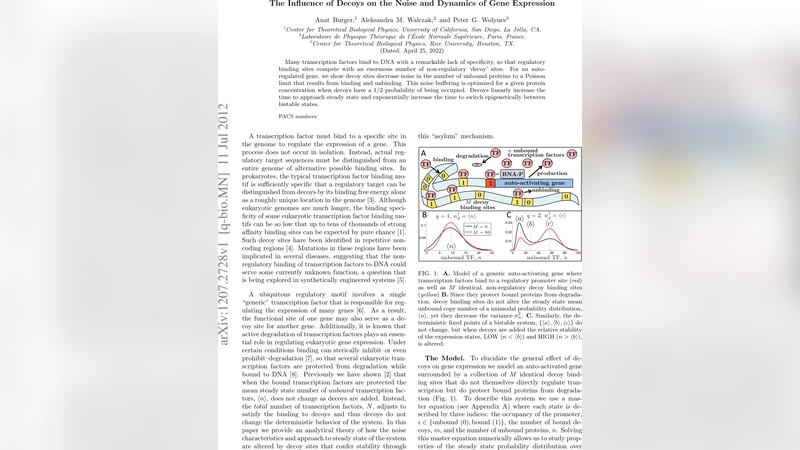
Many transcription factors bind to DNA with a remarkable lack of specificity, so that regulatory binding sites compete with an enormous number of non-regulatory ‘decoy’ sites. For an auto-regulated gene, we show decoy sites decrease noise in the number of unbound proteins to a Poisson limit that results from binding and unbinding. This noise buffering is optimized for a given protein concentration when decoys have a 1/2 probability of being occupied. Decoys linearly increase the time to approach steady state and exponentially increase the time to switch epigenetically between bistable states.
💡 Research Summary
The paper investigates how non‑specific DNA binding sites—referred to as “decoys”—affect stochastic gene expression and the dynamics of regulatory circuits. Using a minimal mathematical model of an auto‑regulated gene, the authors treat a single transcription factor (TF) that can exist in a free state or bound to DNA. The model incorporates four elementary reactions: TF synthesis, TF degradation, TF binding to a specific regulatory site, and TF unbinding. In addition, a large number (N_d) of decoy sites are introduced; each decoy has the same binding affinity (K_d) as the specific site and competes for the same TF pool. The system is described by a master equation, and analytical results are obtained via generating‑function techniques and linear noise approximation.
Key findings on noise: When the number of decoys is sufficiently large, the variance of the free TF number approaches its mean, i.e., the distribution becomes Poissonian. This occurs because binding and unbinding to decoys add an extra stochastic “reaction channel” that averages out the bursty fluctuations generated at the transcription/translation level. The noise reduction is maximal when each decoy is occupied with probability 0.5. At this occupancy, the forward (binding) and reverse (unbinding) rates are equal, minimizing the net stochastic flux and therefore the variance.
Key findings on dynamics: The presence of decoys slows the approach to steady state. Linearizing the master equation yields a transition matrix whose smallest non‑zero eigenvalue (\lambda_{\min}) scales inversely with (N_d). Consequently, the relaxation time (\tau \approx 1/|\lambda_{\min}|) grows linearly with the number of decoys. This “inertial” effect does not eliminate fluctuations but makes the system respond more sluggishly to perturbations.
Bistability and epigenetic switching: The authors extend the model to a positive‑feedback loop that generates two stable expression states (high and low TF levels). Using Kramers‑type escape theory, they show that decoys raise the effective energy barrier between the states. Each bound decoy contributes an additional chemical‑potential term (\Delta\mu); the total barrier becomes (\Delta E + N_d \Delta\mu). As a result, the mean switching time increases exponentially with the number of decoys, making spontaneous epigenetic transitions exceedingly rare.
Experimental relevance: Modern ChIP‑seq and DNA‑seq datasets can quantify the genome‑wide distribution of TF binding affinities, providing estimates for (N_d) and (K_d). By plugging these empirical values into the analytical expressions, one can predict cell‑type‑specific noise levels and relaxation times. Moreover, synthetic biology offers tools (CRISPR‑mediated insertion or deletion of decoy motifs) to deliberately tune decoy abundance, thereby engineering circuits with desired noise buffering or switching kinetics.
Implications: Decoy sites, traditionally viewed as “junk” or irrelevant binding locations, emerge as functional regulators of stochasticity and temporal behavior in gene networks. They act as passive buffers that convert super‑Poissonian burst noise into Poissonian fluctuations, optimize noise suppression at half‑occupancy, and dramatically modulate the speed of both equilibration and state transitions. This insight expands the design space for both natural regulatory architecture and engineered synthetic circuits, suggesting that controlling decoy density could be a powerful strategy for managing cellular heterogeneity, robustness, and epigenetic memory.
Comments & Academic Discussion
Loading comments...
Leave a Comment