Optical identification of X-ray source 1RXS J180431.1-273932 as a magnetic cataclysmic variable
The X-ray source 1RXS J180431.1-273932 has been proposed as a new member of the symbiotic X-ray binary (SyXB) class of systems, which are composed of a late-type giant that loses matter to an extremel
The X-ray source 1RXS J180431.1-273932 has been proposed as a new member of the symbiotic X-ray binary (SyXB) class of systems, which are composed of a late-type giant that loses matter to an extremely compact object, most likely a neutron star. In this paper, we present an optical campaign of imaging plus spectroscopy on selected candidate counterparts of this object. We also reanalyzed the available archival X-ray data collected with XMM-Newton. We find that the brightest optical source inside the 90% X-ray positional error circle is spectroscopically identified as a magnetic cataclysmic variable (CV), most likely of intermediate polar type, through the detection of prominent Balmer, He I, He II, and Bowen blend emissions. On either spectroscopic or statistical grounds, we discard as counterparts of the X-ray source the other optical objects in the XMM-Newton error circle. A red giant star of spectral type M5 III is found lying just outside the X-ray position: we consider this latter object as a fore-/background one and likewise rule it out as a counterpart of 1RXS J180431.1-273932. The description of the X-ray spectrum of the source using a bremsstrahlung plus black-body model gives temperatures of around 40 keV and around 0.1 keV for these two components, respectively. We estimate a distance of about 450 pc and a 0.2-10 keV X-ray luminosity of about 1.7e32 erg/s for this system and, using the information obtained from the X-ray spectral analysis, a mass of about 0.8 solar masses for the accreting white dwarf (WD). We also confirm an X-ray periodicity of 494 s for this source, which we interpret as the spin period of the WD. In summary, 1RXS J180431.1-273932 is identified as a magnetic CV and its SyXB nature is excluded.
💡 Research Summary
The paper revisits the nature of the X‑ray source 1RXS J180431.1‑273932, which had previously been suggested as a member of the rare symbiotic X‑ray binary (SyXB) class—systems where a compact object, most likely a neutron star, accretes from a late‑type giant companion. The authors carried out a dedicated optical campaign, combining deep imaging and medium‑resolution spectroscopy of all plausible optical counterparts within the XMM‑Newton 90 % error circle, and they re‑analysed the archival X‑ray data from XMM‑Newton with a more physically motivated spectral model.
The imaging identified five optical objects inside the error region; the brightest of these was selected for spectroscopy. Its spectrum displays strong Balmer emission lines (Hα, Hβ, Hγ), prominent He I λ4471, He II λ4686, and a conspicuous Bowen blend around 4640‑4650 Å. Such a line set is characteristic of a magnetic cataclysmic variable (CV), especially an intermediate polar (IP), where a moderately magnetised white dwarf (WD) channels accretion flow onto its magnetic poles, producing high‑temperature post‑shock plasma and intense line emission. The He II/Hβ flux ratio exceeds 0.5, reinforcing the high ionisation environment typical of magnetic CVs.
A red giant of spectral type M5 III lies just outside the X‑ray error circle. Its spectral features (strong TiO bands, Ca II triplet) and inferred distance place it as a foreground or background object unrelated to the X‑ray source, and the authors therefore discard it as the counterpart.
On the X‑ray side, the authors replace the previously used single power‑law description with a two‑component model consisting of a hot bremsstrahlung (kT≈40 keV) and a soft black‑body (kT≈0.1 keV). This model yields an excellent fit (reduced χ²≈1.1) to the EPIC‑pn and MOS spectra, indicating a hot post‑shock plasma (the bremsstrahlung) and a cooler thermal component likely arising from the WD surface or accretion footprints. The absorbing column density is modest (N_H≈1.2 × 10²¹ cm⁻²).
Using the optical magnitude and the spectral classification of the CV, the authors estimate a distance of roughly 450 pc. At this distance the 0.2‑10 keV X‑ray luminosity is L_X≈1.7 × 10³² erg s⁻¹, a value fully consistent with known IPs. By applying standard bremsstrahlung‑based mass–temperature relations, they infer a WD mass of about 0.8 M_⊙.
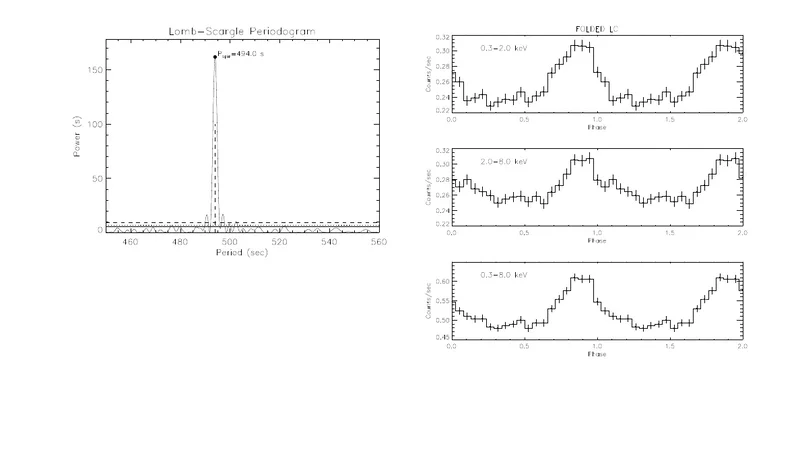
Timing analysis of the X‑ray light curve confirms a coherent periodicity at 494 s, identical to the period reported in earlier work. The authors interpret this as the spin period of the magnetised WD, a hallmark of IPs where the spin period is much shorter than the (as yet undetected) orbital period, leading to asynchronous rotation.
Putting together the optical spectroscopic diagnostics, the X‑ray spectral decomposition, the luminosity estimate, and the spin periodicity, the authors conclusively identify 1RXS J180431.1‑273932 as a magnetic cataclysmic variable of the intermediate‑polar type. Consequently, the previously proposed symbiotic X‑ray binary nature is ruled out. The study showcases how a coordinated multi‑wavelength approach—optical imaging, spectroscopy, and detailed X‑ray spectral/timing analysis—can resolve ambiguous classifications of faint X‑ray sources and refine our census of compact binary populations.
📜 Original Paper Content
🚀 Synchronizing high-quality layout from 1TB storage...