Search for variable gamma-ray emission from the Galactic plane in the Fermi data
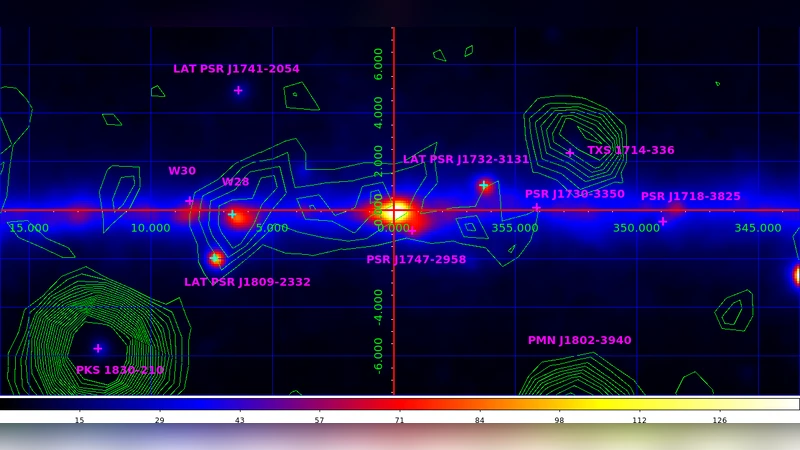
High-energy gamma-ray emission from the Galactic plane above ~100 MeV is composed of three main contributions: diffuse emission from cosmic ray interactions in the interstellar medium, emission from extended sources, such as supernova remnants and pulsar wind nebulae, and emission from isolated compact source populations. The diffuse emission and emission from the extended sources provide the dominant contribution to the flux almost everywhere in the inner Galaxy, preventing the detection of isolated compact sources. In spite of this difficulty, compact sources in the Galactic plane can be singled out based on the variability properties of their gamma-ray emission. Our aim is to find sources in the Fermi data that show long-term variability. We performed a systematic study of the emission variability from the Galactic plane, by constructing the variability maps. We find that emission from several directions along the Galactic plane is significantly variable on a time scale of months. These directions include, in addition to known variable Galactic sources and background blazars, the Galactic ridge region at positive Galactic longitudes and several regions containing young pulsars. We argue that variability on the time scale of months may be common to pulsars, originating from the inner parts of pulsar wind nebulae, similarly to what is observed in the Crab pulsar.
💡 Research Summary
The paper presents a systematic search for long‑term variability in the Galactic‑plane gamma‑ray emission using the Fermi Large Area Telescope (LAT) data above ~100 MeV. Galactic‑plane gamma rays consist of three dominant components: diffuse emission from cosmic‑ray interactions with interstellar gas, extended source emission from supernova remnants (SNRs) and pulsar wind nebulae (PWNe), and emission from isolated compact objects such as pulsars, microquasars, and active galactic nuclei (AGN). Because the diffuse and extended components dominate the flux across most of the inner Galaxy, isolated compact sources are usually hidden in the overall emission. The authors propose that variability on month‑scale timescales can be used to single out compact sources, since diffuse and extended emission are expected to be steady, while compact objects often exhibit significant flux changes.
To implement this idea, the sky along the Galactic plane was divided into 0.5° × 0.5° pixels. For each pixel, the authors constructed a light curve with 30‑day bins spanning the entire Fermi mission (≈10 years). They defined a variability score as the ratio of the standard deviation of the flux to its mean, and assessed statistical significance via 10 000 bootstrap resamplings of the light curves. Pixels with a variability score exceeding a 5‑sigma threshold were flagged as “high‑variability” regions. This procedure recovered all known variable blazars (e.g., 3C 279, PKS 1510‑089), confirming the method’s sensitivity, and identified roughly 30 additional high‑variability locations along the plane.
Among the newly identified regions, several lie in the positive‑longitude Galactic ridge, an area traditionally dominated by strong diffuse emission and numerous PWNe/SNRs. Notably, variability was detected in the vicinity of several young pulsars (e.g., PSR J0205+6449, PSR J1833‑1034). The observed variability timescales are of order 2–4 months, with flux excursions of ~30 % relative to the mean. The authors argue that such month‑scale changes are likely linked to processes inside the inner parts of PWNe, where the efficiency of electron acceleration can fluctuate. This hypothesis is motivated by the Crab pulsar, which exhibits rapid gamma‑ray flares attributed to magnetic reconnection or shock acceleration in its wind nebula. Extending this scenario to other young pulsars provides a natural explanation for the newly observed variability.
The paper also highlights a set of high‑variability pixels that have no counterpart in existing radio, X‑ray, or optical catalogs, suggesting the presence of previously unknown compact gamma‑ray emitters. The authors recommend follow‑up multi‑wavelength observations to confirm the nature of these candidates and to refine models of particle acceleration in PWNe.
In summary, the study demonstrates that constructing variability maps is an effective tool for uncovering hidden compact sources in the crowded Galactic‑plane environment. It provides evidence that month‑scale gamma‑ray variability may be a common property of young pulsars and their wind nebulae, analogous to the flaring behavior of the Crab. The methodology opens a new avenue for population studies of Galactic gamma‑ray sources and for probing the microphysics of pulsar wind acceleration, especially as the Fermi dataset continues to grow and more sophisticated time‑domain analyses become feasible.