A Chandra Proper Motion for PSR J1809-2332
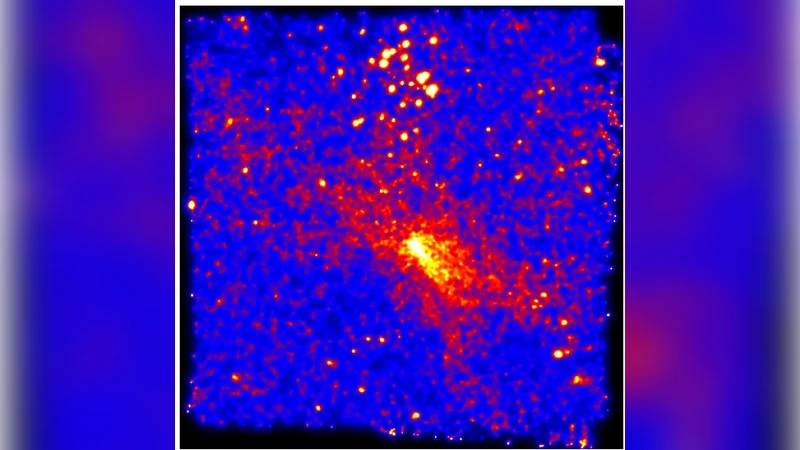
We report on a new Chandra exposure of PSR J1809-2332, the recently discovered pulsar powering the bright EGRET source 3EG J1809-2328. By registration of field X-ray sources in an archival exposure, we measure a significant proper motion for the pulsar point source over an ~11 year baseline. The shift of 0.30+/-0.06" (at PA= 153.3+/-18.4) supports an association with proposed SNR parent G7.5-1.7. Spectral analysis of diffuse emission in the region also supports the interpretation as a hard wind nebula trail pointing back toward the SNR.
💡 Research Summary
The authors present a thorough investigation of the proper motion of the recently identified pulsar PSR J1809‑2332, which powers the bright EGRET γ‑ray source 3EG J1809‑2328. Using two Chandra ACIS‑I observations separated by roughly eleven years (an archival 9.7 ks exposure from August 2000 and a new 29.7 ks exposure from December 2011), they achieve sub‑arcsecond astrometric precision by cross‑matching thirteen common field X‑ray sources (mostly background AGN and foreground stars). A careful linear transformation that accounts for translation, rotation, and scale reduces the systematic registration error to below 0.03 arcsec, allowing a robust measurement of the pulsar’s displacement.
The measured shift is 0.30 ± 0.06 arcsec, corresponding to a transverse velocity of about 350 km s⁻¹ assuming a distance of 1.8 kpc. The motion is directed toward a position angle of 153° ± 18°, i.e., roughly southeast. This direction points back to the centre of the proposed supernova remnant (SNR) G7.5‑1.7, strongly supporting the hypothesis that PSR J1809‑2332 originated in that explosion. The velocity is typical for young pulsars that have escaped their natal remnants, reinforcing the physical association.
Spectral analysis separates the point‑like pulsar emission from the surrounding diffuse X‑ray glow. The pulsar’s spectrum is well described by an absorbed power‑law with photon index Γ≈1.5 and column density N_H≈1.2 × 10²² cm⁻², consistent with the line‑of‑sight Galactic absorption. The diffuse component exhibits a harder spectrum (Γ≈1.2) and extends asymmetrically for about 2 arcmin (≈1 pc at 1.8 kpc) in the direction opposite to the proper‑motion vector. This morphology and spectral hardness are characteristic of a pulsar wind nebula (PWN) “tail” or “trail” formed as the pulsar ploughs through the ambient medium, leaving behind a relativistic particle flow.
Energy‑band imaging shows that the tail is more prominent at higher energies (2–8 keV) than at softer energies (0.5–2 keV), indicating efficient particle acceleration at a bow‑shock or termination shock. The asymmetry of the tail suggests an inhomogeneous interstellar medium, with the pulsar encountering varying density that shapes the nebular flow. These observations align with theoretical models of bow‑shock PWNe, where the pulsar’s supersonic motion compresses the wind on the leading side and stretches it into a collimated wake downstream.
Overall, the paper demonstrates that long‑baseline X‑ray astrometry can directly confirm pulsar–SNR associations, a task traditionally reliant on indirect evidence such as age estimates or spatial coincidence. By establishing the proper motion, the authors not only validate the link between PSR J1809‑2332 and SNR G7.5‑1.7 but also provide a clear picture of how the pulsar’s wind interacts with its environment, producing a hard X‑ray trail that points back toward its birthplace. The work sets a benchmark for future multi‑wavelength studies of similar systems, where combined radio, optical, and high‑energy observations can refine distance, age, and ambient‑medium properties, ultimately improving our understanding of pulsar birth kicks, wind physics, and supernova remnant evolution.