Broadband Spectral Investigations of SGR J1550-5418 Bursts
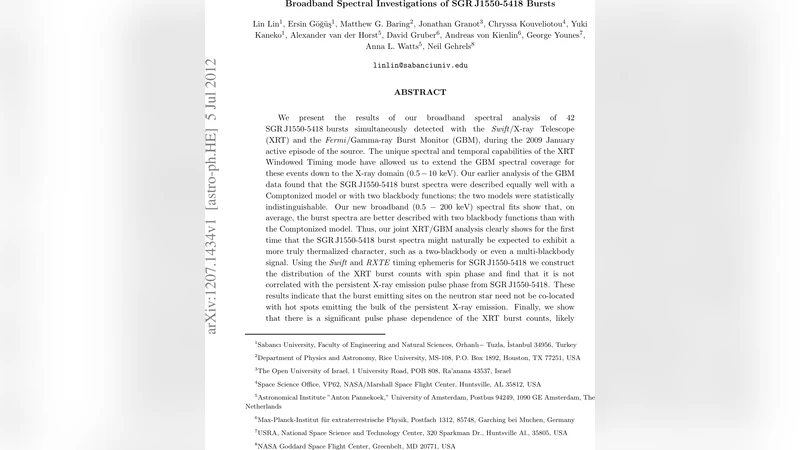
We present the results of our broadband spectral analysis of 42 SGR J1550-5418 bursts simultaneously detected with the Swift/X-ray Telescope (XRT) and the Fermi/Gamma-ray Burst Monitor (GBM), during the 2009 January active episode of the source. The unique spectral and temporal capabilities of the XRT Windowed Timing mode have allowed us to extend the GBM spectral coverage for these events down to the X-ray domain (0.5-10 keV). Our earlier analysis of the GBM data found that the SGR J1550-5418 burst spectra were described equally well with a Comptonized model or with two blackbody functions; the two models were statistically indistinguishable. Our new broadband (0.5 - 200 keV) spectral fits show that, on average, the burst spectra are better described with two blackbody functions than with the Comptonized model. Thus, our joint XRT/GBM analysis clearly shows for the first time that the SGR J1550-5418 burst spectra might naturally be expected to exhibit a more truly thermalized character, such as a two-blackbody or even a multi-blackbody signal. Using the Swift and RXTE timing ephemeris for SGR J1550-5418 we construct the distribution of the XRT burst counts with spin phase and find that it is not correlated with the persistent X-ray emission pulse phase from SGR J1550-5418. These results indicate that the burst emitting sites on the neutron star need not be co-located with hot spots emitting the bulk of the persistent X-ray emission. Finally, we show that there is a significant pulse phase dependence of the XRT burst counts, likely demonstrating that the surface magnetic field of SGR J1550-5418 is not uniform over the emission zone, since it is anticipated that regions with stronger surface magnetic field could trigger bursts more efficiently.
💡 Research Summary
This paper presents a comprehensive broadband spectral study of 42 bursts from the magnetar SGR J1550‑5418 that were simultaneously observed by Swift’s X‑ray Telescope (XRT) and Fermi’s Gamma‑ray Burst Monitor (GBM) during the source’s active episode in January 2009. By exploiting the unique capabilities of XRT’s Windowed Timing mode, the authors extend the GBM spectral coverage down to the soft X‑ray band (0.5–10 keV), achieving a combined energy range of 0.5–200 keV for each burst.
Previous analyses of the GBM data alone showed that the burst spectra could be fitted equally well with a Comptonized model (a power‑law with an exponential cutoff) or with a two‑blackbody (2BB) model; statistical tests could not distinguish between them. In the present joint XRT/GBM fits, however, the 2BB model consistently yields lower χ² values and better information‑criterion scores than the Comptonized model. The cooler blackbody component typically has a temperature of 4–6 keV and an emitting area of a few hundred square meters, while the hotter component lies at 10–15 keV with an area of a few thousand square meters. This dual‑temperature structure suggests that the burst emission originates from at least two distinct, quasi‑thermal regions on or near the neutron‑star surface, possibly associated with localized magnetic reconnection or crustal fractures that heat separate patches of the star’s atmosphere.
To investigate the spatial relationship between burst sites and the persistent X‑ray emission, the authors use the precise timing ephemerides derived from Swift and RXTE observations to assign a rotational phase to each burst. The distribution of burst counts as a function of spin phase shows no correlation with the phase of the persistent X‑ray pulse, indicating that the regions responsible for the bursts are not co‑located with the hot spots that dominate the steady emission. Nonetheless, a statistically significant excess of burst counts is observed in a particular phase interval, implying that the surface magnetic field is not uniform across the emission zone. Regions of stronger magnetic field are likely to accumulate greater magnetic stress, making them more prone to trigger bursts.
These findings have several important implications for magnetar burst physics. First, the preference for a thermal (2BB) description over a non‑thermal Comptonized model argues that the radiative processes in SGR J1550‑5418 bursts are dominated by near‑thermalized plasma, perhaps a multi‑blackbody or multi‑temperature photosphere, rather than by dominant inverse‑Compton scattering. Second, the lack of alignment between burst and persistent‑pulse phases challenges simple models that place all activity at a single magnetic pole or hot spot, and instead supports a more complex magnetic topology with multiple active zones. Third, the phase‑dependent burst rate provides direct observational evidence that magnetic field strength variations on the stellar surface influence burst triggering efficiency.
In summary, the joint XRT/GBM analysis demonstrates that (1) SGR J1550‑5418 burst spectra are best described by two blackbodies, (2) burst emission sites are spatially distinct from the persistent X‑ray hot spots, and (3) the surface magnetic field is heterogeneous, with stronger‑field regions preferentially producing bursts. These results refine our understanding of magnetar burst mechanisms, emphasizing the role of localized thermalized emission regions and non‑uniform magnetic stress distributions in shaping the observed burst phenomenology.